

A Comprehensive Guide to FDM 3D Printer Types: Exploring Cartesian, Polar, Delta, Robotic Arm, and Hybrid Technologies
The world of 3D printing has revolutionized manufacturing, prototyping, and countless other industries. While various additive manufacturing technologies exist, Fused Deposition Modeling (FDM) stands out as one of the most widely adopted and accessible. FDM, also known as Fused Filament Fabrication (FFF), operates on a relatively simple yet highly effective principle: extruding a thermoplastic filament through a heated nozzle and depositing it layer by layer onto a build platform to construct a three-dimensional object. This method’s popularity stems from its cost-effectiveness, ease of use, and versatility. The material landscape for FDM is also quite broad, with common filaments like PLA (Polylactic Acid) and ABS (Acrylonitrile Butadiene Styrene) leading the charge. Beyond these, more specialized engineering thermoplastics such as PETG (Polyethylene Terephthalate Glycol), ASA (Acrylonitrile Styrene Acrylate), Nylon, and high-performance polymers like Ultem are readily available, expanding the functional possibilities of FDM printed parts. However, not all FDM 3D printers are built the same. Their underlying mechanical designs dictate their operational characteristics, strengths, and ideal applications. This comprehensive guide will delve into the distinct differences between the primary types of FDM 3D printers: Cartesian, Polar, Delta, printers utilizing Robotic Arms, and innovative Hybrid systems, helping you understand which technology best suits your specific 3D printing needs.
Types of FDM 3D Printers
1. Cartesian FDM 3D Printers: The Industry Standard
Cartesian 3D printers are arguably the most prevalent and recognizable type of FDM machine available on the market today. Their widespread adoption is largely due to their relatively simple mechanical design, which directly translates to affordability and ease of assembly and operation for beginners. The fundamental principle behind a Cartesian 3D printer is rooted in the mathematical Cartesian coordinate system, which employs three perpendicular axes—X, Y, and Z—to precisely define any point in three-dimensional space. In the context of 3D printing, these axes control the movement of the print head and/or the build platform.
Typically, in a Cartesian setup, the X and Y axes govern the horizontal movement across the print bed, allowing the extruder to position itself accurately within the two-dimensional plane. The Z-axis, on the other hand, controls the vertical movement, incrementing layer by layer as the print progresses, thus defining the object’s height. This methodical, layer-by-layer deposition process is fundamental to FDM technology. The Z-axis movement can be either user-defined through slicing software before printing or managed by pre-configured machine settings, ensuring consistent layer adhesion and structural integrity.
The mechanics of Cartesian printers often involve a print head moving along the X and Y axes, while the build plate moves along the Z-axis, or sometimes a combination where the print head moves in X, Y, and Z, and the bed only moves down in Z. This design allows for precise and predictable movements, making them ideal for a wide range of applications, from intricate prototypes to functional parts. Their robust and straightforward construction contributes to high reliability and repeatability, which are crucial for consistent print quality. Furthermore, the large and active community surrounding Cartesian printers means extensive support, modifications, and troubleshooting resources are readily available.
Prominent manufacturers in the FDM market, such as UltiMaker and Bambu Lab, have built their reputations on developing high-performance Cartesian 3D printers. Their models are known for their reliability, advanced features, and user-friendly interfaces, appealing to both hobbyists and professional users. The primary advantages of Cartesian solutions include their generally lower cost, especially for entry-level models, and the common availability of these machines as kits. These kits empower users to assemble the printer themselves, offering a deeper understanding of its mechanics and often resulting in significant cost savings. However, while generally reliable, these printers can sometimes be slower for very large prints due to the inertia of moving the print bed or the entire gantry structure, which can introduce vibrations at higher speeds.
2. Polar FDM 3D Printers: Circular Precision
Moving away from the rectilinear motion of Cartesian systems, Polar 3D printers offer a unique approach to object positioning. Unlike the X, Y, and Z coordinate system, Polar printers define points on a circular grid using an angle (theta) and a radius (distance from the center), while the Z-axis still manages vertical layering. This distinct kinematic setup means that the print bed itself is typically round and continuously rotates around its central axis (theta), simultaneously moving radially (radius) or in the Z-axis, while the extruder generally moves only up and down along the Z-axis, or sometimes also radially. This collaborative movement creates the intricate circular and spiral patterns required for 3D printing.
This operational method makes Polar printers exceptionally well-suited for printing objects with rotational symmetry or those that naturally follow a spiral path, such as decorative plant vases, intricate bottle designs, or even traffic cones. The continuous rotational motion can result in smoother exterior surfaces for such geometries, minimizing visible layer lines that might be more pronounced on Cartesian systems when printing curved walls.
A significant advantage of Polar FDM 3D printers lies in their mechanical simplicity. They often require fewer motors compared to Cartesian designs – typically two motors (one for rotation/radius, one for Z-axis) instead of the three or more found in Cartesian systems. This reduction in moving parts can lead to greater energy efficiency and potentially lower manufacturing costs for the printer itself. Furthermore, despite often having a smaller overall footprint, some Polar designs can achieve surprisingly large build volumes for certain types of objects, making efficient use of space.
However, this distinct mechanism comes with its own set of challenges. One of the primary drawbacks of Polar printers is their less consistent accuracy across the entire print bed. Due to the circular nature of their movement, precision tends to be highest at the center of the build plate and gradually decreases as the print extends towards the outer edges. This differential accuracy can make printing geometrically complex objects that lack rotational symmetry or require uniform precision across a large area more challenging. Calibration can also be more complex, as any small error in angular or radial movement can propagate across the entire print. Despite these limitations, Polar printers represent an interesting niche for specific aesthetic and functional applications where their unique kinematics can be leveraged for optimal results.
3. Delta FDM Printers: Speed and Agility
Delta FDM printers are increasingly gaining traction in the 3D printing community, recognized for their distinctive appearance and operational benefits. While they ultimately produce objects defined by Cartesian coordinates, their underlying kinematic system is dramatically different from traditional Cartesian printers. A Delta printer features a fixed, typically circular, print bed and a lightweight print head suspended by three independent arms, arranged in a triangular (delta) formation around the build volume. Each of these three vertical arms moves up and down independently, and their combined motion precisely dictates the X, Y, and Z position of the print head. This intricate choreography allows the print head to move with exceptional speed and agility.
The unique design of Delta printers, with their static print bed and fast-moving, lightweight effector (print head), is specifically engineered for accelerating the printing process. Because the build plate remains stationary, there’s no inertia from moving a heavy bed, allowing for much higher print speeds without significant loss of quality, especially when printing tall objects. This makes them particularly appealing for applications requiring rapid prototyping or batch production where print time is a critical factor. The manufacturing limits of these machines are primarily determined by the diameter of the base and the maximum height of the vertical towers, enabling impressive vertical build volumes relative to their horizontal footprint.
Another notable advantage of Delta printers is their scalability. Their design allows for resizing the overall machine (making the towers taller or the base wider) without fundamentally altering the core kinematics, meaning print quality can be maintained across different machine sizes. This flexibility can be beneficial for specific industrial applications. However, the sophisticated movement system also presents challenges. Delta printers are renowned for being more difficult to calibrate accurately. Any slight misalignment in the arm lengths, tower positions, or end-effector offset can lead to significant inaccuracies in print geometry, requiring precise initial setup and ongoing maintenance. While their speed and impressive build height are compelling, the learning curve for setup and fine-tuning can be steeper for newcomers compared to Cartesian systems.
4. FDM with Robotic Arms: Industrial Scale and Freedom
Robotic arms have long been the workhorses of industrial production lines, particularly in sectors like automotive manufacturing where they perform repetitive tasks such as welding, painting, and component assembly with unmatched precision and speed. The integration of robotic arms into the realm of 3D printing represents a significant leap towards industrial-scale additive manufacturing, although this technology is still considered to be in a relatively early stage of development and commercialization for direct 3D printing.
While traditional 3D printers are constrained by a fixed build volume and often a horizontal build plate, robotic arms liberate the FDM process from these limitations. By mounting an extrusion head onto a multi-axis robotic arm, manufacturers can deposit material onto virtually any surface and in any orientation, opening up possibilities for printing truly massive structures, like entire homes and buildings. This method moves beyond the typical layer-by-layer approach on a flat bed, allowing for non-planar printing paths and truly three-dimensional deposition, leading to novel architectural and engineering designs that were previously impossible.
The primary advantage of using robotic arms for FDM is their unparalleled flexibility and reach. They are not tethered to a static printing plate, making the entire process highly mobile and adaptable. This mobility, combined with the extended reach of the robotic arm, facilitates the creation of exceptionally large and complex structures, often without the need for support material where self-supporting geometries are achievable. Applications range from large-scale construction using concrete or specialized polymers to printing directly onto existing components for repair or customization. The multi-axis capability also enables printing on curved surfaces, which is a significant departure from conventional FDM.
Despite these promising capabilities, the technology faces significant challenges. Chief among them is achieving the same level of fine print quality and resolution that conventional Cartesian or Delta printers offer. Robotic arms, while powerful and flexible, can introduce challenges related to precision, vibration, and material flow control, especially at high speeds or with intricate details. Many companies are actively investing in R&D to refine control algorithms, extruder designs, and material science to overcome these hurdles. Major industrial robotics manufacturers like Kuka and ABB are at the forefront of this integration, supplying the robotic platforms. Their solutions are then adapted by innovative 3D printing companies such as COBOD (specializing in construction 3D printing) and Massive Dimension, who develop the specialized extrusion systems and software needed to transform these industrial robots into powerful 3D printing machines.
5. Hybrid FDM 3D Printers: Combining the Best of Both Worlds
Hybrid manufacturing represents a revolutionary approach to fabrication, merging the strengths of additive manufacturing (3D printing) with subtractive manufacturing methods (like CNC milling, drilling, or laser cutting) within a single, integrated machine. This synergy addresses many of the limitations inherent in purely additive or purely subtractive processes. In the context of FDM 3D printing, a hybrid printer typically allows for the exchange of different tool heads – meaning an FDM extruder can be swapped out for a milling spindle, a laser engraver, or even a pick-and-place robot, all within the same machine cycle.
The primary benefit of a hybrid system is its ability to create complex geometries through additive means and then refine or finish those parts with subtractive precision. For instance, an FDM extruder can print a part quickly, and then a CNC milling head can be used to machine critical surfaces to extremely tight tolerances, create smooth finishes, or drill precise holes that would be difficult or impossible to achieve with FDM alone. This process can significantly reduce the need for post-processing steps and improve the overall dimensional accuracy and surface quality of printed parts. Many hybrid FDM 3D printers that incorporate subtractive capabilities are often built upon a robust Cartesian structure, given its inherent precision and rigidity, which is vital for milling operations.
However, the concept of hybridity is not limited to Cartesian platforms. Innovative projects, such as the Kraken project, demonstrate how robotic arms can also serve as the foundation for hybrid manufacturing. These advanced systems equip a robotic arm with both an FDM extrusion head and various subtractive tools, offering unparalleled flexibility in part creation, including the ability to print and then machine very large or uniquely shaped objects. This truly integrates the freedom of robotic movement with the precision of subtractive techniques.
While the expanded capabilities of hybrid FDM 3D printers are substantial, they naturally come with a higher price tag compared to single-process machines. The increased complexity of the mechanics, electronics, and software required to manage multiple tools and processes contributes to this higher cost. However, for industries requiring high precision, complex geometries, reduced lead times, and consolidated manufacturing steps – such as aerospace, medical device production, or specialized tooling – the investment in a hybrid solution can yield significant returns, making it a powerful and versatile tool in advanced manufacturing.
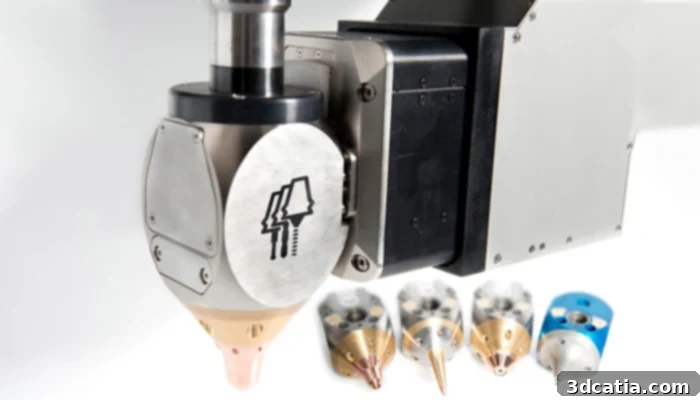
Hybrid 3D printers offer more printing possibilities.
The diverse landscape of FDM 3D printers, encompassing Cartesian, Polar, Delta, Robotic Arm, and Hybrid systems, offers a spectrum of choices tailored to various applications and user needs. From the reliable and cost-effective Cartesian models to the high-speed Delta, the specialized Polar, the expansive Robotic Arm systems, and the versatile Hybrid solutions, each technology brings its unique advantages and challenges. Understanding these distinctions is crucial for making an informed decision, whether you’re a hobbyist seeking an entry-level machine or an industrial professional looking for advanced manufacturing capabilities.
Which FFF / FDM 3D printer technology do you currently use, or which one are you considering for your next project? We’d love to hear your experiences and insights! Share your thoughts in a comment below or engage with us on our social media channels: LinkedIn, Facebook, and Twitter. For the latest updates, news, and breakthroughs in the additive manufacturing world, don’t forget to sign up for our free weekly Newsletter here, delivered straight to your inbox. You can also explore our extensive collection of 3D printing videos and tutorials on our dedicated YouTube channel.