
Food-Safe 3D Printing: Navigating Regulations and Pioneering Solutions with FABULOUS’s Certified PA11 Materials
Additive manufacturing, commonly known as 3D printing, has rapidly transcended its prototyping origins to become a transformative technology across a multitude of industries. While its presence is well-established in high-stakes sectors like aerospace and defense, the automotive sector, and the medical field, its application spectrum continues to broaden. Beyond industrial components and intricate prototypes, 3D printing is now revolutionizing the creation of consumer and luxury goods, making inroads into the construction industry, and perhaps most intriguingly, transforming the food sector. This expansion into food-related applications encompasses two primary categories. Firstly, it involves the direct creation of innovative, edible products from a 3D printer, exemplified by the pioneering work of companies like Barilla with its 3D-printed pasta, Revo Foods with its industrial-scale food printing, and Steakholder Foods producing meat alternatives. Secondly, and equally vital, 3D printing is increasingly employed to manufacture objects that come into contact with food during processing, packaging, and consumption. This includes essential items such as specialized food nozzles, precision grippers, scraping tools, serving plates, cutlery, packaging components, and various machine parts used within food production lines. The critical common denominator for all these applications is an unwavering commitment to food safety.
The interaction between any item and food necessitates adherence to rigorous regulations designed to safeguard consumer health. These stringent rules and safety standards are paramount for end-users, yet they present a significant challenge for material manufacturers and 3D printing service providers. The regulatory frameworks established by relevant authorities worldwide are notably strict and complex. In the European Union, for instance, Directive 10/2011 meticulously outlines the criteria for polymer materials to be certified as “food-safe”. This directive specifies maximum migration limits for substances from the material into food, ensuring that no harmful chemicals leach out. Across the Atlantic, in the United States, the Food and Drug Administration (FDA) governs the materials and procedures related to food safety, primarily through the Code of Federal Regulation Title 21 (CFR21). This comprehensive code covers everything from raw materials to finished products and processing equipment. It’s crucial to note that these regulations exhibit subtle differences across various countries and regions, adding layers of complexity. Furthermore, approvals are not solely material-dependent; they also vary significantly based on how a material is processed and the intended end-use of the 3D-printed object. This intricate landscape demands materials that are not only compliant but also offer reliability and peace of mind for manufacturers in the food industry.
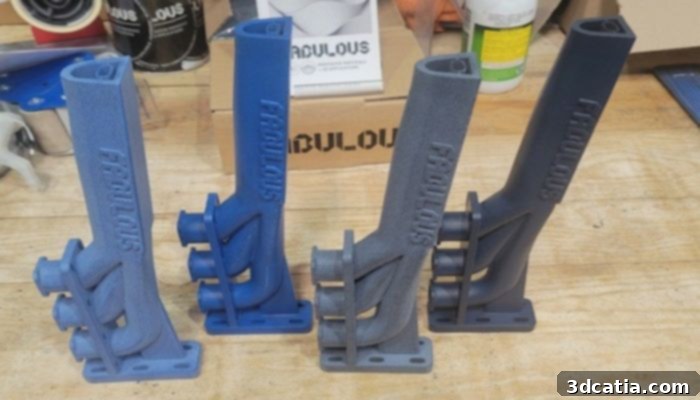
Food nozzles 3D printed in BLUECARE and DETECT materials. Some of them were post-processed by vapor smoothing.
When examining common 3D printing materials, the journey to food-safe certification reveals numerous hurdles. For example, PLA (Polylactic Acid) is generally regarded as a food-safe material by the FDA, but this status is often conditional, typically only applicable if the material is uncolored and pure. The same conditional approval often applies to PETG (Polyethylene Terephthalate Glycol). A significant challenge arises when these materials are processed using the Fused Deposition Modeling (FDM) technique. FDM printers, with their heated nozzles and internal PTFE tubes, introduce a potential for material contamination from metallic components, non-food-grade coatings, or plastic degradation products. The porous nature of FDM-printed parts, characterized by layer lines, also creates micro-cavities where bacteria can harbor and thrive, making thorough cleaning and sanitization exceptionally difficult. This inherent drawback limits FDM’s suitability for many direct and indirect food contact applications.
In contrast, Selective Laser Sintering (SLS) 3D printing largely bypasses these fundamental contamination problems. SLS utilizes a laser to sinter powdered material layer by layer, eliminating the need for nozzles, heated beds, or support structures that can introduce contaminants. This makes SLS a significantly more appropriate process for achieving genuinely food-safe parts. However, even within the SLS domain, the selection of certified materials remains somewhat restricted. While polyamide materials like PA11 and PA12 are widely used for their excellent mechanical properties, the number of commercially available, truly food-safe certified PA materials for SLS is still limited. This scarcity creates a critical gap in the market for manufacturers seeking reliable and compliant solutions. Addressing this specific need is FABULOUS, a French company that has already carved out a strong reputation in Europe for its high-performance technical 3D printing materials. With an international patent extension to the United States, FABULOUS is now strategically positioned to enter and establish a significant foothold in the North American market, offering its innovative food-safe materials to a broader audience.
FABULOUS Pioneers Certified Food-Safe PA11 Powders for Additive Manufacturing
FABULOUS distinguishes itself by adopting a philosophy rooted in practical applications and end-user needs. This approach guides their material development, leading to the creation of innovative yet accessible polymers. A significant advantage of FABULOUS’s polymer powders is their broad compatibility, enabling use on approximately 90% of currently available SLS machines, all while maintaining competitive pricing. While FABULOUS does offer PA12 powders, its product portfolio is notably characterized by a strong emphasis on PA11 materials. This strategic focus sets FABULOUS apart from many other nylon powder manufacturers, as the majority of food-safe materials on the market are typically PA12-based, with certified PA11 options being a rarity. FABULOUS has already achieved remarkable success in Europe with its PA11-based food-safe powders, and the company is now leveraging this proven track record and expertise to replicate and build upon that success in the burgeoning North American market.
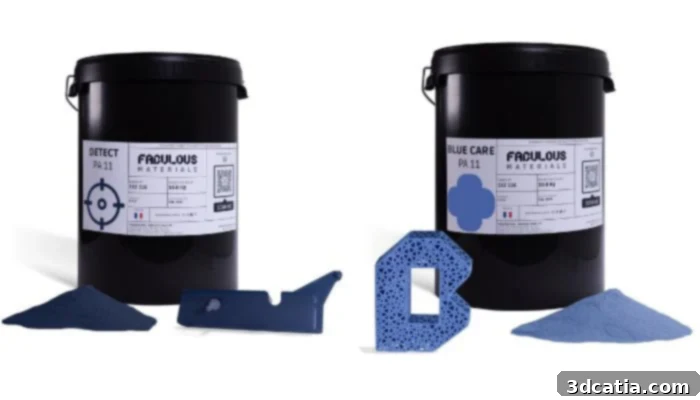
The French company Fabulous develops food-safe PA11.
The choice of PA11 over PA12 is not arbitrary; it’s a deliberate decision driven by distinct advantages. Unlike PA12, which is typically derived from petroleum, PA11 boasts a biological origin, making it a more sustainable and environmentally conscious choice. Furthermore, PA11 is recyclable, aligning with the growing global push for more circular economies and responsible manufacturing practices. These eco-friendly attributes, combined with its excellent mechanical properties – including superior impact resistance, ductility, and lower water absorption compared to PA12 – are increasingly leading companies to adopt PA11 for the production of durable and reliable end-use parts. By offering a diverse and high-performing range of PA11 materials, FABULOUS has secured a significant competitive edge in the European market. The company is now actively pursuing opportunities to extend these business advantages and expand its innovative solutions to new geographies, particularly within North America, where demand for advanced, compliant materials is on the rise.
At the heart of FABULOUS’s European success are two groundbreaking materials: BLUE CARE and DETECT. These materials are engineered for the production of blue safety plastic parts, which are indispensable in various industrial sectors, especially within food production lines. Their distinctive optical blue conspicuousness serves a crucial safety function: enabling the rapid identification and removal of foreign bodies or plastic fragments in food products. This visual detectability is a critical measure to prevent contamination and ensure product integrity. Both BLUE CARE and DETECT are derived from bio-based and natural raw materials, meticulously developed into PA11 powder suitable for 3D printing without the addition of unnecessary additives or organic pigments that could compromise food safety. Beyond their detectability, a key differentiator lies in their certification status. PA11 holds genuine food-contact certification, a significant advantage over PA12 in many applications. PA12, being petroleum-derived, often faces scrutiny, and some specific PA12 formulations are not fully FDA compliant for certain 3D printed parts due to their composition. Furthermore, PA12 sometimes incorporates additives like titanium dioxide, which has been banned by the European Union for certain food-contact applications. This makes FABULOUS’s PA11 blue and detectable powders a superior choice, guaranteeing unparalleled health safety for the end consumer and ensuring compliance with the most stringent regulatory requirements. Both BLUE CARE and DETECT materials have achieved comprehensive food-safe certification in Europe under EU /2011 – 1935/2004 regulations, and crucially, in the USA under FDA CFR 21, representing the highest level of food contact certification applicable in the United States. This dual certification underscores their suitability for global food processing and packaging applications.
As part of its strategic expansion into the North American market, FABULOUS will proudly showcase its innovative materials at RAPID + TCT in Los Angeles, one of the premier additive manufacturing events globally. Their certified food-safe PA11 powders are already available, and the company has proactively forged key partnerships with leading machine manufacturers and reputable dealers across the USA, establishing a robust distribution network. This expansion is further bolstered by their international patent, securing their unique position in the market. Looking ahead, FABULOUS is committed to continuous innovation and is actively researching and developing other cutting-edge materials to further enhance its Safety & Security range. These new, innovative materials are anticipated to be launched on the market by the end of the year, promising even more advanced solutions for critical applications. Interested parties can explore the existing range of FABULOUS materials in detail on their official website HERE, and personally experience their capabilities at RAPID + TCT, where they will be featured at various partner booths, including that of ARKEMA.
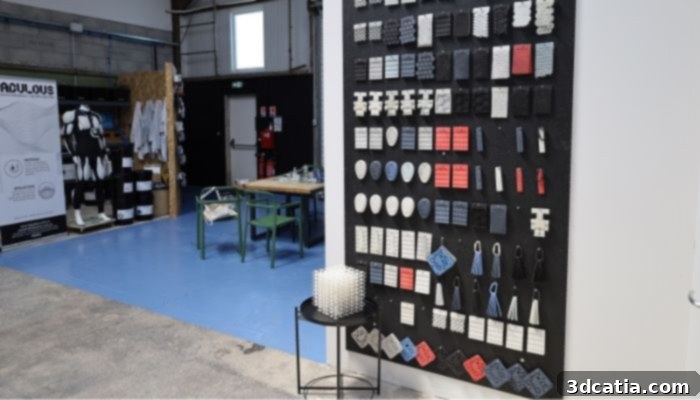
Check out the FABULOUS materials at RAPID + TCT.
The evolution of 3D printing in the food industry hinges on the availability of genuinely food-safe and compliant materials. FABULOUS’s dedication to developing certified PA11 powders, particularly its bio-based and detectable BLUE CARE and DETECT materials, represents a significant leap forward in ensuring consumer safety and operational efficiency within food processing environments. Their commitment to stringent regulatory standards and sustainable practices positions them as a key innovator in this crucial segment of additive manufacturing. What are your thoughts on FABULOUS and their food-safe materials for 3D printing? Do you currently produce parts that come into contact with food, and what challenges have you encountered with material certification? We invite you to share your insights and experiences in a comment below or join the conversation on our LinkedIn, Facebook, and Twitter pages. Don’t forget to sign up for our free weekly newsletter here to receive the latest 3D printing news directly in your inbox! You can also find all our comprehensive videos on our YouTube channel.
*All Photo Credits: FABULOUS