

Weekly Additive Manufacturing Innovations: Ducati’s 3D Printed Frame, Affordable Housing, New Materials, and Dental Breakthroughs
Welcome to our latest edition of 3DExpress, your comprehensive weekly roundup of the most significant developments in the additive manufacturing market. This week, we delve into a fascinating array of advancements, starting with a groundbreaking application in high-performance motorsports: how a 3D printed titanium frame has been seamlessly integrated into a legendary Ducati motorcycle. Beyond the racetrack, we explore how the transformative power of 3D printing is poised to make housing significantly more affordable as early as 2025, addressing critical global needs. We’ll also examine the expansion of material libraries with One Click Metal’s introduction of new metallic options, pushing the boundaries of what’s possible with metal additive manufacturing. Furthermore, we’ll discover how French manufacturer Prodways is innovating the dental sector with new specialized 3D printers, enhancing precision and efficiency. Finally, we highlight a remarkable community initiative where 3D printed darts are proving to be an unexpectedly effective tool in the crucial fight against invasive Asian wasps, demonstrating the versatility and social impact of this technology. Join us as we uncover these exciting stories and the continuous evolution of 3D printing. Happy reading and have a wonderful weekend!
Ducati Unveils a High-Performance 3D Printed Titanium Motorcycle Frame
In a thrilling showcase of engineering prowess and advanced manufacturing, Ducati has unveiled a Panigale V4 motorcycle featuring a pioneering 3D printed titanium frame. This ambitious project, spearheaded by Angelelli Automobili, began its journey in 2020. The team meticulously redesigned and optimized the frame specifically for additive manufacturing, leveraging their proprietary software, Alien Mesh Design. This cutting-edge program harnesses the power of generative design algorithms and topological optimization to create structures that are not only significantly lighter but also possess superior strength and stiffness compared to traditionally manufactured parts. By precisely placing material only where it’s needed, these advanced design techniques allow for unprecedented geometric complexity and performance enhancements, which are critical in the demanding world of motorcycle racing and high-performance vehicles.
The actual 3D printing of this intricate titanium frame was expertly carried out by the Italian WEAREAM center, a hub renowned for its expertise in advanced additive manufacturing. A key achievement of this project is that each critical section of the frame was printed in a single piece. This ‘monolithic’ approach dramatically eliminates the need for complex and time-consuming post-processing steps such as machining or welding, which are typically required for multi-part assemblies. The result is a more integrated, robust, and structurally sound component that pushes the boundaries of motorcycle design and performance, ensuring enhanced structural integrity and reduced assembly complexity. Currently, this revolutionary Ducati bike is drawing significant attention at the prestigious EICMA Motorcycle Show in Milan, where it stands as a testament to the future of high-performance vehicle manufacturing, showcasing the profound impact of additive manufacturing on innovation and product development within the automotive and motorsports industries.
3D Printing Paving the Way for More Affordable Homes by 2025
The promise of 3D printing revolutionizing the construction industry is rapidly becoming a reality, with companies like PERI 3D Construction leading the charge. Widely regarded as one of the foremost pioneers in 3D home printing, PERI has been at the forefront of this technological shift. While Germany saw its first 3D-printed building just three years ago, PERI has significantly advanced its capabilities, successfully completing a total of 15 3D-printed structures to date. Each project has contributed to a growing repository of expertise, refining processes, and demonstrating the tangible benefits of additive construction, including faster build times, reduced labor costs, and greater design flexibility. This continuous innovation positions PERI as a key player in transforming how we build our communities.
Historically, 3D home printing has faced challenges in directly competing with traditional construction methods on cost. However, this dynamic is on the cusp of a major transformation. According to optimistic yet well-founded estimates from PERI 3D Construction, the landscape will fundamentally change by 2025. They project that as early as next year, 3D-printed construction could become a more economically viable option than conventional home building. This anticipated shift is not merely due to isolated improvements but stems from comprehensive developments across the entire value chain of additive construction. Printing processes have evolved dramatically, becoming faster, more efficient, and more precise. Concurrently, advancements in construction-grade materials have yielded stronger, more sustainable, and more versatile compounds optimized for 3D printing, further driving down costs and enhancing performance.
Beyond cost-efficiency, 3D house printing unlocks intriguing possibilities for architectural design and functionality. The ability to create complex geometries, optimize material use, and reduce construction waste offers significant advantages over traditional methods, enabling architects to design more innovative and sustainable structures. Dr. Fabian Meyer-Brötz, Managing Director of PERI 3D Construction GmbH, articulates the urgent need for these developments and the immense potential of 3D printing in addressing the industry’s stagnation: “If we look at developments in the construction sector, it’s clear that as a sector we’re not progressing fast enough, but with small incremental improvements. The construction sector needs a leap in productivity comparable to what industry has achieved through digitization and automation. This is the only way we’ll be able to respond in the long term to the challenges of the future.” This perspective underscores how additive manufacturing offers the critical ‘leap’ required to meet global housing demands, improve sustainability, and innovate construction practices, ultimately delivering cheaper, more durable, and more sustainable homes for a growing population worldwide. This shift promises not only economic benefits but also a significant step forward in environmental responsibility and urban development.
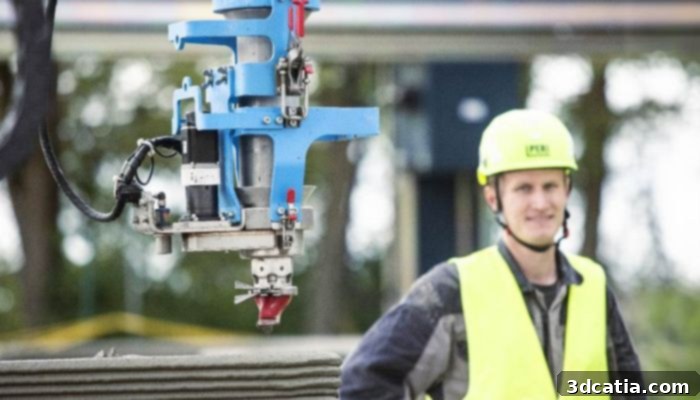
Photo Credits: PERI 3D Construction
One Click Metal Expands Material Portfolio with Advanced Metallic Powders
German manufacturer One Click Metal, a prominent name in the realm of accessible metal 3D printing, has announced significant advancements in its material offerings. The company has successfully optimized printing parameters for two new high-performance metallic materials, making them readily available for use with their innovative additive manufacturing solutions. This expansion broadens the capabilities of their systems and opens up new applications for users across various industries, reinforcing One Click Metal’s commitment to advancing metal 3D printing accessibility and performance for industrial applications, prototyping, and small-batch production.
The newly introduced materials, CoCR 2.4979 and A6061-RAM2, each bring distinct advantages to the forefront of metal additive manufacturing. CoCR 2.4979, a cobalt-chrome alloy, is celebrated for its exceptional strength, outstanding corrosion resistance, and remarkable temperature stability. These properties make it an ideal choice for critical applications where material integrity under harsh conditions is paramount. One Click Metal highlights its suitability for demanding sectors such as medical implants, where biocompatibility, high strength, and long-term durability are essential for devices like prosthetics and dental components; aerospace components, which require resistance to extreme temperatures and corrosive environments; and high-wear applications, benefiting from its inherent toughness and abrasion resistance. The ability to 3D print with such a material allows for the creation of intricate, customized parts that might be challenging or impossible to produce with traditional methods, all while maintaining superior material characteristics.
Conversely, A6061-RAM2 is an aluminum alloy variant that strikes an excellent balance between being lightweight and strong, boasting an impressive strength-to-weight ratio. This material also exhibits robust corrosion resistance, making it suitable for environments where exposure to elements is a concern, and offers improved thermal conductivity, which is crucial for applications involving efficient heat dissipation. The company identifies its key applications in aerospace, where weight reduction is a constant priority for fuel efficiency and performance; automotive, for performance components that benefit from lighter yet strong parts such as brackets, housings, and structural elements; and other high-performance applications where the combination of strength, light weight, and excellent thermal properties is critical for optimal operation. The availability of these two distinct metallic materials significantly enhances the versatility of One Click Metal’s printer solutions, empowering engineers and designers to tackle a wider range of complex challenges with optimized materials and advanced additive manufacturing techniques.

Photo Credits: One Click Metal
Ingenious 3D Printed Darts Combat Invasive Asian Wasp Nests
In a testament to the creative problem-solving potential of additive manufacturing, the Spanish association Makers Bierzo has developed an innovative 3D printed dart designed to significantly improve the efficiency and safety of removing invasive Asian wasp nests. This clever application highlights how targeted technological solutions can address pressing ecological issues within local communities. Asian wasps (Vespa velutina) pose a serious threat to native bee populations, honey production, and the broader ecosystem, making their eradication and management a critical environmental concern across Europe.
The customized design of these 3D printed darts has proven to be remarkably effective in practice. Traditionally, firefighters and other operatives face considerable risks when attempting to neutralize wasp nests, especially those located high in trees or in other hard-to-reach areas. The Makers Bierzo dart facilitates a more precise and safer intervention by allowing for the targeted application of insecticides or other solutions from a distance. This reduces the need for operatives to get dangerously close to aggressive swarms, thereby mitigating risks of stings, falls, and other hazards associated with manual removal. The precision offered by the dart ensures that the treatment is delivered directly to the heart of the nest, maximizing effectiveness while minimizing environmental impact from overspray on surrounding vegetation or unintended areas.
Beyond the immediate efficacy, Makers Bierzo’s initiative is underpinned by a strong commitment to community welfare and environmental protection. The association has altruistically produced over a thousand units of these specialized darts on a non-profit basis, distributing them to local emergency services, environmental agencies, and conservation groups. This collaborative effort directly contributes to the protection of biodiversity, particularly the vital conservation of bee colonies, which are severely impacted by the predatory nature of Asian wasps. This innovation perfectly encapsulates how advanced technology, combined with a profound sense of social responsibility, can generate practical and effective solutions to urgent local problems, ultimately enhancing both community safety and safeguarding the natural environment of Bierzo and surrounding regions. It’s a prime example of how 3D printing can be leveraged for impactful, grassroots conservation efforts.
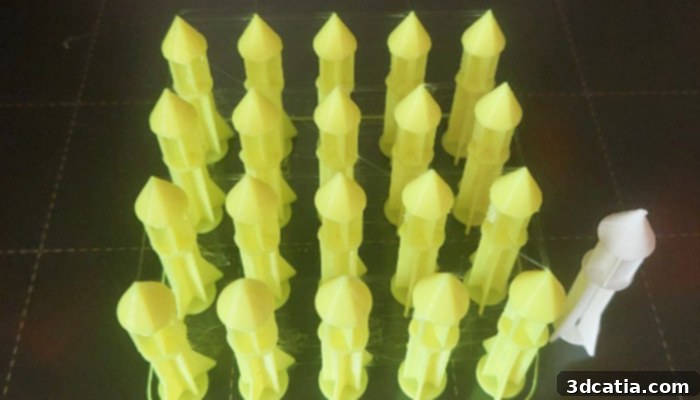
Photo Credits: Makers Bierzo
Prodways Unveils New High-Performance Dental 3D Printers
Concluding this week’s 3DExpress, we turn our attention to the innovative contributions of Prodways, a renowned French manufacturer, to the medical sector. Prodways has recently announced the exciting launch of a brand-new range of resin 3D printers, meticulously engineered and designed specifically for the demanding applications within the dental industry. This dedicated line, aptly named ‘Dental Pro,’ is set to redefine efficiency and precision in dental laboratories worldwide, addressing the growing need for rapid, high-quality production of custom dental appliances and models.
The Dental Pro range is built upon the robust and highly reliable DLP (Digital Light Processing) technology. This advanced process allows for extremely fast printing speeds, which translates directly into significantly higher productivity for dental professionals. The ability to rapidly produce multiple highly accurate dental models, surgical guides, and provisional prosthetics streamlines workflows, reduces lead times for patients, and ultimately enhances overall patient care and satisfaction. While technical specifications vary across the models within the series, both the Dental Pro 200 and Dental Pro 100 boast a generously sized 3D printing volume of 300 x 445 x 2350 mm. This substantial build envelope enables laboratories to print numerous small parts simultaneously or tackle larger, more complex dental appliances with ease, further boosting throughput and operational flexibility for various dental applications.
Vincent Icart, CTO-CCO of Prodways Machines, emphasized the transformative potential of these new machines: “Our new dental 3D printers are a revolutionary solution for dental laboratories. They are designed to address the increasing complexity of dental applications, while offering faster production times and superior accuracy. This solution is specifically designed for dental labs that demand both efficiency and high quality in their production.” This statement highlights Prodways’ commitment to providing cutting-edge tools that meet the evolving needs of modern dentistry. From highly accurate surgical guides for implant placement and orthodontic models for clear aligners, to precision-fit crowns, bridges, and removable prosthetics, the Dental Pro series offers unparalleled detail, consistency, and a wide compatibility with various dental resins. By integrating these advanced DLP 3D printers into their workflows, dental laboratories can achieve new levels of efficiency, reduce material waste, and deliver exceptionally high-quality products to their clients, solidifying 3D printing’s indispensable role in the future of dental care and patient-specific treatments.
This week’s roundup truly underscores the incredible versatility and impact of additive manufacturing across diverse sectors, from high-octane motorsports and the urgent need for more affordable housing to essential public services and critical healthcare applications. What are your thoughts on Ducati’s innovative 3D printed motorcycle frame, or the prospect of more affordable housing thanks to 3D printing? We’d love to hear your insights and predictions for the future of these technologies! Share your comments below or connect with us on our LinkedIn, Facebook, and Twitter pages. To stay continuously updated with the very latest in 3D printing news and breakthroughs, don’t forget to sign up for our free weekly Newsletter here, delivered directly to your inbox. You can also explore all our engaging video content and interviews on our YouTube channel. Thank you for joining us for this edition of 3DExpress, and we look forward to bringing you more exciting news and analyses next week!