
Cutting-Edge Additive Manufacturing: Your Weekly Top 5 3D Printing Innovations
Welcome to another exciting Sunday roundup of the most groundbreaking advancements and compelling stories from the world of additive manufacturing. Each week, we scour the globe for the latest 3D printing innovations that are not only pushing technological boundaries but also reshaping various industries, from construction and aerospace to sustainable design and personal consumer products. This week’s selection is particularly diverse, showcasing the incredible versatility and impact of 3D printing technology.
We kick things off with a fascinating architectural marvel: a public park in Shenzhen, China, brought to life with over 2,000 intricately 3D-printed components. Next, we delve into the ambitious realm of space exploration as Elon Musk reveals the advanced 3D printer instrumental in manufacturing critical parts for SpaceX rockets. Continuing our journey of innovation, an Italian designer has envisioned a revolutionary, smart village in Ecuador, uniquely constructed from cocoa waste—a testament to sustainable and circular economy principles. Our exploration then turns to the fascinating world of electronics with the first-ever 3D-printed OLED display, promising a future of more accessible and customizable screens. Finally, we step into the fashion and design sector to examine “The Cryptide Sneaker,” a fully 3D-printed, custom-fit footwear concept that redefines personalization. Join us as we explore these remarkable developments in our carefully curated Top 5 videos of the week. Prepare to be inspired by the relentless pace of innovation in additive manufacturing!
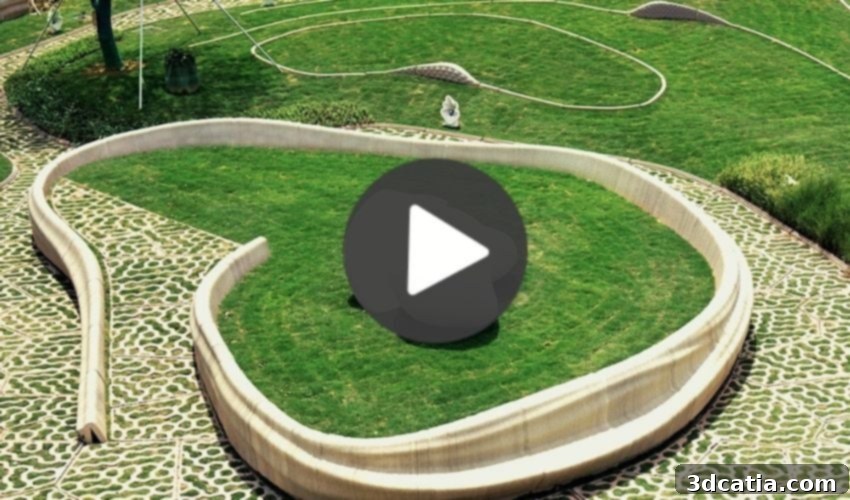
Top 1: Unveiling China’s First 3D-Printed Public Park
In a monumental stride for urban development and construction innovation, U.S.-based Advanced Intelligent Construction Technology (AICT) has proudly opened China’s first public park to be extensively constructed using 3D printing technology. Located at the prestigious Shenzhen International Convention & Exhibition Center, this project is a shining example of how additive manufacturing can revolutionize the way we design and build our public spaces. Spanning an impressive 55,000 square meters, the park is a harmonious blend of natural aesthetics and technological prowess.
The park’s finished landscape comprises more than 2,000 individual concrete elements, each precisely 3D-printed to form a cohesive and visually striking environment. These elements range from elegant sculptures and comfortable benches to functional flower beds, robust retaining walls, and perfectly sculpted curbs. The sheer scale and complexity of this project underscore the capabilities of modern construction 3D printing. What’s even more remarkable is the efficiency of its execution: the entire implementation process, from printing to assembly, was completed in an astonishingly short period of just two months. This rapid turnaround time, combined with an approximate total cost of $650,000, highlights the cost-effectiveness and speed that additive manufacturing brings to large-scale construction projects.
The aesthetic vision for the park was inspired by the fluid and organic course of a river, a theme beautifully realized through the intricate shapes and flowing lines made possible by 3D printing. Unlike traditional construction methods that might struggle with such complex geometries, 3D printing allows for unparalleled design freedom, enabling architects and designers to translate their most imaginative concepts into tangible reality. This park is not just a recreational area; it’s a living exhibition of sustainable and efficient construction practices, demonstrating how technology can be harnessed to create beautiful, durable, and unique urban landscapes. It sets a new benchmark for future public infrastructure projects globally, proving that 3D printing is not just for small prototypes but for large-scale, impactful civic endeavors. Delve deeper into the innovative creation of this park by watching the video below and witness the future of urban design unfold.
Top 2: Elon Musk Unveils the Revolutionary SpaceX Rocket Part 3D Printer
In the rapidly evolving landscape of technological innovation, few figures command as much global attention and excitement as Elon Musk. Renowned for his audacious visions and disruptive ventures, Musk has been at the forefront of a modern space race with his SpaceX project, an endeavor aimed at nothing less than making humanity a multi-planetary species. The ultimate goal? To facilitate Mars colonization and enable a new era of space tourism. Central to this monumental ambition is the advanced manufacturing capability that underpins SpaceX’s rocket production, specifically, the groundbreaking 3D printing technology that fabricates critical rocket components.
Musk recently offered a glimpse into the sophisticated technology responsible for additively manufacturing SpaceX rocket parts. This revelation highlights the pivotal role of 3D printing in modern aerospace. For the demanding conditions of space travel, traditional manufacturing often falls short in terms of speed, complexity, and material efficiency. Additive manufacturing, however, provides an unparalleled solution. It allows for the creation of incredibly complex geometries that are impossible or cost-prohibitive with conventional methods, significantly reducing part count through consolidation and optimizing designs for maximum performance and minimum weight—a crucial factor in rocketry.
While specific details of the proprietary process used by SpaceX are often closely guarded, it is widely understood that metal additive manufacturing techniques such as Selective Laser Melting (SLM), Electron Beam Melting (EBM), or Directed Energy Deposition (DED) are employed. These processes are ideal for working with high-performance aerospace materials like titanium alloys, nickel-based superalloys (e.g., Inconel), and aluminum alloys. These materials are chosen for their exceptional strength-to-weight ratios, extreme temperature resistance, and durability—qualities essential for surviving the immense stresses of launch and the harsh environment of space.
The benefits of 3D printing for SpaceX extend beyond mere part creation. It enables rapid iteration and prototyping, allowing engineers to quickly test and refine designs. This agility is vital in the fast-paced development cycle of reusable rockets and advanced spacecraft. Furthermore, 3D printing minimizes material waste, contributing to a more sustainable manufacturing process, and allows for the integration of features like internal cooling channels or lightweight lattice structures, which enhance component performance. Witness firsthand the incredible technology powering humanity’s journey to the stars and discover the ingenious methods behind the creation of SpaceX’s crucial rocket parts in the compelling video below.
Top 3: A Sustainable Future: The 3D-Printed Cocoa Waste Village in Ecuador
In a truly visionary project that exemplifies the potential of sustainable architecture and the circular economy, we explore an innovative smart village taking shape in Pedernales, Ecuador. This remarkable development is conceptualized by acclaimed Italian architect Valentino Gareri and is being realized through a collaborative effort with chocolate manufacturer MUZE Cacao and the nonprofit organization Avanti. What makes this village particularly groundbreaking is its primary construction material: 3D-printed cocoa waste. This initiative redefines waste as a valuable resource, showcasing a creative and eco-friendly solution to housing and urban development.
The “Cocoa Eco Village” project is envisioned as the next ‘Silicon Valley’ for the circular economy, aiming to foster an ecosystem of innovation and sustainable living. Its purpose extends beyond merely providing homes; it’s designed to act as a vital network connecting various sustainable, carbon-neutral villages, simultaneously serving as a dynamic innovation hub focused on circular economic principles. This means that resources are kept in use for as long as possible, extracting the maximum value from them whilst in use, then recovering and regenerating products and materials at the end of their service life.
The decision to use cocoa waste as a building material is a stroke of genius. Ecuador is a major cocoa producer, and utilizing agricultural by-products not only reduces landfill waste but also creates a local, abundant, and renewable construction resource. This approach significantly lowers the environmental footprint of construction, minimizing carbon emissions and promoting local economic growth by adding value to agricultural waste. The 3D printing process allows for the efficient and precise construction of modular components, which can be assembled to create resilient and architecturally appealing structures.
The village is meticulously designed to be modular, offering flexibility and scalability in its expansion. It prioritizes functionality, ensuring that living spaces are practical and comfortable. Sustainability is at its core, from material sourcing to energy consumption, aiming for carbon neutrality. Furthermore, it is technology-enabled, incorporating smart features for energy management and community interaction, and is deeply connected to the local community, ensuring that its development benefits the people it serves. This project is a powerful model for how design, technology, and environmental consciousness can converge to create resilient, self-sufficient, and thriving communities. Discover more about this inspiring blend of architecture, sustainability, and social responsibility in the compelling video below.
Top 4: The Dawn of Flexible Displays: The First 3D-Printed OLED Screen
For years, the manufacturing of Organic Light-Emitting Diode (OLED) screens, ubiquitous in high-end smartphones and televisions, has been a capital-intensive process, requiring massive factories and specialized machinery. This high barrier to entry has kept production centralized and costs relatively high. However, a significant breakthrough has recently emerged from the University of Minnesota, promising to democratize and revolutionize the production of advanced displays. A dedicated group of researchers has unveiled an innovative method to create a flexible OLED screen using a standard 3D printer.
This pioneering achievement involved combining two distinct yet complementary 3D printing methods: extrusion printing and spray printing. Extrusion printing, a technique familiar in consumer-grade 3D printers, is used to lay down precise lines of conductive and emissive materials. Spray printing, on the other hand, allows for the deposition of thin, uniform layers over larger areas, which is crucial for the various layers that constitute an OLED display. By synergistically integrating these two processes, the researchers were able to fabricate a multi-layered, functional OLED display with unprecedented flexibility and efficiency.
The implications of this discovery are profound. It signifies a potential for a massive reduction in manufacturing costs for screens, opening doors for localized production and customization that were previously unimaginable. Imagine bespoke smartphone screens, custom-shaped displays for wearable technology, or even integrated smart surfaces for smart homes and vehicles, all produced on demand with significantly lower overheads. The prototype display, measuring approximately 1.5 inches on each side, may seem small, featuring 64 pixels, but its success lies in its perfect functionality—every single pixel worked flawlessly, emitting light as intended.
This breakthrough is not just about cheaper screens; it’s about enabling a new generation of electronic devices. Flexible OLEDs could lead to rollable phones, transparent displays, and even biomedical sensors that conform to the human body. It promises greater freedom in industrial design, allowing products to take on forms dictated by user needs rather than manufacturing constraints. This innovation could make advanced display technology accessible to a much wider array of applications and industries, fueling creativity and fostering new product categories. Witness this game-changing project and its potential to reshape the future of electronics in the insightful video below.
Top 5: Step into the Future with “The Cryptide Sneaker” – A Fully 3D-Printed Footwear Revolution
Rounding out our weekly dive into the world of additive manufacturing, we take a closer look at a truly innovative concept in footwear design: “The Cryptide Sneaker.” This remarkable creation is the brainchild of Stephan Henrich, a visionary German architect and designer, and represents a significant leap forward in personalized and sustainable fashion. What sets The Cryptide Sneaker apart is its construction: it is entirely 3D printed, utilizing advanced selective laser sintering (SLS) technology and a highly flexible Thermoplastic Polyurethane (TPU) material.
The choice of SLS printing with TPU is critical to the sneaker’s unique properties. SLS allows for the creation of intricate internal structures and complex geometries that are impossible with traditional manufacturing methods, resulting in a lightweight yet robust design. TPU, known for its exceptional elasticity, durability, and abrasion resistance, makes the sneaker not only comfortable but also incredibly resilient. This combination of technology and material enables a footwear design that is both avant-garde and highly functional. Henrich’s design ingeniously divides the sneaker into two primary parts: a distinctly articulated sole and an upper part that itself resembles a continuation of the sole, creating a seamless, organic aesthetic.
One of the most compelling benefits of this type of 3D-printed footwear lies in its unparalleled ability to be customized. The Cryptide Sneaker is designed to adapt precisely to the unique measurements of an individual’s foot. By simply scanning the wearer’s foot beforehand, a perfectly tailored shoe can be printed, promising a level of comfort, support, and performance that mass-produced footwear cannot match. This bespoke approach offers greater autonomy for the consumer, allowing for footwear that is not only stylish but also ergonomically optimized for their specific needs, mitigating common issues like pressure points or ill-fitting shoes.
Beyond personal comfort, this technology paves the way for a more sustainable future in the footwear industry. On-demand manufacturing reduces waste, as shoes are only produced when needed, and the use of flexible, recyclable materials like TPU further enhances its eco-friendly credentials. The Cryptide Sneaker is more than just a shoe; it’s a statement about the future of design, demonstrating how additive manufacturing can merge art, engineering, and sustainability to create products that are both visually stunning and incredibly practical. Explore the shoes’ unusual properties, Henrich’s design philosophy, and the profound reasons he chose 3D printing for his creation in the captivating video below.
What a week it has been for additive manufacturing! From groundbreaking architectural projects in China and ambitious aerospace innovations by SpaceX to sustainable village concepts in Ecuador, the development of revolutionary display technology, and personalized footwear design, the scope and impact of 3D printing continue to expand at an incredible pace. Each of these stories underscores the transformative power of this technology, showcasing its potential to address complex challenges and create novel solutions across diverse sectors. Whether it’s enhancing urban infrastructure, pushing the boundaries of space exploration, promoting ecological sustainability, advancing electronics, or revolutionizing personal goods, 3D printing is clearly at the heart of many future innovations.
We hope this week’s selection of top 5 videos has offered you a fascinating glimpse into the vibrant and dynamic world of additive manufacturing. Which innovation resonated with you the most? Were you captivated by the speed and scale of the 3D-printed park, inspired by Elon Musk’s vision for space, intrigued by the sustainable cocoa waste village, or amazed by the flexible OLED display and personalized sneakers? We’d love to hear your thoughts! Share your favorite in a comment below or connect with us on our LinkedIn, Facebook, and Twitter pages. Don’t miss out on the latest advancements and sign up for our free weekly Newsletter here, delivering the freshest 3D printing news straight to your inbox! You can also find all our compelling videos and more engaging content on our YouTube channel. Happy innovating!