
The Future is Now: Unlocking Industrial Mass Production with 3D Printing Automation
The manufacturing industry is on the cusp of a profound revolution, largely driven by the accelerating integration of additive manufacturing, commonly known as 3D printing. Over the past two years, leading industrial companies worldwide have intensively explored how to seamlessly embed this transformative technology into their production ecosystems. Their overarching goal is clear: to fully automate the 3D printing process, thereby transforming it from a specialized tool for rapid prototyping into a robust and scalable method for true mass production. This significant paradigm shift is not merely a theoretical concept but a tangible trend, rigorously analyzed and highlighted in SmarTech Publishing’s comprehensive study, “Markets for Automated 3D Printing 2016-2017.” This seminal report meticulously examines the evolving market dynamics of automated 3D printing, forecasting its growth and impact over the crucial decade leading up to 2027.
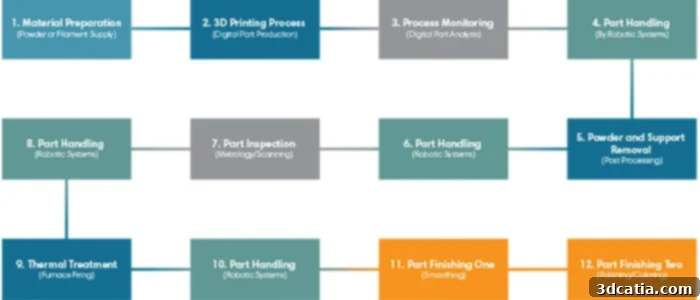
Understanding 3D printing automation requires a holistic perspective, as it encompasses the entire digital production chain, extending far beyond the printer itself. This integrated approach involves orchestrating various sophisticated elements to create a self-sufficient manufacturing environment. Specifically, it includes the autonomous operation of the 3D printing machine, the automated supply and replenishment of diverse printing materials, advanced post-processing techniques that eliminate manual intervention, and the strategic deployment of robotics or sophisticated electronic systems that interconnect each individual machine. This seamless integration ensures a continuous, efficient, and largely unsupervised workflow. SmarTech Publishing’s research emphasizes this end-to-end digital production chain, recognizing it as the cornerstone for achieving industrial-scale additive manufacturing. The visual representation below illustrates this interconnected cycle, showcasing how each component contributes to a fully automated 3D printing ecosystem:
The widespread adoption of automation within 3D printing carries profound implications for efficiency, cost-effectiveness, and workforce management. SmarTech’s analysts project that over the next ten years, the vast majority of industrial 3D printers will come equipped with integrated automation features as a standard offering. This fundamental shift promises to dramatically reduce the reliance on highly skilled human operators for routine supervision and manual tasks. For companies specializing in rapid prototyping, this translates into significant cost savings, primarily by minimizing labor expenditures and increasing throughput. More broadly, the ability to produce parts faster, with greater consistency, and at a lower per-unit cost adds substantial value for stakeholders. This economic advantage positions additive manufacturing as an increasingly attractive investment, capable of transforming traditional manufacturing models and fostering unprecedented levels of production scalability and agility.
3D Printing Automation: A New Frontier for Revenue Generation
The financial impact of automating 3D printing is poised to be immense, positioning this technological advancement as a crucial driver of revenue for the entire additive manufacturing industry in the coming decade. Projections indicate that revenue streams generated directly from 3D printing automation—including sales of automated systems, specialized software, robotic components, and related services—are expected to skyrocket, reaching an astounding $11.2 billion by the end of 2027. This robust forecast underscores the significant economic opportunities that lie within integrated, automated additive manufacturing. However, achieving this ambitious revenue target is critically dependent on widespread adoption; manufacturers and industrial producers must actively embrace and implement these automation solutions across their operations. Their willingness to invest in and utilize these advanced systems will be the determining factor in unlocking the full market potential of automated 3D printing.
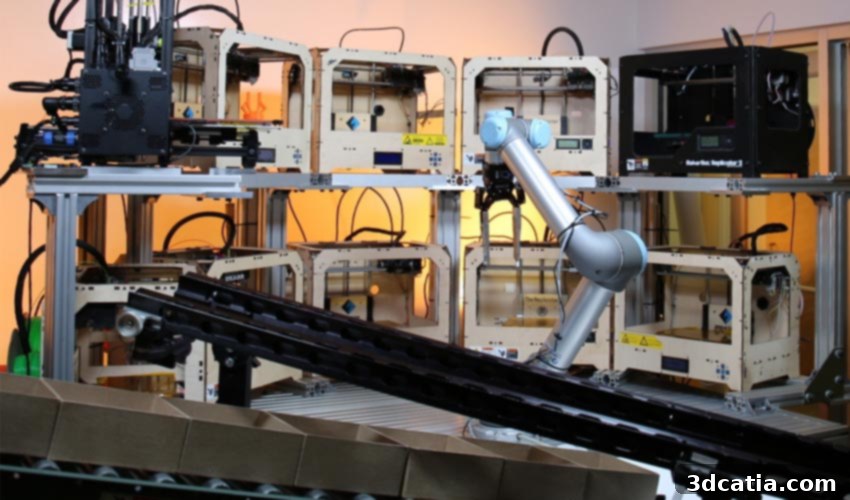
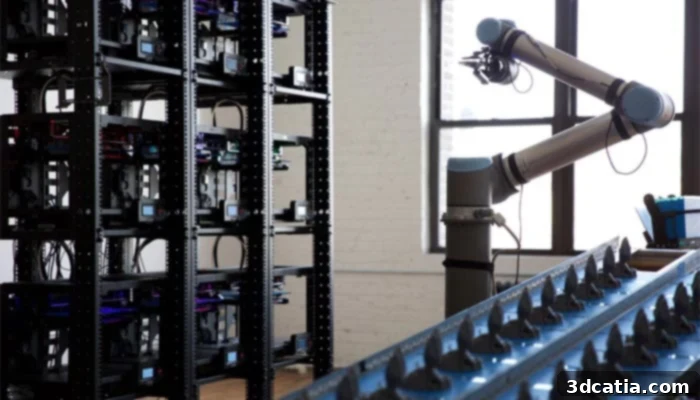
While the vision of fully automated 3D printing often feels futuristic, groundbreaking initiatives are already bringing this reality to the present. Forward-thinking companies are actively demonstrating the power and potential of automated additive manufacturing workflows. A compelling example is Voodoo Manufacturing, a dynamic startup that has established a highly automated 3D printer factory. This facility is ingeniously designed for the efficient, large-scale production of numerous small parts, leveraging automation to maximize throughput and consistency. Beyond small components, Voodoo Manufacturing also produces larger parts intended for subsequent assembly, showcasing the versatility of an automated setup. Another notable innovation comes from Formlabs with their pioneering Form Cell system. This solution integrates multiple resin-based 3D printers, a robotic gantry for automated part handling, and integrated post-processing units into a compact, self-operating production platform. These real-world applications underscore that 3D printing automation is not merely a concept but a rapidly evolving, tangible force already reshaping industrial production paradigms today.
The comprehensive SmarTech study also identifies key industry leaders who are strategically poised to harness the power of automation and further solidify their dominant market positions. These visionary companies are making substantial investments in research, development, and the seamless integration of automated solutions. Among the distinguished firms highlighted are EOS, a global leader in industrial metal and polymer 3D printers, and Stratasys, a pioneer renowned for its FDM and PolyJet additive manufacturing technologies. Other significant players include Concept Laser, now a pivotal part of GE Additive, recognized for its advanced metal additive manufacturing systems, and Carbon 3D, which is revolutionizing resin printing with its innovative Digital Light Synthesis™ technology. Precision engineering giant Renishaw, along with foundational additive manufacturing companies like 3D Systems, and groundbreaking newcomers such as Desktop Metal, focusing on scalable metal binder jetting, are also highlighted as key innovators. These companies are not just responding to market shifts; they are actively orchestrating the future of manufacturing by leveraging automation to expand capabilities, reduce operational costs, and enhance the overall scalability of additive manufacturing. The report additionally provides critical insights into evolving price trends across various components essential for automated ecosystems, including advanced materials, sophisticated robotics, integrated electronics, and intelligent software platforms, offering a holistic perspective for all industry stakeholders. For a complete and in-depth understanding of these dynamic market trends, the full report from SmarTech Publishing is available here.
The Broader Impact and Future Landscape of Automated Additive Manufacturing
Beyond the immediate financial forecasts and the contributions of individual companies, the automation of 3D printing signifies a monumental leap forward for global manufacturing. This technological convergence promises to unlock unprecedented levels of efficiency, enable unparalleled customization, and build greater resilience within supply chains. Picture smart factories where state-of-the-art 3D printers, robotic arms, and AI-driven software collaborate seamlessly, autonomously producing complex parts on demand with minimal human intervention. This vision paves the way for truly decentralized manufacturing, allowing production facilities to be located closer to the point of consumption, thereby drastically reducing transportation costs and shortening lead times. Furthermore, it facilitates genuine mass customization, where each product can be individually tailored to specific customer requirements without incurring prohibitive costs or necessitating extensive retooling. This transformative shift will fundamentally alter the competitive landscape, empowering businesses of all sizes to innovate at a faster pace and respond with greater agility to fluctuating market demands.
The journey towards fully automated additive manufacturing, while incredibly promising, is not without its complexities and challenges. Significant initial investment costs for advanced robotics, integrated software, and specialized training can present a barrier, particularly for small and medium-sized enterprises. Establishing universal standards across diverse 3D printing technologies, various material types, and different software platforms remains an ongoing effort within the industry. Moreover, as manufacturing processes become increasingly interconnected and digitally driven, addressing cybersecurity concerns becomes paramount to protect intellectual property and ensure operational integrity. Nevertheless, the substantial benefits—including dramatically enhanced production speeds, minimized material waste, consistently improved part quality, and the ability to operate continuously 24/7—far outweigh these initial hurdles. Collaborative efforts between governments, industry consortia, and academic institutions are actively addressing these challenges, fostering an environment conducive to continued innovation and widespread adoption.
As we gaze into the future, the trajectory of 3D printing automation is undeniably upward and accelerating. This evolution is not merely about making existing production processes faster or more efficient; it represents a fundamental rethinking of how products are conceived, designed, manufactured, and ultimately delivered to consumers. The powerful synergy created by the convergence of advanced materials science, artificial intelligence, sophisticated robotics, and the ubiquitous Internet of Things (IoT) is forging a new industrial ecosystem. This ecosystem promises to redefine the entire industrial paradigm, opening vast new avenues for economic growth, generating new categories of highly skilled jobs, and championing a more sustainable approach to production through localized, on-demand manufacturing. The compelling insights derived from SmarTech Publishing’s detailed analyses and the continuous breakthroughs from industry leaders paint a vivid and optimistic picture: a future where additive manufacturing, supercharged by automation, transitions from a specialized technology to an indispensable cornerstone of global industrial output.
What are your thoughts on the transformative future of automation in 3D printing? Do you envision it revolutionizing industrial production as predicted, or do you foresee significant obstacles that might impede its widespread adoption? We sincerely invite you to share your valuable perspectives and actively engage in this vital conversation by leaving a comment below. You can also connect with us and join the broader discussion on our Facebook and Twitter pages! For all the very latest news, groundbreaking innovations, and in-depth analyses from the dynamic world of 3D printing, be sure to sign up for our free weekly Newsletter, delivered conveniently straight to your inbox.