
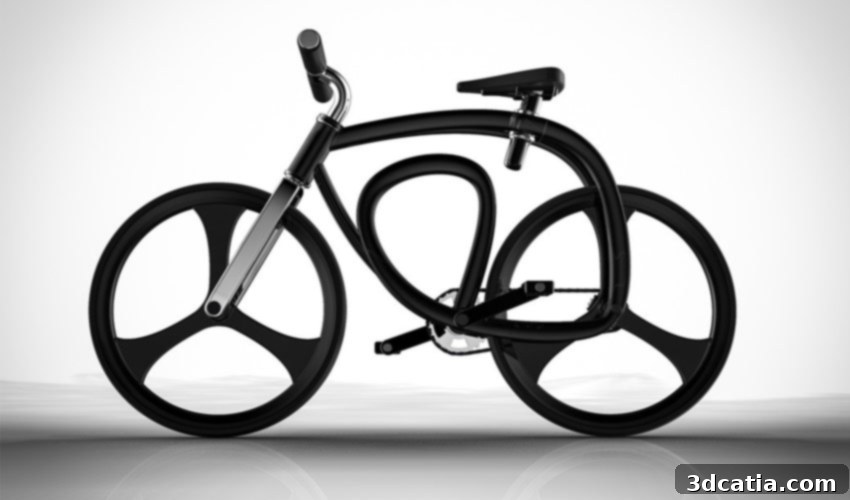
The Continuous Loop Bike: Revolutionizing Cycling Design with Futuristic 3D Printing
The convergence of cutting-edge technology and innovative design continues to push boundaries across various industries, and the world of cycling is no exception. For some time, it has been evident that advanced 3D technologies possess immense potential to reshape how bicycles are conceived, manufactured, and ultimately experienced. From creating resilient, puncture-proof tires to engineering remarkably lighter structural components, additive manufacturing has opened up a new realm of possibilities for cyclists and designers alike. However, designer Steve Jenkins has taken this vision a significant step further with his groundbreaking proposal: a truly futuristic bicycle completely 3D printed, an iconic creation he aptly named “The Continuous Loop Bike.”
Jenkins’ design immediately captivates the observer, giving the distinct impression of an infinite loop where the beginning and end seamlessly merge, creating an elegant and profoundly artistic form. This project serves as a compelling testament to how 3D printing technologies are not merely manufacturing tools but powerful enablers for artistic expression and radical innovation in industrial design. They empower designers to transcend the limitations imposed by conventional manufacturing techniques, offering an unprecedented scope for creative exploration and realization. The Continuous Loop Bike perfectly embodies the principles of Design for Additive Manufacturing (DfAM), a methodology that meticulously explores how components can be specifically engineered to fully leverage the expansive geometric freedom and material efficiencies afforded by additive manufacturing processes.
Unlocking Design Freedom: Advantages of 3D Printing in Bicycle Manufacturing
The allure of 3D printing for bicycle manufacturing lies in its ability to transform conceptual designs into tangible realities, particularly those that would be impossible or prohibitively expensive to produce using traditional methods. Steve Jenkins himself eloquently articulates this sentiment, stating, “Completely new design approaches are sometimes strange to see. Unlike engineers, we designers can explore these areas without focusing solely on functionality. However, thanks to additive manufacturing, we can finally give life to these original designs. The frame of this bicycle, for example, can be made in one piece through 3D printing, reinforcing the infinite side of the loop. I hope to bring this project to life!” This powerful statement underscores a fundamental shift: 3D printing acts as a bridge, connecting the most imaginative design concepts with practical, manufacturable solutions. It grants designers the ultimate freedom to experiment with organic forms, intricate geometries, and complex structures that were once confined to the realm of digital rendering.
One of the most significant advantages highlighted by Jenkins is the capability to produce the entire bicycle frame as a single, monolithic piece. This eliminates the need for welding, bonding, or bolting multiple components together, which traditionally introduces weak points and adds weight. A single-piece frame inherently boasts superior structural integrity, optimizing stress distribution and enhancing overall durability. Furthermore, this unitary construction beautifully complements the “infinite loop” aesthetic, making the design not just visually striking but also structurally robust. This holistic approach to manufacturing significantly streamlines the production process, potentially reducing assembly time and associated costs while elevating the quality and reliability of the final product.
The Continuous Loop Bike: A Vision of Form and Function
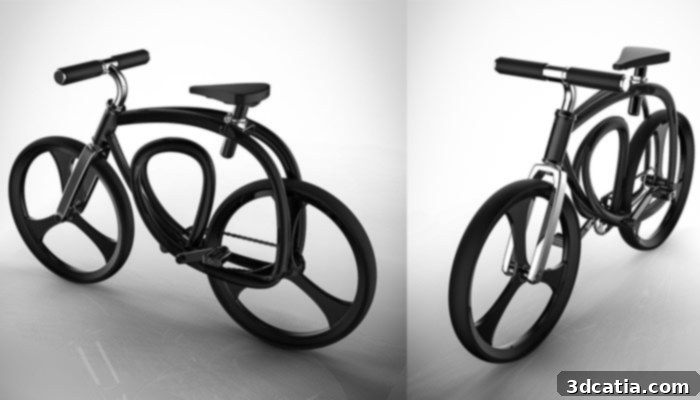
The aesthetic appeal of Steve Jenkins’ Continuous Loop Bike is undeniable, characterized by its seamless, flowing lines that challenge conventional bicycle frame architecture. This design isn’t just about visual novelty; it embodies a sophisticated blend of form and highly optimized function. Jenkins envisioned utilizing 3D technologies specifically to realize this unique style, expressing his desire for a futuristic aesthetic that communicates both innovation and performance. While he hasn’t explicitly detailed the preferred 3D printing technology or the precise materials, the underlying principles point towards a manufacturing process capable of producing complex, organic shapes with exceptional precision and material efficiency.
A critical benefit of additive manufacturing for such a design is its profound impact on the bicycle’s final weight. Jenkins emphatically mentions that 3D printing will significantly reduce the bicycle’s mass, a crucial factor in cycling performance, while simultaneously contributing to its avant-garde, future-oriented aesthetic. This remarkable weight reduction is often achieved through topological optimization, an advanced algorithmic design process. Topological optimization software analyzes the forces and stresses acting on a component and then removes material from areas that are not critical to structural integrity, leaving only the optimal load-bearing structure. This results in incredibly lightweight yet strong parts, mimicking natural structures like bones, which are hollow yet immensely robust. This technique is routinely employed in high-performance sectors such as the aerospace and automotive industries to enhance the efficiency and performance of vehicles; thus, its application in advanced bicycle design is a logical and powerful progression.
Considering the emphasis on strength and lightness, the choice of materials is paramount. While Steve Jenkins didn’t specify, the natural question arises: why not leverage advanced composites like carbon fiber, known for being as strong as steel but considerably lighter? 3D printing with carbon fiber composites, or even advanced engineering plastics reinforced with continuous fibers, presents an exciting avenue. Furthermore, high-performance metal alloys like titanium or aluminum, processed via technologies such as Selective Laser Melting (SLM) or Electron Beam Melting (EBM), could also be viable options for producing critical, high-stress components of the frame. These materials offer exceptional strength-to-weight ratios and fatigue resistance, essential characteristics for a durable and responsive bicycle. The ability of additive manufacturing to work with such a diverse range of advanced materials, combined with geometric optimization, positions it as the ideal technology for bringing a vision like The Continuous Loop Bike to fruition.
Beyond the Frame: The Broader Impact of Additive Manufacturing on Cycling
The Continuous Loop Bike is more than just an inspiring concept; it signifies a broader paradigm shift in the cycling industry enabled by additive manufacturing. One of the most transformative aspects is the unparalleled degree of customization it allows. Traditional bicycle manufacturing involves standardized frame sizes, often leading to compromises in fit for many riders. With 3D printing, it becomes feasible to produce bespoke bike frames and components tailored precisely to an individual rider’s unique biomechanics, body dimensions, and riding style. Imagine a saddle perfectly molded to your anatomy, handlebars ergonomically designed for your grip, or a frame optimized for your power output – all made possible by scanning technologies combined with 3D printing. This level of personalization can significantly enhance comfort, efficiency, and injury prevention, elevating the riding experience to an entirely new level.
Moreover, additive manufacturing accelerates the design and development cycle through rapid prototyping. Designers and engineers can quickly iterate on designs, printing multiple versions of a component or a scaled-down frame to test aerodynamics, structural integrity, and ergonomic considerations. This iterative process, which might take weeks or months with traditional manufacturing, can be compressed into days, leading to faster innovation and bringing advanced products to market more swiftly. For companies, this means reduced development costs and the ability to stay ahead in a competitive industry.
Beyond frames, virtually every component of a bicycle stands to benefit from 3D printing. This includes pedals, cranks, suspension parts, gear components, and even intricate accessories like bottle cages or integrated lighting systems. The design freedom allows for the creation of internal lattice structures, further reducing weight while maintaining or even increasing strength. Consider complex shock absorbers with optimized internal channels for fluid flow, or aerodynamic handlebar extensions custom-fitted to a rider’s forearms – these are the kinds of innovations that become commercially viable through 3D printing applications.
Furthermore, additive manufacturing offers compelling advantages in terms of supply chain and sustainability. It enables on-demand production, reducing the need for large inventories and minimizing waste. Localized manufacturing becomes a real possibility, decreasing transportation costs and carbon footprint. When parts can be printed only when needed, in the quantities required, it fosters a more agile and environmentally responsible manufacturing ecosystem. This potential for sustainable and efficient production makes 3D printing a crucial technology for the future of the cycling industry and beyond.
The Road Ahead for 3D Printed Bicycles
While the concept of a fully 3D printed futuristic bicycle like The Continuous Loop Bike still embodies an element of forward-thinking vision, the underlying technologies are rapidly maturing. Challenges such as the cost of industrial 3D printers, the speed of production for large components, and the qualification of novel materials are continually being addressed by advancements in the field. As these technologies become more accessible, faster, and capable of processing an even wider array of high-performance materials, we can anticipate seeing more of these revolutionary designs transition from conceptual renderings to tangible products available to consumers. The potential for lighter, stronger, more aerodynamic, and perfectly customized bicycles is not just a distant dream but a rapidly approaching reality.
Projects like Steve Jenkins’ “The Continuous Loop Bike” are invaluable as they ignite the imagination and showcase the immense capabilities of additive manufacturing technologies. They inspire us to envision a future where bicycles are not merely modes of transport or sporting equipment, but masterpieces of engineering and art, perfectly harmonized with the rider and the environment. We eagerly anticipate the day when this unique design, and others born from similar innovative spirit, grace our roads and trails, offering an unparalleled riding experience.
What are your thoughts on this futuristic 3D printed bicycle design and the transformative power of additive manufacturing in the cycling world? We invite you to share your perspective in a comment below or join the conversation on our Facebook and Twitter pages! Don’t miss out on the latest advancements and groundbreaking innovations in the world of 3D printing; make sure to sign up for our free weekly Newsletter, delivering all the essential news straight to your inbox!