
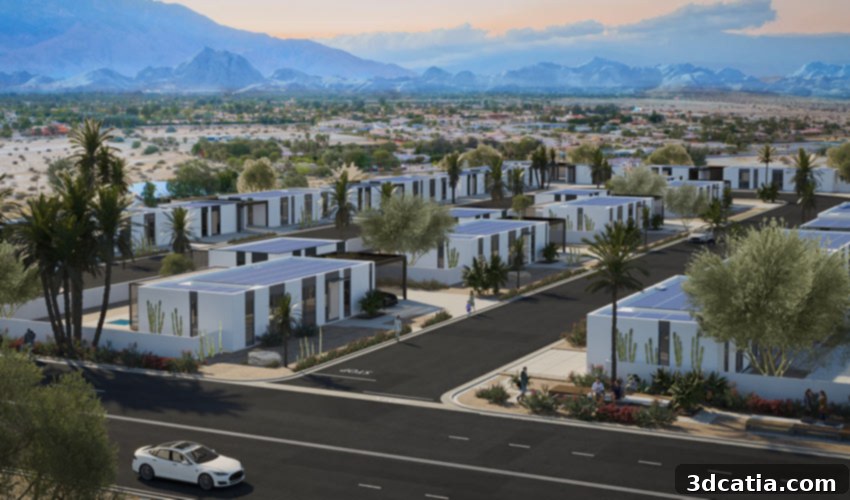
Revolutionizing Real Estate: Mighty Buildings & Palari Group Unveil World’s First 3D-Printed Zero-Net Energy Home Community in Rancho Mirage
The landscape of residential construction is undergoing a significant transformation, driven by innovations in additive manufacturing. At the forefront of this evolution are companies like Mighty Buildings, a pioneer in constructing and delivering residences using advanced concrete 3D printing technologies. Recently, the company announced a monumental partnership with Palari Group, a distinguished developer specializing in sustainable real estate. This collaboration marks a pivotal moment, as they embark on building the world’s inaugural community of 3D-printed zero-net energy homes. This ambitious project is set in the luxurious city of Rancho Mirage, nestled within California’s picturesque Coachella Valley, and has already garnered substantial attention, reportedly attracting over $70 million in investments since its announcement. Such a venture unequivocally demonstrates the immense potential of additive manufacturing in the construction industry, promising to fundamentally redefine conventional concrete fabrication methods.
This pioneering initiative, spearheaded by Mighty Buildings and Palari Group, envisions the development of a unique community comprising 15 state-of-the-art homes, all fabricated with the precision and efficiency of 3D printing. Each of these exclusive residences will span a spacious 1,450 square feet (approximately 134 square meters), meticulously designed to include three comfortable bedrooms, two modern bathrooms, a private terrace perfect for relaxation, and a refreshing swimming pool. The starting price for these innovative homes is set at $595,000, offering a gateway into sustainable luxury. For those seeking even more space or a multi-generational living solution, interested buyers have the option to add a second, smaller residence on the same expansive 10,000 square foot lot. This additional dwelling unit, measuring 700 square feet (about 65 square meters), features two extra bedrooms and another bathroom, elevating the potential total investment to $950,000 for a fully upgraded, two-home configuration. The project aims to commence construction activities in September, with an anticipated completion by the spring of 2022, showcasing an accelerated timeline compared to traditional building processes. This innovative approach to housing is increasingly viewed by many as “the future of housing,” not merely due to its profound implications for environmental sustainability but also as a viable and rapid solution to global housing crises.
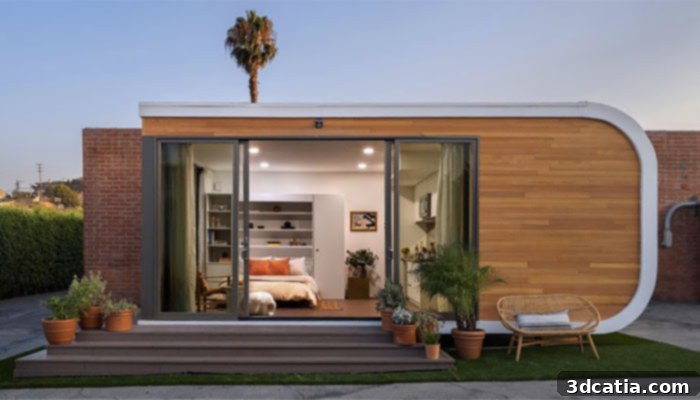
Photo Credits: Mighty Buildings
The Dawn of Sustainable 3D-Printed Housing: A New Paradigm for Eco-Friendly Living
The chosen locale for this groundbreaking development, Rancho Mirage, is strategically positioned in the heart of the Coachella Valley, renowned for its serene desert landscapes and close proximity to the vibrant city of Palm Springs. Palari Group’s vision involves transforming a 5-acre parcel into a fully integrated, eco-friendly community that sets new benchmarks for sustainable living. The structural components of these innovative 3D-printed homes will be fabricated using a proprietary stone composite material. Basil Starr, CEO of Palari Group, emphasizes the superior qualities of this extruded concrete, highlighting its exceptional resistance to fire, water, and termites—attributes that significantly enhance the durability and longevity of the homes. The construction process itself is remarkably efficient, involving the assembly of a series of pre-fabricated interior and exterior walls, much like piecing together Lego blocks, which streamlines the on-site build time and reduces labor requirements. Furthermore, every component and material that cannot be manufactured through 3D printing is rigorously sourced for its sustainability credentials, ensuring a minimal environmental footprint across the entire supply chain.
Beyond the structural integrity and eco-conscious material selection, homeowners in this pioneering community will have the unique opportunity to equip their residences with cutting-edge sustainable technologies. Each home is designed to integrate seamlessly with additional devices such as Tesla Powerwall home batteries, ensuring reliable energy storage and enhanced energy independence. A cornerstone of the “zero-net energy” designation is the comprehensive installation of solar panels, engineered to supply 100% of all energy needs for the entire residence. This commitment extends to electric vehicle chargers, promoting sustainable transportation options for residents. The overarching goal is to create housing that exquisitely integrates advanced technology with unparalleled sustainability. This ethos begins with the 3D-printing production process itself, which remarkably eliminates approximately 99% of construction waste—a drastic reduction compared to traditional building methods. The culmination of these integrated strategies will result in homes that produce as much energy as they consume, representing a critical and transformative step forward in the journey towards truly sustainable construction practices and a greener future for urban development.
The Transformative Power of Additive Manufacturing in Modern Construction
Basil Starr eloquently articulates the paramount importance of 3D printing for this ambitious project, stating, “3D printing allows us to build faster, stronger and more efficiently, making it integral to our platform of streamlining home-building process centered on sustainability of construction, materials, and operations.” This statement encapsulates the core advantages that additive manufacturing brings to the fore. The inherent automation and precision of 3D printing significantly accelerate construction timelines, drastically reducing the labor-intensive stages typically associated with traditional building. Moreover, the ability to deposit material layer by layer with meticulous accuracy creates incredibly strong and durable structures, often exceeding the structural integrity of conventional builds. This efficiency not only translates to quicker project completion but also optimizes material usage, minimizing waste and further enhancing the project’s sustainability profile. The streamlined process facilitated by 3D printing is a cornerstone of Palari Group’s commitment to sustainability, ensuring that every aspect, from initial construction to long-term operational impact, adheres to eco-friendly principles.
Beyond the immediate environmental benefits, this advanced 3D printing technology offers a suite of compelling advantages over traditional construction methodologies. One significant benefit is enhanced price stability. By automating much of the construction process and optimizing material consumption, 3D printing mitigates fluctuations in labor costs and material waste, leading to more predictable and often lower overall project expenses. The sheer speed of construction is another revolutionary aspect; entire homes can be printed in a fraction of the time it would take using conventional methods, thereby allowing for quicker market entry and faster occupancy. This rapid deployment capability is particularly critical in addressing urgent housing demands. Furthermore, the technology ensures a consistently high quality of components. Digital designs translate directly into physical structures with unparalleled accuracy and uniformity, minimizing human error and ensuring that every element meets stringent quality standards. These combined benefits position 3D printing not just as an alternative but as a superior method for future housing development, promising to alleviate housing shortages and provide durable, high-quality homes to a wider population.
The broader societal implications of this project are immense. As the world grapples with increasing urbanization and persistent housing crises, 3D-printed homes offer a scalable, efficient, and environmentally responsible solution. The ability to rapidly construct durable and energy-efficient homes can revolutionize disaster recovery efforts, provide affordable housing in underserved communities, and reduce the overall carbon footprint of the construction sector. Projects like the one in Rancho Mirage serve as powerful proof-of-concept, inspiring further innovation and adoption of additive manufacturing across the globe. They demonstrate that luxury, sustainability, and technological advancement can coalesce to create living spaces that are not only desirable but also contribute positively to the planet and its inhabitants.
What are your thoughts on this pioneering zero-net energy 3D-printed community and its potential to shape the future of housing? We invite you to share your insights in a comment below or engage with us on our social media platforms: Facebook, Twitter, and LinkedIn! To stay informed with the very latest advancements and news in the additive manufacturing space, sign up for our free weekly Newsletter here, delivered directly to your inbox!
*Thumbnail photo credits: Mighty Buildings