
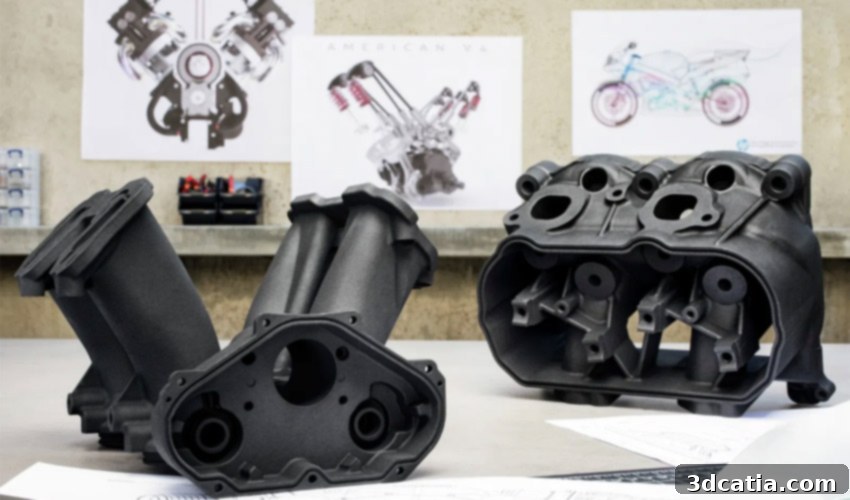
Mastering Design for Additive Manufacturing (DfAM): Optimizing 3D Printing Performance and Efficiency
The landscape of manufacturing is continually transformed by innovation, with additive manufacturing—more commonly known as 3D printing—leading the charge. Fundamentally, designing a component for 3D printing differs significantly from designing for traditional methods like CNC machining, where material is removed. Each manufacturing process has its unique design considerations. In additive manufacturing, specific design rules and specialized tools are essential to create an optimized part, ready for efficient 3D printing. These methods are collectively grouped under the powerful concept of Design for Additive Manufacturing (DfAM).
DfAM was developed to push the boundaries of functional performance for printed parts, while also rigorously addressing cost-efficiency, reliability, and other critical aspects throughout the product lifecycle. By strategically applying DfAM principles, engineers can unlock unprecedented geometric freedom, consolidate complex assemblies, reduce material consumption, and achieve performance metrics unattainable with conventional manufacturing. Today, several advanced techniques fall under the DfAM umbrella, including generative design, topology optimization, and the creation of intricate lattice structures. But with a range of sophisticated methods available, how does one select the most appropriate design strategy to streamline and optimize the entire development process for a 3D printed part? To answer this pivotal question, we consulted three esteemed experts in the field of additive manufacturing for their invaluable insights.
To comprehensively address the complexities and opportunities related to DfAM, we posed a series of questions to our panel of experts: Ravi Kunju, SVP, Strategy and Business Development at Altair; Daniel Pyzak, Director, EMEA CATIA Competency Center at Dassault Systèmes; and Peter Rogers, APAC Product Specialist for Additive Manufacturing at Autodesk. Their collective expertise offers a profound perspective on how DfAM is revolutionizing product design and production.
-

- Ravi Kunju

-
- Daniel Pyzak
-
- Peter Rogers

What Dictates the Choice of DfAM Technique?
DfAM emerged as a necessary discipline due to the unparalleled design freedom and unique capabilities provided by additive manufacturing technologies. Unlike traditional methods like CNC machining, which impose significant geometric constraints, AM allows for the creation of incredibly complex shapes. Peter Rogers from Autodesk articulates this shift: “For additive, the question ‘Can we do that?’ is often answered by a ‘yes’. While it is feasible to do something, it doesn’t mean it should be done that way. Production and manufacturing teams are building out their understanding of the best practices around AM.” This highlights that simply being able to print a design isn’t enough; the goal is to print it optimally and efficiently, transforming mere feasibility into best practice.
Crucially, the chosen design technique(s) within DfAM are intrinsically linked to the specific additive manufacturing technology being employed. Ravi Kunju makes this point explicitly clear: “It is the process that dictates how a part is prepared and how it is finished.” For instance, the design strategies for a component intended for an FDM (Fused Deposition Modeling) 3D printer will be fundamentally different from those for a metal or SLS (Selective Laser Sintering) 3D printer. Each technology imposes its own unique set of constraints related to layer adhesion, material properties, cooling rates, and support structure requirements.
By starting with a deep understanding of the chosen technology, designers can proactively mitigate potential issues, leading to better optimized surface finishes, maximized mechanical properties, and significantly easier post-processing. This foresight directly translates into substantial savings in time, material, and overall production costs. Daniel Pyzak from Dassault Systèmes further emphasizes the nuanced nature of DfAM: “There are a lot of rules to follow during the design stage to get a proper design for 3D printing: these rules depend strongly on the machine (capacity size, type of technology, material, etc.)” This underlines that DfAM is not a generic checklist but a dynamic framework tailored to the specific machine, material, and application.
To illustrate, consider the complexities of metal 3D printing, particularly using Laser Powder Bed Fusion (LPBF) technology. Ravi Kunju explains a crucial design consideration: “For example, in a selective laser melting process to print metal, a support structure is required when printing surfaces that are under 45 degrees. Otherwise the down-facing surface quality can be very poor. Support structures are expensive to print and remove, considering they have to be subtracted from the final part. The best approach is to create designs that have minimal support structures. One must add a constraint to ensure that the structure that is generated has surfaces well over the 45-degree angle from the horizontal.” This specific example underscores a core DfAM principle: design to minimize support material. This not only reduces print time and material waste but also significantly cuts down on post-processing labor and costs. The strategic orientation of the part during the design phase can also dramatically impact support requirements and print success, a critical aspect of DfAM applicable across many 3D printing technologies.
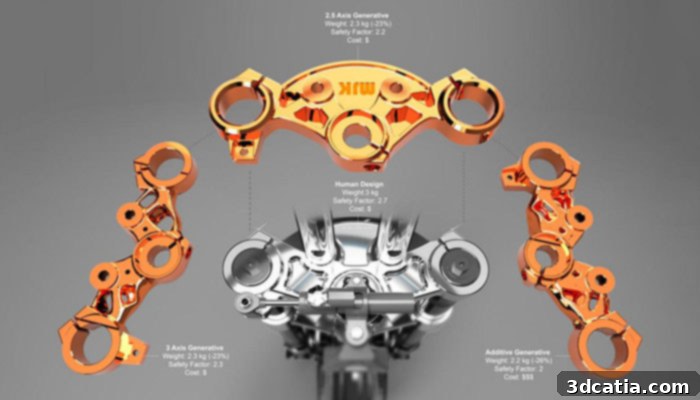
Peter Rogers explains that an exciting new technology can compare the results if using 3D printing, 2.5, 3, 5-axis machining, and other manufacturing methods to determine which parts are suitable for AM | Credits: Autodesk
Key Design for Additive Manufacturing Techniques for Enhanced Functionality
A fundamental aspect of DfAM is its capacity to inject advanced functionality into parts that were previously constrained by traditional manufacturing limitations. Understanding a part’s ultimate purpose and its operational environment is paramount when deciding which design technique(s) to implement. In essence, DfAM goes beyond mere manufacturability; it’s about strategically adding value and unlocking new capabilities. Peter Rogers illuminates this functional emphasis: “For example, there is a strong focus on generative design and topology optimization for aviation and aerospace mission-critical parts, which in part stems from the requirement to be able to do easy crack inspections. With lattices, the internal sections cannot be easily inspected, which would mean that the ongoing disadvantages would outweigh the benefits. However, in medical devices, the shape is relatively set in place, and lattices are more functional for osseointegration, so most DfAM is done using latticing.” This insight clearly demonstrates that the choice of DfAM technique is often dictated by specific industry standards, regulatory requirements, and the precise functional role of the component.
Generative Design and Topology Optimization
Generative design and topology optimization are often mentioned in the same breath, reflecting their complementary nature and significant impact within DfAM. Daniel Pyzak succinctly describes their broader application: “They are design technologies for lightweight engineering serving multiple manufacturing processes: milling, casting, and additive manufacturing.” While these techniques can benefit various manufacturing methods, it is with additive manufacturing that their full transformative power is truly realized, thanks to AM’s ability to produce highly complex, organic geometries.
Generative design represents a cutting-edge computational approach where engineers define their design objectives—such as weight targets, structural performance, material choices, and manufacturing constraints. The software then leverages advanced algorithms, often incorporating artificial intelligence and machine learning, to autonomously generate and explore thousands, or even millions, of design variations. This iterative process helps designers discover innovative solutions that are optimized for specific performance criteria, often leading to lighter, stronger, and more efficient parts than could be achieved through traditional human-led design. It allows for a vast exploration of the design space, identifying optimal configurations that might otherwise be overlooked.
Topology optimization, a well-established subset of generative design, focuses specifically on optimizing the distribution of material within a predefined design space. Given a set of load conditions and constraints, the software intelligently removes material from areas that contribute minimally to structural integrity, resulting in highly efficient, organic shapes that are perfectly tailored to stress paths. The resulting geometries from topology optimization are frequently so intricate and non-uniform that they are virtually impossible to manufacture using conventional subtractive or formative processes. This makes additive manufacturing the ideal, and often the only, method capable of realizing these optimized designs, thereby unlocking significant benefits in terms of weight reduction, material efficiency, and performance in critical applications across aerospace, automotive, and medical sectors.
However, Ravi Kunju introduces a crucial caveat: indiscriminately altering designs and exploring an infinite number of variations can be prohibitively expensive, time-consuming, and may even lead to sub-optimal outcomes. “If there are too many constraints, one may never arrive at an optimal solution. There are many numerical techniques and methods available to drive the designs, such as DOE (design of experiments), stochastic methods, genetic algorithms, neural networks etc., all of which have their strengths and weaknesses and can be classified as design study and synthesis (DSS).” This emphasizes the importance of a guided and intelligent approach, leveraging advanced analytical tools and computational methods to efficiently navigate the design space and converge on truly optimal solutions.
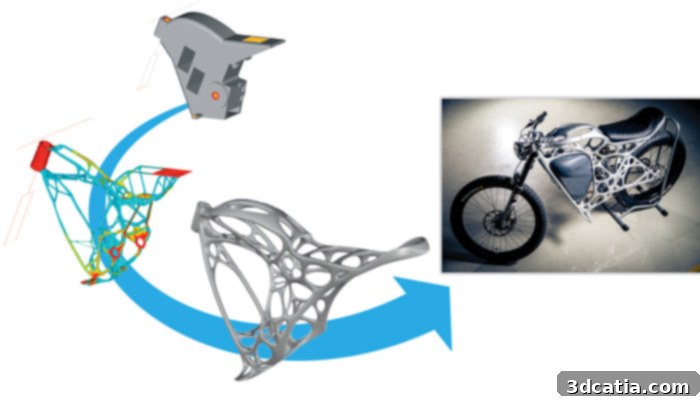
Thanks to Altair’s software solutions, AP Works (an Airbus subsidiary) designed a 3D printed frame for its motorcycle. With topology optimization, they were able to reduce the final weight of the part by 30% | Credits: Altair
Lattice Structures: A Game-Changer in DfAM
Beyond topology optimization, our experts underscored the concept of lattice structures as another exceptionally potent form of DfAM optimization. Lattices are characterized by intricate networks of interconnected beams or unit cells, often resembling natural cellular structures like honeycomb or bone. The primary objective of employing latticing is to drastically reduce a part’s weight while simultaneously maintaining, or even significantly enhancing, its structural integrity and specific mechanical properties. This is achieved by strategically placing material in load-bearing regions and removing it from non-critical areas, creating a lightweight yet robust internal architecture.
The fabrication of such complex, internal geometries is exceedingly challenging, if not entirely unfeasible, with traditional manufacturing techniques. However, additive manufacturing excels at building these highly customized and intricate internal structures with precision. The benefits of lattice designs are extensive: they offer an optimal strength-to-weight ratio, superior energy absorption and impact protection (making them ideal for protective gear or automotive crash zones), improved thermal management due to increased surface area for heat dissipation, and even custom porosity for specialized applications such as medical implants where controlled ingrowth (osseointegration) is desired. For example, in performance cycling or aerospace components, the shock absorption capabilities and lightweight nature of lattice structures can lead to significantly improved performance, safety, and fuel efficiency. The ability to precisely control the unit cell type, size, and density of these structures empowers designers to tailor performance characteristics to an unprecedented degree, opening up entirely new frontiers in product innovation.
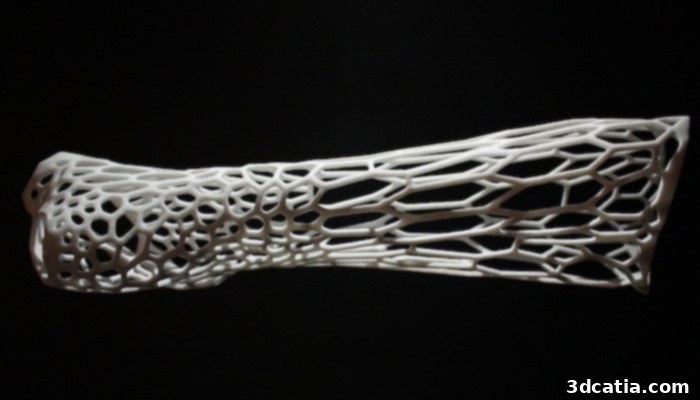
Example of a lattice structure designed using Dassault Systèmes’ CATIA software | Credits: Dassault Systèmes
The Impact of DfAM Techniques on Post-Processing Efficiency
For a significant number of 3D printing users, post-processing stands out as one of the most substantial bottlenecks in the entire additive manufacturing workflow. It can be a highly labor-intensive, time-consuming, and often technically challenging stage, which adds considerable cost and extends the lead time for the final product. This inherent difficulty is precisely why a core principle of DfAM is to strategically minimize these post-processing steps as much as possible, ideally by making informed design choices from the very earliest stages of development. Thoughtful design decisions made upfront can dramatically reduce, or even eliminate, the need for extensive and costly post-build operations.
Ravi Kunju delineates three primary categories of post-treatment commonly applied to 3D printed parts: thermal, mechanical, and thermo-mechanical. “Thermal post-processing relieves the part of residual stresses and, in some cases, alters the grain structure. Mechanical post-processing removes the support structure, and finish/drill/mill holes etc. Thermo-mechanical post-processing could be like hot iso-static pressing (HIP).” Each of these steps contributes to the overall manufacturing cost and time, thereby emphasizing the critical importance of designing for minimal intervention. The more a part can be optimized in design to reduce these steps, the more economically viable and efficient the additive manufacturing process becomes.
A primary target for reduction in post-processing is the removal of support structures, which is particularly challenging and costly in metal additive manufacturing. Daniel Pyzak strongly advocates for significantly reducing the quantity of 3D printing supports, or even eradicating them entirely, through ingenious design. He suggests an advanced approach: “Another way is to integrate these supports (this is the job of the designer, not that of the machine operator) into the design of the part itself. Here, no need to remove them! Today, there are very few parts being designed in this way, but it’s definitely a promising idea.” This forward-thinking concept, where supports become functional, integral elements of the final component, represents a pinnacle of DfAM. It demands a transformative shift in design philosophy but promises substantial benefits by eliminating the labor-intensive, material-wasting, and often damage-prone process of support removal. Furthermore, optimizing the part’s orientation on the build plate during the design phase is another crucial DfAM strategy that can drastically minimize the need for support material and improve overall print quality.
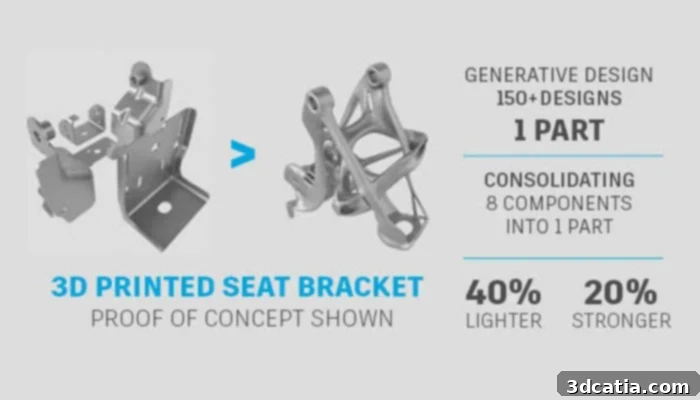
Another example of the results of generative design, consolidating 8 components into 1 part | Credits: Autodesk
Conclusion: Integrating DfAM for Future Success in Additive Manufacturing
The widespread adoption and sophisticated application of Design for Additive Manufacturing principles are absolutely critical for the future success and industrial scalability of additive manufacturing. As Peter Rogers aptly concludes: “Bringing in the AM knowledge as early into the initial design process as possible will be the key to best leveraging the hardware. In large organizations that can be difficult, so putting together a working group with people of various backgrounds can help to find new, innovative ways to improve parts and turn what was originally implemented as “thought leadership” technology into an irreplaceable production technology.” This holistic approach, which integrates deep manufacturing knowledge with design capabilities from the very outset, is fundamental for transitioning additive manufacturing from a specialized prototyping tool to a robust, indispensable production method for mainstream applications.
By fully embracing DfAM, industries can move beyond merely replicating existing designs using 3D printing and instead create truly optimized, high-performance parts that fully exploit the inherent and unique advantages of additive manufacturing. This paradigm shift not only leads to the development of lighter, stronger, and more functional components but also significantly drives down production costs, accelerates time-to-market, and fosters a culture of rapid innovation. The journey towards pervasive DfAM adoption involves continuous learning, fostering strong collaboration between design and production teams, and the strategic deployment of advanced software tools that empower designers to continually push the boundaries of what is technologically and functionally possible with 3D printing.
*Cover Picture Credits: HP/Motus
We trust that this expert advice has provided valuable insights into the critical role of Design for Additive Manufacturing in optimizing your 3D printing projects. Share your thoughts, questions, and experiences in the comments section below or connect with us on our Facebook and Twitter pages! Don’t forget to subscribe to our free weekly Newsletter to receive all the latest news and developments about 3D printing directly in your inbox, ensuring you stay informed in this dynamic and rapidly evolving field!