
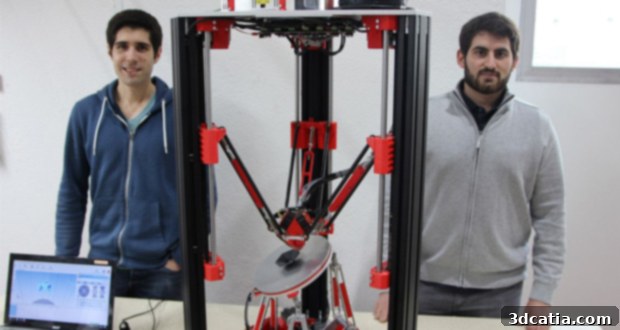
Unlocking New Dimensions: Pioneering Support-Free 3D Printing with the Innovative 6-Axis System
Last week, the world of additive manufacturing was captivated by the revelation of a truly groundbreaking 6-axis 3D printer, a revolutionary creation meticulously engineered by two brilliant Swiss students from the esteemed University of Applied Sciences in Zurich. This innovative machine promised to redefine the landscape of Fused Deposition Modeling (FDM) by enabling printing without the perennial need for cumbersome support structures. Intrigued by the ambitious scope of this project and eager to delve deeper into its underlying principles and future potential, we at 3Dnatives sought an exclusive interview. We were fortunate to sit down with Oliver Tolar and Denis Herrmann, the visionary masterminds whose ingenuity brought this cutting-edge technology to life. Our conversation aimed to uncover their journey, the challenges they overcame, and the profound implications of their novel approach to 3D printing.
3DN: How did you discover 3D printing and what motivated you to innovate?

Oliver Tolar
Our initial foray into the fascinating world of 3D printing began during our systems-engineering course at the University of Applied Sciences in Zurich. It was a hands-on experience, requiring us to operate various 3D printers and produce different functional components. While the process itself was exciting, we quickly encountered numerous frustrations with the limitations of the available machines. We often found the results unsatisfactory, plagued by issues such as poor surface finish, warping, and the complexities introduced by support structures. This recurring dissatisfaction ignited a shared ambition within us. Rather than simply accepting these limitations, we envisioned a better way.
During the third year of our degree program, fueled by our passion for engineering and a desire to overcome these hurdles, we embarked on an ambitious journey with the invaluable guidance of one of our dedicated teachers. Our goal was not just to operate an existing printer, but to design and develop our very own 3D printer from scratch. This custom-built machine was engineered to be more versatile and robust, capable of processing a wider array of materials, including common thermoplastics like PLA and ABS, as well as more flexible options such as TPE. This early project proved incredibly successful and transformative. Today, this very first printer we developed continues to be an integral part of the Institution of Mechatronics Systems in Zurich, where both of us now work part-time. Our involvement extends to utilizing this machine for printing critical prototypes for the institution’s R&D department, consistently pushing the boundaries of what is achievable in rapid prototyping and material experimentation.
3DN: What was the core idea and driving force behind developing a 6-axis 3D printer?

Denis Herrmann
Our fundamental objective was to transcend the conventional boundaries of Fused Deposition Modeling (FDM) technology. While FDM has matured significantly and is now a widely adopted and well-understood additive manufacturing process, its inherent limitations, particularly concerning geometric complexity and the necessity of support structures, remained a persistent challenge. Traditional FDM printers typically operate on three axes (X, Y, Z), depositing material layer by layer on a fixed print bed. This method necessitates the use of sacrificial support material for any features that overhang beyond a certain angle, or for enclosed cavities.
The requirement for support structures, while essential for printing complex geometries with conventional FDM, introduces several significant drawbacks. Firstly, it leads to increased material consumption, adding to operational costs and waste. Secondly, the printing process becomes longer as the machine must deposit both the primary model material and the support material. More critically, the removal of these supports often leaves undesirable traces, blemishes, or rough surfaces on the finished object, compromising its aesthetic appeal and functional precision. For professional-grade machines, water-soluble support materials exist, which can be dissolved relatively cleanly, but this still represents an additional step, consumes water and chemicals, and contributes to overall production time. However, for personal or entry-level 3D printers, removing support material is typically a manual, labor-intensive, and often destructive process, frequently resulting in damaged parts or an unsatisfactory surface finish. This post-processing adds an extra layer of complexity and expense that many users, particularly individuals or small businesses, would prefer to avoid.
Recognizing these pervasive problems, our vision for the 6-axis 3D printer was born. Instead of designing geometries to merely accommodate the limitations of a 3-axis system and subsequently requiring supports, we aimed to fundamentally alter the printing process itself. The core innovation lies in the printer’s ability to manipulate the print bed or the print head with additional degrees of freedom – specifically, three rotational axes in addition to the standard three linear axes. This allows the printer to dynamically reorient the object being printed in real-time. By continuously adjusting the print angle, we can strategically avoid overhangs that would traditionally necessitate supports. This ‘support-free’ approach dramatically simplifies the printing workflow, reduces material waste, eliminates post-processing steps related to support removal, and ultimately yields parts with superior surface quality and enhanced geometric accuracy directly from the printer. It truly offers a paradigm shift in how designs are approached for FDM, granting unprecedented design freedom and pushing the boundaries of what is conventionally printable.
3DN: In which sectors do you foresee your 6-axis 3D printer making the most significant impact?
Currently, our innovative 6-axis printer is in its developmental stages and is not yet widely commercialized. However, its immediate and most impactful application lies firmly within the realm of research and development (R&D) and rapid prototyping. For R&D-oriented purposes, where engineers and designers are constantly iterating on complex designs, the ability to print intricate geometries without support structures is an immense advantage. It accelerates the design cycle, reduces material waste during prototyping, and provides engineers with cleaner, more accurate physical models that closely resemble the final product, without the need for time-consuming and often messy post-processing.
Beyond R&D, we believe that printers featuring a dynamically tiltable tray or additional axes hold substantial promise for individual users, small businesses, and educational institutions. Imagine hobbyists creating intricate figures with perfect finishes, or small design studios rapidly producing functional prototypes that are production-ready straight off the print bed. This technology has the potential to democratize advanced manufacturing, making high-quality, complex part production accessible to a broader audience. However, to achieve this widespread adoption, significant acceleration in the development of our machine is imperative, particularly on the software front.
The current state of traditional slicing software, designed for conventional 3-axis printers, can only be leveraged up to a very limited extent for a multi-axis system. A 6-axis printer requires a sophisticated and entirely new generation of software capable of intelligently interpreting complex CAD models, generating multi-axis toolpaths, and dynamically adjusting print orientations in real-time. This bespoke software must seamlessly transmit precise data to control the expanded mechanical degrees of freedom, ensuring impeccable calibration and coordinated movement of all axes. Developing such an intelligent software ecosystem, one that is user-friendly yet robust enough to handle the intricacies of 6-axis motion, represents a significant undertaking. The challenge also includes creating intuitive user interfaces that allow designers to harness the full potential of multi-axis printing without requiring extensive specialized knowledge. Once these software hurdles are overcome, and the mechanics are perfectly calibrated for seamless operation, our 6-axis 3D printer could revolutionize fields demanding high-performance, lightweight components with complex internal structures, such as aerospace, medical device manufacturing, and custom consumer product design, where geometric freedom directly translates to functional improvement and cost efficiency.
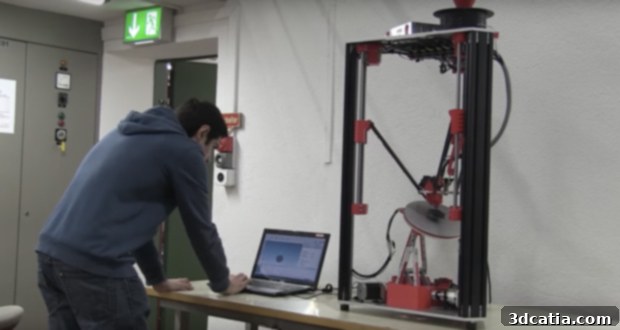
The 6-axis 3D printer in operation
3DN: What are the immediate next steps for your project, and how do you envision its future evolution?
The entire 6-axis printer project originated as an integral part of our university thesis, serving as the culmination of our academic journey. It was a comprehensive undertaking, encompassing both the meticulous development and construction of the advanced mechanical systems on one side, and the intricate evolution of the specialized software required to control its multi-axis functionality on the other. This fusion of hardware and software innovation was the bedrock of our final project.
As of today, we don’t have a definitive roadmap with commercialization or independent venture stages clearly outlined. The project’s genesis and development were deeply rooted within the academic framework of the University of Applied Sciences in Zurich. Therefore, any further advancements, refinements, or significant expansions of this technology will most likely continue to take the form of university projects. This means that future developments would typically be integrated into ongoing research initiatives at the institute, potentially involving new cohorts of students and researchers. This collaborative, academic environment provides a fertile ground for continued exploration, allowing for deeper dives into areas such as optimizing slicing algorithms for even more complex geometries, experimenting with novel materials specifically suited for multi-axis FDM, or enhancing the robustness and user-friendliness of the control software. While the immediate future sees the project evolving within academic boundaries, the foundational work we have laid undoubtedly paves the way for potential future commercial applications, should the right opportunities and resources emerge. The exploration of its full capabilities and the broader impact it can have on additive manufacturing remains an exciting prospect within the research community.
The innovation brought forth by Oliver Tolar and Denis Herrmann marks a significant leap in additive manufacturing, promising cleaner prints and greater design freedom. Do you believe that the 6-axis 3D printer technology holds the key to widespread support-free additive manufacturing in the near future? Share your thoughts in a comment below!