
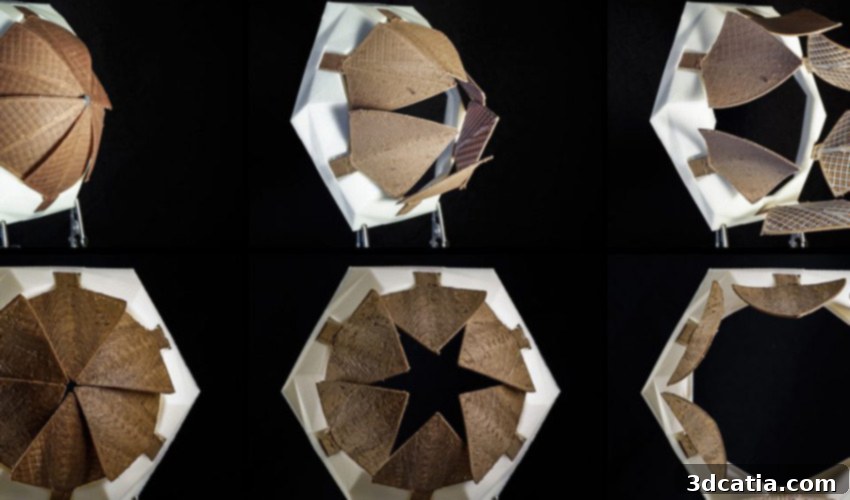
The Transformative Power of 4D Printing: Self-Adapting Metamaterials Revolutionizing Industries
Emerging as a groundbreaking evolution of additive manufacturing, 4D printing represents a paradigm shift from static, pre-defined objects to dynamic, self-transforming structures. While fundamentally similar to 3D printing in its layer-by-layer fabrication process, 4D printing introduces a crucial fourth dimension: time. This innovative technology allows printed objects to change their shape, properties, or function autonomously over a predefined period or when exposed to specific external stimuli. Unlike traditional 3D printed items, which remain fixed once created, 4D printed objects are crafted from “smart” materials engineered to react to environmental factors such as heat, light, water, pH changes, magnetic fields, or other forms of energy. This inherent programmability unlocks a vast array of possibilities, extending the utility and lifespan of manufactured components far beyond their initial state.
The allure of 4D printing lies in its capacity to create objects that are not merely shaped but are inherently intelligent and adaptive. Imagine structures that can self-assemble, repair themselves, or even respond to their environment to optimize performance. This technology moves beyond simple fabrication to enable active, responsive systems that can adapt to changing conditions without human intervention. The smart materials at the heart of 4D printing are carefully selected or synthesized to exhibit specific physical or chemical responses, allowing engineers to program their desired transformations. This sophisticated interplay between material science, design, and manufacturing processes positions 4D printing as a frontier technology with immense potential to reshape various industries, from aerospace and biomedicine to consumer goods and infrastructure.
Groundbreaking Metamaterials Paving the Way for Adaptive Technologies
Pioneering research at Rutgers University-New Brunswick in New Jersey has brought the promise of 4D printing significantly closer to reality. A team of engineers has successfully developed flexible, lightweight 4D printed metamaterials that exhibit unprecedented properties and adaptability. These innovative materials hold immense potential for a diverse range of applications, including the creation of adaptive airplane or drone wings that can optimize their shape during flight, soft robotics capable of interacting delicately with their surroundings, and tiny, implantable biomedical devices designed for minimally invasive procedures. Dr. How Lee, an assistant professor spearheading this project, eloquently describes time as the critical fourth dimension, enabling these objects to morph into new configurations. He emphasizes the profound implications of this work, stating, “We believe this unprecedented interplay of materials science, mechanics and 3D printing will create a new pathway to a wide range of exciting applications that will improve technology, health, safety and quality of life.” This sentiment encapsulates the revolutionary nature of 4D printing, highlighting its capacity to transcend traditional manufacturing limitations and deliver truly intelligent products.
One of the most significant advancements demonstrated by the Rutgers researchers is the development of metamaterials that defy the conventional limitations of fixed properties. Unlike many traditional materials that are rigid and unable to adjust to dynamic conditions, these newly engineered metamaterials are inherently dynamic and programmable. Their key characteristics include being geometrically reconfigurable, functionally deployable, and mechanically tunable. This means they can be precisely engineered to change their physical shape, activate specific functions, and adjust their mechanical stiffness or flexibility on demand. The creation of these remarkable materials was achieved through advanced digital micro 3D printing techniques, utilizing a sophisticated shape memory polymer. Shape memory polymers are a class of smart materials that can be programmed to remember a permanent shape and then temporarily deform into another shape, only to return to their original configuration when triggered by a specific stimulus, such as heat.
Versatile Applications Across Diverse Sectors
The versatility and programmability of these 4D printed metamaterials open up a vast spectrum of applications. Researchers at Rutgers have demonstrated an impressive ability to adjust the stiffness of these materials by more than 100-fold across a temperature range of 23ºC (73ºF) to 90ºC (194ºF). This extraordinary level of control over mechanical properties has significant implications for precise shock absorption and vibration damping, allowing structures to adapt their rigidity based on environmental needs. Furthermore, as previously highlighted, these materials possess the remarkable ability to be reshaped in numerous ways for a wide array of functional purposes. Crucially, once transformed into a specific deformed shape, they retain the capacity to revert to their original, pre-programmed configuration simply by applying heat. This reversible shape-memory effect is fundamental to many of their envisioned applications.
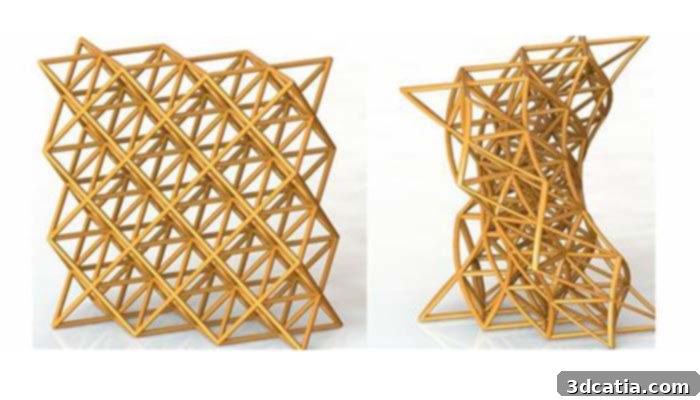
In the realm of applications, the potential impact of these smart metamaterials is truly transformative. One of the most compelling uses lies within the aerospace industry, where the materials could be integrated into airplane or drone wings. Imagine wings that can dynamically change their aerodynamic profile during different phases of flight – morphing for optimal lift during takeoff and landing, then streamlining for maximum fuel efficiency at cruising altitudes. This adaptability could lead to significant improvements in performance, fuel economy, and overall flight control, potentially reducing noise pollution and increasing safety. Such active morphing structures represent a leap forward from traditional fixed-wing designs, offering unprecedented flexibility in aircraft design and operation.
Beyond Earth’s atmosphere, 4D printing offers revolutionary solutions for space exploration. The materials could be used to create lightweight structures that are collapsed into incredibly compact forms for efficient and cost-effective space launches. Once in space, these structures could then self-deploy and reform into their intended large-scale configurations, such as vast solar panels or communication antennas. This capability drastically reduces the volume and mass required for payload fairings, leading to substantial savings in launch costs and enabling the deployment of larger, more complex systems in orbit or on other celestial bodies. The concept could even extend to self-assembling habitats or repair components, further enhancing the longevity and capability of space missions.
Perhaps one of the most impactful applications is within the biomedical field. Tiny devices, whether inserted or implanted into the human body for diagnosis or treatment, could be temporarily made soft and flexible. This temporary softening would allow for minimally invasive and significantly less painful insertion into the body, dramatically improving patient comfort and reducing recovery times. For example, catheters could be rigid for precise navigation and then soften once in place, or implants could be delivered in a compact form and then expand to their full functional size within the body. This approach could revolutionize drug delivery systems, surgical tools, and a wide array of prosthetics and medical implants, leading to safer, more effective, and more patient-friendly healthcare solutions. The ability to precisely control the mechanical properties of these devices within the biological environment opens up entirely new avenues for therapeutic interventions.
Furthermore, the implications for soft robotics are profound. 4D printed components can be designed to mimic biological muscles, allowing for the creation of robots that move with unprecedented fluidity and dexterity. These robots could be used in delicate handling tasks, exploration of confined spaces, or even as wearable assistive devices that conform perfectly to the human body. The inherent adaptability of 4D printed soft robots enables them to interact safely and effectively with fragile objects and uncertain environments, offering a stark contrast to rigid, traditional robotic systems.
The pioneering research, detailed in the paper titled “4D printing reconfigurable, deployable and mechanically tunable metamaterials,” was prominently featured in the esteemed Materials Horizons journal. This publication underscores the scientific community’s recognition of the significant breakthrough achieved by the Rutgers team and its potential to shape the future of smart materials and manufacturing. The findings lay a robust foundation for future research and development, inviting further exploration into the vast possibilities that 4D printing and programmable metamaterials present.
What are your thoughts on this latest cutting-edge research in 4D printing and smart metamaterials? How do you envision these self-adapting technologies impacting our daily lives or specific industries? Share your insights and opinions with us in the comment section below, or join the conversation on our Facebook and Twitter pages! Don’t miss out on the most recent advancements and breakthroughs in additive manufacturing; sign up for our free weekly Newsletter to receive all the latest news in 3D printing directly in your inbox!