
Exploring the Cutting Edge: Top 5 3D Printing Innovations Shaping Our Future
Welcome to our weekly dive into the fascinating world of 3D printing! This week, we’ve curated a selection of the top 5 videos that vividly showcase how additive manufacturing is not just changing, but fundamentally transforming production across numerous sectors. From the intricate demands of medical applications to the robust requirements of the automotive industry, this revolutionary technology is breaking new ground and pushing the boundaries of what’s possible. Our hand-picked videos offer a glimpse into the forefront of innovation, allowing you to keep pace with the rapid advancements. If these insights ignite your curiosity, remember you can explore even more groundbreaking 3D printing content on our YouTube channel. We hope you enjoy this journey through the latest breakthroughs and have an inspiring read!
Top 1: When 3D Printing Meets Biomimicry for Inspired Design
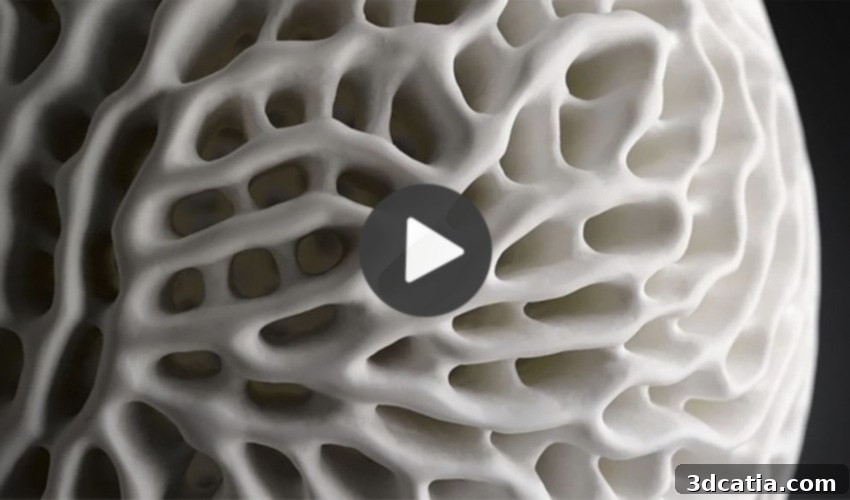
The concept of biomimicry is a powerful design philosophy, derived from two Greek words: ‘bio,’ meaning nature, and ‘mimesis,’ meaning imitation. At its core, biomimicry involves learning from nature’s ingenious solutions and incorporating its time-tested patterns and strategies into human designs and engineering challenges. Nature, through millions of years of evolution, has perfected designs that are efficient, resilient, and sustainable. From the lightweight yet strong structure of bird bones to the self-cleaning properties of lotus leaves, biological systems offer an endless source of inspiration.
The synergy between biomimicry and 3D printing is nothing short of revolutionary. Additive manufacturing offers an unparalleled ability to create highly complex geometries, intricate internal structures, and multi-material compositions that directly mimic natural forms. This capability allows for the development of new materials with enhanced properties and the introduction of novel patterns that optimize performance, reduce material waste, and improve functionality. Imagine creating medical implants that perfectly integrate with the human body by emulating bone structures, or designing aerospace components that achieve superior strength-to-weight ratios by replicating honeycomb patterns. 3D printing enables engineers and designers to move beyond traditional manufacturing constraints and unlock designs previously confined to the natural world. Discover the profound role of biomimicry in advancing 3D printing in the insightful video below.
Top 2: ICON and NASA Aim for Lunar Construction and Beyond
For generations, the dream of space travel and establishing humanity’s presence beyond Earth has captivated our collective imagination. What once seemed like pure science fiction is rapidly transitioning into a tangible reality, thanks to relentless technological advancements. One of the most significant challenges in sustained space exploration is the ability to construct infrastructure in off-world environments. Sending pre-fabricated structures from Earth is incredibly costly and logistically complex due to launch weight restrictions. This is where additive manufacturing, particularly large-scale additive construction, emerges as a game-changer.
ICON, the pioneering U.S. startup renowned for its advanced building technologies and earth-based 3D printed homes, has recently made headlines with a groundbreaking announcement. They secured a prestigious government contract, backed by crucial funding from NASA, to embark on the research and development of a system capable of additive construction on the Moon. This ambitious undertaking, dubbed “Project Olympus,” is designed to propel space exploration into a new era by enabling the creation of lunar habitats and infrastructure using local resources – a concept known as in-situ resource utilization (ISRU). By harnessing lunar regolith (moon dust) as a primary building material, ICON aims to significantly reduce the logistical burden and cost of establishing a permanent human presence on the Moon. This initiative is not merely about building structures; it’s about laying the foundation for future long-duration missions to Mars and beyond. Learn more about ICON’s visionary project and its implications for humanity’s extraterrestrial future in the captivating video below.
Top 3: Shaping the Future of Sustainable Mobility with 3D Printing
The challenge of creating more sustainable and environmentally friendly transportation solutions is one of the most pressing issues of our time. Traditional manufacturing processes for vehicles often involve extensive material waste, energy-intensive production, and result in heavy components that contribute to higher fuel consumption. The pursuit of lighter, more efficient, and greener modes of transport is driving innovation across the globe, and 3D printing is proving to be an indispensable tool in this endeavor.
At ETH Zurich, a prestigious technical university, a team of forward-thinking students took on this challenge as part of their “ETH City Project.” Their ambitious goal was to design and produce an electric motorcycle that embodies the future of mobility – one that is not only environmentally friendly but also highly efficient and sustainable. To achieve this, they leveraged Sintratec’s cutting-edge Selective Laser Sintering (SLS) 3D printing technology. SLS is particularly well-suited for such applications due to its ability to create complex, lightweight parts without the need for support structures, offering exceptional design freedom. This allowed the team to optimize the motorcycle’s components for both weight and performance, leading to significant reductions in production time, overall costs, and the amount of material used. The result is a testament to how additive manufacturing can revolutionize vehicle design, enabling rapid prototyping of innovative concepts and the creation of functional, optimized parts for next-generation transportation. Witness this remarkable achievement in the video demonstration below.
Top 4: Siemens and Ingersoll Pioneer Hybrid Additive-Subtractive Manufacturing
In the manufacturing world, a significant paradigm shift is occurring as companies seek to combine the best attributes of various production methods. Traditionally, Ingersoll has been a company dedicated to the development of high-performance manufacturing machines, primarily for subtractive processes like milling, where material is removed from a larger block to create a desired shape. While subtractive methods excel in precision and surface finish, they can be wasteful and limited by geometric complexity. Additive manufacturing, on the other hand, excels at creating highly complex, optimized geometries with minimal waste by building parts layer by layer, but sometimes struggles with surface finish and ultimate precision.
Recognizing the complementary strengths of both approaches, Ingersoll has forged a powerful collaboration with industrial giant Siemens to create a revolutionary production platform. This innovative system seamlessly integrates additive manufacturing methods with traditional milling capabilities, ushering in an era of true hybrid manufacturing. The platform is engineered to deposit successive layers of plastic, building up complex forms, while simultaneously allowing for precise machining of the part. This unique combination enables manufacturers to leverage the geometric freedom and material efficiency of 3D printing alongside the superior surface quality and dimensional accuracy of subtractive machining. Above all, this advanced platform offers the potential for high production volume and a unique ability to print both horizontally and vertically without requiring extensive support structures, which significantly saves time, reduces material consumption, and ultimately lowers costs. This integration represents a major leap forward, allowing for the creation of components that were previously impossible to manufacture efficiently, offering unparalleled design flexibility and efficiency for industries such as aerospace, automotive, and heavy machinery. Explore this transformative technology in action in the video.
Top 5: The First 3D Printed Residential Building in Germany
The global construction sector is undergoing a profound transformation, driven by an urgent need for faster, more affordable, and sustainable building solutions. Traditional construction methods are often labor-intensive, time-consuming, generate substantial waste, and can be limited in terms of architectural design freedom. Concrete additive manufacturing, or 3D printing for construction, is emerging as a revolutionary technology that directly addresses these challenges, allowing structures to be built with unprecedented speed and significantly lower costs. This innovative approach is rapidly gaining traction, particularly among forward-thinking companies in Germany, which is quickly becoming a hub for advanced construction technologies.
This week, a monumental milestone was achieved with the presentation of the first fully 3D printed residential structure in Germany. This pioneering building stands as a testament to the capabilities of additive construction, featuring two floors, each spanning an impressive 80 square meters. The entire structure was meticulously printed using a BOD2 machine from the renowned Danish manufacturer COBOD, a company at the forefront of large-scale concrete 3D printing. The utilization of additive manufacturing in this project delivered a multitude of benefits: drastically reduced construction times, minimized material usage (due to optimized designs and less waste), and vastly increased geometric freedom, enabling complex and aesthetically pleasing architectural forms that would be challenging or impossible with conventional methods. This project not only showcases the viability of 3D printing for residential buildings but also signals a future where housing can be constructed more efficiently, affordably, and sustainably, potentially addressing housing shortages and opening up new possibilities for customized living spaces worldwide. Witness this architectural marvel come to life in the video below.
What were your thoughts on this week’s collection of transformative 3D printing videos? Which innovation captured your imagination the most, and why? We’d love to hear your insights and favorite picks! Share your comments below, or connect with us on our social media channels: find us on Facebook and Twitter to join the conversation. And to ensure you never miss out on the latest breakthroughs and essential news in the dynamic 3D printing industry, don’t forget to sign up for our free weekly Newsletter, delivered straight to your inbox!