

Julia Daviy’s Zero-Waste 3D Printed Skirt: A Leap Towards Sustainable and Customizable Fashion
In a groundbreaking move that continues to bridge the gap between high technology and haute couture, visionary designer Julia Daviy recently unveiled her latest innovation: a fully customizable and environmentally friendly 3D printed skirt. This remarkable piece is not just a fashion statement; it represents a significant step forward in sustainable manufacturing, utilizing a patented zero-waste process developed by the artist herself. Having had the pleasure of discussing with Julia Daviy the immense potential that 3D printing technologies bring to the fashion industry – particularly in terms of design opportunities and unparalleled sustainability – we are thrilled to witness the tangible realization of her vision with this new garment. Available now for order, the skirt offers unparalleled personalization, allowing customers to select from a variety of styles and colors directly from her website. This launch marks a pivotal moment, as it is the first garment commercially marketed by the designer, making innovative, eco-conscious fashion accessible to a wider audience.
Julia Daviy has been a pioneering force in the realm of 3D printing and fashion since 2017, when she first launched her collection of 3D printed clothing. At that time, she was among a select few market initiatives daring to combine these two seemingly disparate fields. Her foresight has proven accurate, as additive manufacturing continues to demonstrate its profound benefits for the sector. This innovative production method offers designers unprecedented geometric freedom, enabling the creation of intricate and complex designs that would be impossible or prohibitively expensive with traditional textile manufacturing. Beyond aesthetic innovation, 3D printing provides a wider choice of advanced materials and facilitates a greater degree of customization, catering to individual preferences and body types with precision. Crucially, 3D printing is also recognized as a significantly more sustainable means of production. Unlike subtractive manufacturing processes that often generate substantial waste, additive manufacturing builds objects layer by layer, using only the material absolutely necessary. This inherent efficiency translates directly into less material consumption and drastically reduced waste generation, a core principle deeply cherished by Julia Daviy, whose ultimate goal is to produce truly sustainable clothing. Her latest 3D printed skirt stands as a testament to this commitment, pushing the boundaries of what is possible in eco-conscious fashion.
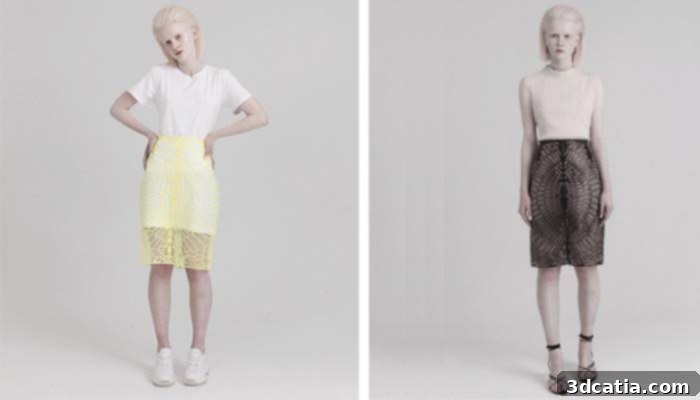
Introducing Julia Daviy’s Revolutionary Zero-Waste 3D Printed Skirt
The highlight of Daviy’s latest collection, this stunning skirt embodies the pinnacle of sustainable fashion design. It is not only fully customisable but is also meticulously crafted from 100% recyclable filaments, ensuring that its lifecycle is as environmentally friendly as its production. The design itself is a masterful fusion of a classic silhouette with an innovative, intricate lace-like pattern – a sophisticated aesthetic made possible only through the precision and versatility of 3D printing technology. This unique garment challenges the perception that 3D printed fashion is solely reserved for avant-garde runways or conceptual art installations. With this skirt, Julia Daviy emphatically demonstrates that this cutting-edge technology is becoming increasingly accessible, suggesting that anyone can integrate 3D printed clothing into their everyday wardrobe, provided they are willing to invest in high-quality, sustainable design. Priced at $780, the skirt reflects its bespoke nature and innovative manufacturing process. Each piece is made on demand, tailored precisely to the customer’s specific choices regarding colors, materials, and stylistic preferences. Julia proudly states that her streamlined process allows her to model, print, and deliver these personalized skirts in less than 10 days, showcasing the efficiency and responsiveness of her digital production workflow.
Further elaborating on the core principles behind her creation, Julia Daviy passionately asserts, “This is a truly durable, waste-free skirt, meticulously designed and produced in the United States using revolutionary technology, invented and patented by our teams. This unique method allows us to 3D print garments containing less than 1% waste in the manufacturing process – a monumental achievement in sustainable production. The skirt is produced by combining innovative 3D printing methods with carefully selected fabric linings and luxury trimmings that not only complement the design but also meet the highest environmental and ethical standards.” This statement underscores not only the technological prowess but also the holistic commitment to ethical and ecological practices that define Daviy’s brand. The integration of traditional linings and trimmings elevates the garment’s comfort and luxury feel, proving that sustainable innovation does not necessitate a compromise on quality or wearability.
The Sustainability Advantage: How 3D Printing Redefines Fashion Production
The concept of “zero-waste” is often discussed in fashion, but rarely fully achieved. Julia Daviy’s patented process pushes the boundaries of what’s possible, demonstrating that additive manufacturing is a game-changer. Traditional textile production is notoriously wasteful, from excessive fabric cutting to the environmental impact of dyeing and finishing processes. 3D printing, by contrast, builds objects from the ground up, adding material only where it is needed. This fundamental difference drastically reduces scrap material, effectively minimizing raw material input and subsequent landfill burden. Beyond the material itself, on-demand manufacturing further enhances sustainability by eliminating overproduction. Unlike fast fashion cycles that lead to vast inventories of unsold garments, Daviy’s model ensures each skirt is produced only when ordered, aligning production directly with consumer demand. This approach not only conserves resources but also mitigates the financial and environmental costs associated with excess stock and eventual disposal.
Moreover, the use of 100% recyclable filaments signifies a commitment to circularity, allowing the materials to be repurposed at the end of the garment’s life. This vision aligns perfectly with the burgeoning circular economy principles, where products are designed for durability, reuse, and recycling, thereby minimizing their environmental footprint. Julia Daviy’s work serves as a powerful example of how digital fabrication can reduce water and energy consumption, decrease transportation emissions through localized production, and ultimately pave the way for a more responsible and resource-efficient fashion industry. Her embrace of advanced materials and manufacturing techniques positions her at the forefront of a movement towards genuinely eco-friendly apparel that doesn’t sacrifice style or innovation.
The Future of Fashion: Driven by 3D Technologies
Julia Daviy is a staunch advocate for the integration of 3D printing into the broader fashion sector, believing it is not merely an option but a necessity for the industry’s long-term viability. As she explained in a recent interview, she envisions no sustainable future for this sector without the widespread adoption of 3D technologies. The traditional fashion model is increasingly facing challenges related to environmental degradation, complex and often unethical supply chains, and the unsustainable pace of fast fashion. 3D printing offers compelling solutions to these problems. It empowers designers with unprecedented creative freedom, allowing them to explore new textures, forms, and functionalities previously unattainable. It facilitates mass customization, enabling brands to offer perfectly fitted, personalized garments that cater to individual bodies and preferences, moving away from standardized sizing that often leads to dissatisfaction and returns. Furthermore, it supports localized production, potentially shortening supply chains, reducing logistics costs, and fostering regional manufacturing hubs.
Daviy’s work with her custom 3D printed skirts serves as a tangible blueprint for this future. By demonstrating that garments can be both technologically advanced, aesthetically pleasing, highly customizable, and unequivocally sustainable, she is inspiring a paradigm shift within the industry. Her approach proves that cutting-edge innovation can go hand-in-hand with ethical manufacturing and environmental responsibility. The combination of digital design, additive manufacturing, and a commitment to high-quality, ethically sourced trimmings positions her brand as a leader in the next generation of fashion. This holistic vision, where technology is harnessed not just for novelty but for genuine improvement in both product and process, is what truly sets Julia Daviy apart and makes her contributions so vital to the ongoing evolution of global fashion. Find more detailed information about this truly unique 3D printed skirt and its innovative production process HERE.
Conclusion and Call to Action
Julia Daviy’s zero-waste 3D printed skirt represents more than just a new garment; it symbolizes a bold step into the future of fashion. It showcases how additive manufacturing can revolutionize design, production efficiency, and, most importantly, sustainability within an industry traditionally notorious for its environmental impact. By combining artistic vision with technological innovation and an unwavering commitment to eco-conscious practices, Daviy is not only creating beautiful, customizable clothing but is also charting a course for a more responsible and innovative fashion landscape. Her work underscores the critical role that 3D printing will play in shaping an industry that is both aesthetically groundbreaking and environmentally sound, proving that the future of fashion is undeniably digital, sustainable, and custom-made.
What are your thoughts on Julia Daviy’s innovative 3D printed skirt and its potential to transform the fashion industry? Do you believe 3D printing is the key to a more sustainable future for clothing? Share your insights and let us know in a comment below or join the conversation on our Facebook and Twitter pages! Don’t miss out on the latest advancements and news in additive manufacturing – be sure to sign up for our free weekly Newsletter, delivering all the essential updates directly to your inbox!