
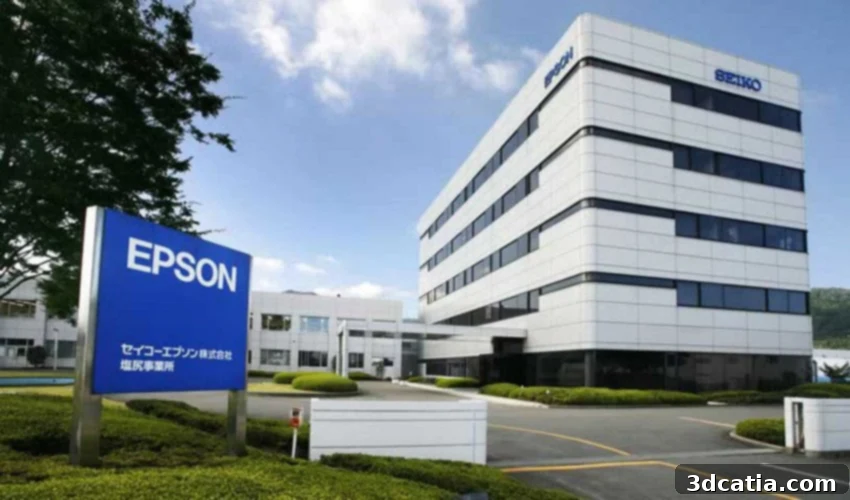
Epson Enters Industrial 3D Printing with Innovative Flat Screw Extrusion Technology
For decades, the name Epson has been synonymous with cutting-edge imaging and printing solutions, particularly dominating the 2D printer market with its reliable and high-performance devices. However, the electronics giant is now making a significant and strategically compelling move into the rapidly expanding additive manufacturing (AM) sector. This pivot is not just an incremental step but a bold leap, as Epson is set to unveil its inaugural industrial 3D printer at the prestigious International Robot Exhibition 2022. This grand reveal comes eight years after a foundational announcement by its president, Minoru Usui, signaling the company’s long-term vision to explore this innovative manufacturing frontier. The new solution is positioned as a robust industrial machine, leveraging an advanced extrusion process. What truly sets this technology apart is its groundbreaking use of a flat screw mechanism as the nozzle, a design choice engineered to dramatically broaden the spectrum of compatible materials and enhance the efficiency of material deposition, thus promising unprecedented versatility and performance in additive manufacturing.
The journey to this unveiling began much earlier, rooted in Epson’s strategic long-term planning. In January 2014, coinciding with the group’s momentous 30th anniversary, Minoru Usui, then president, publicly articulated Epson’s ambition to penetrate the 3D printing market within the subsequent five years. At that juncture, Epson’s internal analyses highlighted what were perceived as significant limitations within the nascent 3D printing technology, particularly concerning the relatively narrow range of compatible materials available for industrial applications. Fast forward to today, the additive manufacturing landscape has undergone a profound transformation. The market has matured considerably, witnessing exponential growth in technological capabilities and material science. This evolution is underscored by the entry of numerous established 2D printing powerhouses into the 3D printing arena, keen to capitalize on the paradigm shift in manufacturing. Prominent examples include HP, which has emerged as a formidable player with its Multi Jet Fusion technology, along with other global leaders such as Canon and Xerox, each carving out their niche with distinct approaches to additive manufacturing. Now, it is Epson’s strategic moment to introduce its sophisticated new machine to the commercial market, following an extensive period of rigorous internal development and application.
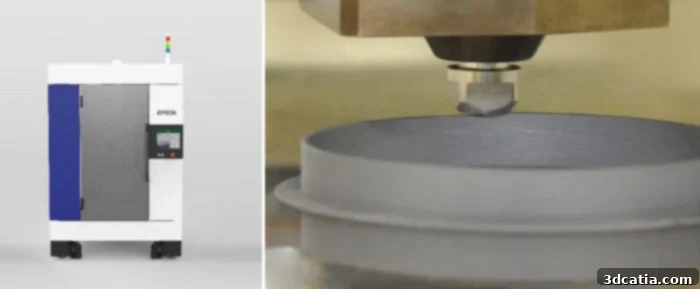
The new Epson industrial 3D printer utilizes an advanced flat screw extrusion process (photo credits: Epson)
While Epson has maintained a carefully managed level of discretion surrounding the specifics of this new industrial 3D printer, crucial details have emerged that highlight its innovative core. The machine’s operational foundation is an advanced extrusion method, innovatively powered by a flat screw mechanism. This design choice is particularly noteworthy because, as the manufacturer emphasizes, it is the very same type of screw mechanism that has been rigorously tested and proven reliable in Epson’s high-precision injection molding machines. This direct lineage from existing, robust industrial equipment speaks volumes about the expected durability, precision, and long-term stability of the 3D printer. The strategic integration of such a flat screw is not merely an engineering choice but a fundamental differentiator, enabling a dramatically expanded array of compatible materials. This technology facilitates 3D printing with a diverse range of granular materials, encompassing standard plastics, various metallic powders, and crucially, high-performance polymers such as PEEK (Polyether Ether Ketone). The ability to process PEEK, a material renowned for its exceptional strength, chemical resistance, and biocompatibility, positions Epson’s machine at the forefront of demanding industrial applications, from aerospace and automotive to medical and tooling sectors. Epson proudly elaborated on these capabilities in its official press release:
“In addition, the amount of material injected is precisely controlled by regulating the pressure within the head and by regulating the action of a valve in concert with the modeling speed. The temperature at the surface of a piece being printed must also be controlled in order to obtain the required strength. Epson employs a unique mechanism to precisely control this temperature and achieve both strength and accuracy.”
This emphasis on meticulous control over material injection and temperature is paramount for achieving the stringent quality requirements of industrial additive manufacturing. Epson’s engineering prowess is evident in its holistic approach to process optimization. By regulating pressure within the print head and synchronizing valve actions with the modeling speed, the system ensures a highly precise and consistent deposition of material, minimizing variability and maximizing repeatability. Furthermore, the intelligent management of temperature at the print surface is critical. In extrusion-based 3D printing, maintaining an optimal thermal environment is essential for ensuring robust layer adhesion, preventing warpage, and ultimately dictating the mechanical properties and dimensional accuracy of the final part. Epson’s proprietary “unique mechanism” for temperature control likely involves advanced localized heating and cooling strategies, perhaps incorporating intelligent sensors and real-time adjustments. This integrated precision system allows the machine to achieve not only exceptional mechanical strength in its printed objects but also outstanding accuracy, making it an ideal choice for manufacturing high-quality, end-use parts and functional prototypes across a multitude of industries.
The strategic decision to launch an industrial machine signals Epson’s intent to target demanding manufacturing applications where precision, material versatility, and robustness are non-negotiable. This printer is explicitly designed for the production of high-quality finished parts, catering to sectors such as automotive for specialized components and tooling, aerospace for lightweight yet strong parts, and even medical industries for custom prosthetics or surgical guides, particularly given its PEEK capabilities. Furthermore, the ability to utilize granular materials presents significant advantages, including lower material costs, greater flexibility in material sourcing, and enhanced opportunities for recycling and repurposing materials, thereby contributing to more sustainable manufacturing practices. This approach positions Epson to challenge established players and offer a compelling alternative for companies seeking to integrate additive manufacturing into their production workflows for both prototyping and serial manufacturing. The machine’s debut at the International Robot Exhibition in Tokyo is not merely a product launch but a statement of intent, showcasing Epson’s commitment to driving innovation within the industrial automation and manufacturing landscape.
Epson’s entry into industrial 3D printing represents a pivotal moment for the company and the additive manufacturing industry as a whole. It underscores a broader trend where traditional manufacturing powerhouses are increasingly investing in and integrating advanced AM technologies into their core strategies. This move allows Epson to leverage its extensive expertise in precision mechanics, robotics, and material science, cultivated over decades in the imaging sector, and apply it to a new, high-growth market. The potential for synergy between Epson’s existing robotics solutions and this new 3D printing technology is also immense, hinting at integrated, automated manufacturing cells that could redefine production efficiency and flexibility. The International Robot Exhibition 2022 serves as the ideal platform for this unveiling, where the Japanese giant is expected to reveal more intricate details regarding the printer’s specifications, performance benchmarks, and perhaps even its strategic roadmap for the additive manufacturing market. We will undoubtedly follow these developments closely to bring you the latest insights. In the interim, further details can be found in the official press release HERE.
What are your thoughts on Epson’s strategic entry into the competitive and dynamic 3D printing market? Do you believe their innovative flat screw extrusion technology will be a game-changer for industrial applications and high-performance materials like PEEK? We invite you to share your valuable insights and opinions in a comment below or engage with us on our various social media platforms, including LinkedIn, Facebook, and Twitter! To stay abreast of the very latest developments, breakthrough innovations, and essential news in the rapidly evolving world of 3D printing, don’t forget to sign up for our free weekly Newsletter here, ensuring the freshest updates are delivered directly to your inbox! Additionally, you can explore our comprehensive video content and in-depth analyses on our dedicated YouTube channel, where we regularly feature interviews, product reviews, and industry trends.