
EOS and Hyperion Metals: Forging a Sustainable Future for Titanium in Additive Manufacturing
In today’s rapidly evolving technological landscape, strategic alliances are increasingly becoming the bedrock for driving innovation and overcoming complex industrial challenges. This holds especially true within the dynamic realm of additive manufacturing, where collaborations between pioneering companies are accelerating the development and adoption of advanced processes and materials. We’ve witnessed numerous such partnerships, from Hiperbaric and Aenium joining forces to establish the HIP process for improved material properties, to Carbon and Specialized combining expertise to redefine bicycle saddle manufacturing with cutting-edge 3D printing. Now, another significant collaboration has been announced, poised to revolutionize the metal additive manufacturing sector: EOS, a global leader in industrial 3D printing, and Hyperion Metals, an emerging force in sustainable raw materials, are set to integrate Hyperion’s groundbreaking HAMR and GSD technologies into additive manufacturing workflows. This ambitious venture has been formalized through a Memorandum of Understanding, clearly outlining the shared vision and strategic objectives of this technology partnership to unlock the full potential of titanium.
At the heart of this collaboration lies a synergy of shared values and complementary strengths. EOS stands at the forefront of industrial 3D printing, renowned for its robust and reliable systems that enable responsible manufacturing solutions across diverse industries. Their commitment extends beyond machine capabilities to fostering a sustainable future for manufacturing, a principle deeply embedded in the German company’s ethos. Hyperion Metals, on the other hand, is rapidly positioning itself as a key developer of CO2-free, sustainable materials, aiming to become a leader in environmentally conscious raw material supply. This alignment in sustainability goals forms a powerful foundation for their joint initiative. The primary objective of the partnership is to dramatically optimize titanium metal powders specifically for additive manufacturing applications, utilizing Hyperion’s proprietary Hydrogen Assisted Metallurgical Reaction (HAMR) and Granulation Sintering and Deoxygenation (GSD) processes. Their ambitious goal is to develop and produce a carbon-free, spherical titanium powder that not only offers superior properties but also comes at a fraction of the cost of conventional alternatives. This disruptive approach is set to fundamentally transform the existing market for titanium powders, making this critical material more accessible and sustainable for a broader range of industrial applications, particularly as metal 3D printing continues its exponential growth.
Titanium: The Versatile Light Metal Driving Advanced Industries
Titanium is celebrated as one of the most remarkable light metals, distinguished by an exceptional combination of properties that make it indispensable across a multitude of high-performance sectors. Its high strength-to-weight ratio, superior corrosion resistance, excellent biocompatibility, and ability to withstand extreme temperatures have cemented its status as a material of choice in industries where performance and reliability are paramount. Consequently, titanium is extensively utilized in critical applications within the aerospace, automotive, medical, marine, and defense sectors. In aerospace, it’s integral for airframe components, engine parts, and landing gear due to its strength and low density, which contribute directly to fuel efficiency. The automotive industry is increasingly exploring titanium for performance vehicles and lightweighting initiatives to improve efficiency and reduce emissions. In the medical field, its biocompatibility makes it ideal for implants like prosthetics, dental implants, and surgical instruments. These demanding industries, particularly aerospace and automotive, also represent key markets for Hyperion Metals’ sustainable material focus and are increasingly adopting additive manufacturing for complex, high-value components. EOS, with its extensive portfolio of industrial 3D printing solutions, already supports these sectors with advanced materials, including titanium alloys such as Ti64, Ti64ELI, and TiCP. The integration of HAMR and GSD technologies promises to further enhance the capabilities and accessibility of titanium, expanding its use cases and improving the overall sustainability of the metal additive manufacturing supply chain.
Unveiling HAMR Technology: A Breakthrough in Titanium Powder Production
Central to Hyperion Metals’ innovative approach is the Hydrogen Assisted Metallurgical Reaction (HAMR) technology. This pioneering process for producing non-spherical titanium metal powders was initially developed at the esteemed University of Utah by the visionary Professor Zhigang Zak Fang. The research and development of HAMR received substantial backing from significant industry players and government agencies, including vital funding from the Department of Energy, alongside strategic support from aerospace giants like Boeing and advanced material specialists such as Arconic. This strong foundation underscores the technology’s potential and industry relevance. HAMR technology represents a paradigm shift in the initial stages of titanium powder production. Unlike conventional methods that often result in materials with inherent impurities or less desirable characteristics, HAMR enables the production of non-spherical titanium powders that boast superior properties when compared to commercially available titanium sponge, which is the primary raw material for most titanium processing. The process is not only designed for enhanced material quality but also for remarkable efficiency and sustainability. It is projected to require approximately 50% less energy to produce the powder, significantly reducing the environmental footprint associated with titanium manufacturing. Furthermore, HAMR aims to be highly competitive with the traditional Kroll process, which has been the industry standard for titanium metal production for decades but is known for its high energy consumption and complex, costly steps. By offering a more energy-efficient and cost-effective pathway to high-quality titanium feedstock, HAMR lays the groundwork for more accessible and sustainable titanium production, a critical first step towards revolutionizing its application in advanced manufacturing.
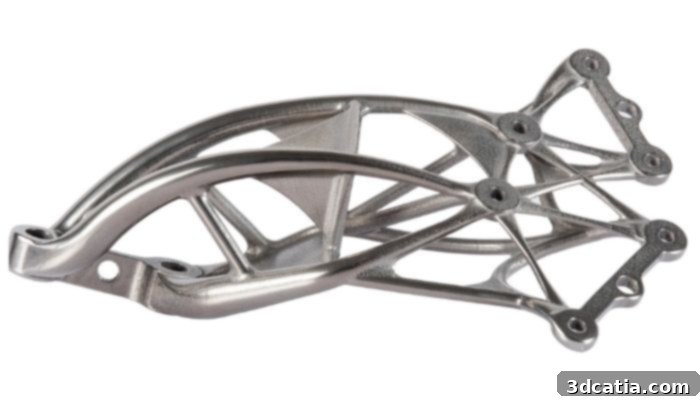
Liebherr trolley support made of Ti64, produced with an EOS machine (Image: Liebherr/EOS)
GSD Technology: Spherical Titanium Powders for Flawless Additive Manufacturing
Building upon the advancements of HAMR, Hyperion Metals introduces its Granulation Sintering and Deoxygenation (GSD) technology, a critical second stage that transforms the non-spherical HAMR powder into the ideal spherical form required for high-performance additive manufacturing. GSD is ingeniously designed to process not only HAMR-produced powder but also other titanium feedstocks such as Ti scrap or conventional Ti sponge, thus fostering a more circular and sustainable material economy. The production of spherical titanium metal powder is paramount for additive manufacturing processes, particularly those like powder bed fusion. The spherical shape is crucial because it ensures optimal flowability of the material, allowing for consistent and even spreading of powder layers within the 3D printer. This, in turn, leads to higher print quality, reduced defects, and ultimately, more reliable and performant final parts. Without excellent flowability, powder delivery can be erratic, leading to voids and inconsistencies in the printed object. GSD is an innovative, multi-step process engineered to deliver titanium powder with highly specific characteristics. Hyperion planned to commence pilot production for GSD in Q3 2021, marking a significant milestone in bringing this advanced material to market. The primary objective of the GSD process is to develop a titanium alloy powder characterized by a critically low oxygen content, which is essential for maintaining the material’s mechanical properties and preventing embrittlement. Additionally, the technology aims for a precisely controllable particle size distribution, allowing for tailored powders that meet the specific requirements of various additive manufacturing machines and applications. Coupled with excellent flowability, these characteristics position GSD-produced titanium powder as a superior material solution, poised to significantly elevate the capabilities and adoption of metal 3D printing across industrial sectors. Together, HAMR and GSD create a comprehensive, sustainable, and cost-effective pathway to advanced titanium powders.
Leveraging Synergies: A New Era for Titanium Applications
The combined strength of EOS’s decades of expertise in industrial additive manufacturing systems and Hyperion Metals’ revolutionary material production technologies (HAMR and GSD) promises to unlock unprecedented opportunities for titanium. This strategic partnership is not just about producing a new material; it’s about fundamentally reshaping the economics and environmental impact of titanium usage in advanced industries. Sascha Rudolph, Commercial Director Metal Materials at EOS, succinctly captures the profound potential of this collaboration: “The HAMR and GSD technology has the potential to lower the entry barriers for titanium into existing markets with more conventional materials and to enable completely new mass market applications where a high strength-to-weight ratio is crucial – such as in electric vehicles.” This statement highlights a pivotal shift. Historically, titanium’s high cost and complex processing have limited its application primarily to niche, high-performance sectors like aerospace and medical. By significantly reducing production costs and offering a sustainable, carbon-free alternative, HAMR and GSD can democratize titanium, making it competitive against more common, albeit heavier or less performant, materials. This accessibility opens doors to a plethora of innovative applications. Imagine lighter components in electric vehicles, which directly translate to extended range and improved energy efficiency. Consider consumer electronics, sporting goods, or even general industrial machinery where weight reduction without compromising strength could lead to entirely new product designs and functionalities. The ability to produce high-quality, cost-effective, and sustainable titanium powder will accelerate the adoption of additive manufacturing in these sectors, fostering innovation and contributing to a greener global manufacturing footprint. This partnership represents a forward-looking step towards a future where advanced materials are not only high-performing but also environmentally responsible and economically viable for a broader industrial landscape.
The collaboration between EOS and Hyperion Metals marks an exciting chapter in the evolution of metal additive manufacturing. By focusing on sustainable, cost-effective, and high-quality titanium powder production through HAMR and GSD technologies, they are setting a new standard for material innovation and environmental responsibility. This partnership is poised to expand the horizons of what’s possible with 3D printed titanium, impacting industries from aerospace to electric vehicles and beyond. We eagerly anticipate the groundbreaking developments that will emerge from this powerful alliance.
What are your thoughts on this significant new partnership between EOS and Hyperion? How do you foresee HAMR and GSD technologies impacting the future of additive manufacturing and sustainable materials? Share your insights and comments below, or connect with us on our Facebook and Twitter pages. Don’t forget to sign up for our free weekly newsletter, ensuring you receive all the latest news in 3D printing directly to your inbox!