
Pioneering 3D-Printed Breast Tissue: Unlocking the Mysteries of Milk Production and Revolutionizing Women’s Health Research
For too long, dedicated scientific inquiry into the intricacies of the female body, especially concerning critical aspects of women’s health, has been disproportionately underrepresented and underfunded. This historical oversight has left vast gaps in our understanding of fundamental biological processes unique to women. However, a significant paradigm shift is on the horizon, spearheaded by an innovative research team at ETH Zurich. Their groundbreaking study focuses on deciphering the complex mechanisms behind breast milk production, a process surprisingly ill-understood from a scientific standpoint, despite its profound importance for infant health and maternal well-being. Led by the visionary Professor Marcy Zenobi-Wong, the team is embarking on a pioneering project that promises to yield invaluable insights not only into the enigma of lactation but also into broader female biology. What makes this research particularly captivating is their innovative approach: creating functional breast milk tissue models using advanced 3D printing technologies, marking a new era in biomedical research.
Breast milk is often hailed as nature’s perfect food, an exquisitely complex biological fluid precisely formulated to meet the dynamic and evolving nutritional, immunological, and developmental needs of a growing infant. Its composition changes not only during a single feeding but also over the course of lactation, adapting perfectly to the baby’s requirements. Yet, despite its critical role in human health and development, the precise biological symphony orchestrating its production, from the initial cellular signals to the final secretion of nutrient-rich milk, has remained largely an unsolved scientific mystery. Professor Zenobi-Wong’s team at ETH Zurich is committed to unraveling this enigma. Their journey began with the meticulous isolation of specific cells from human breast milk – known as lactocytes. These specialized epithelial cells are the primary cellular factories responsible for the synthesis, secretion, and transport of milk components within the mammary gland’s intricate tissue architecture. To simulate the natural environment, the researchers carefully cultivated these human lactocytes within artificially engineered miniature milk ducts. For the scaffolding of these delicate structures, they ingeniously utilized a biomaterial derived from bovine udder tissue. This choice was deliberate, as bovine mammary tissue shares remarkable structural and compositional similarities with human breast tissue, providing a biologically relevant and ethically sound matrix for their in vitro model.
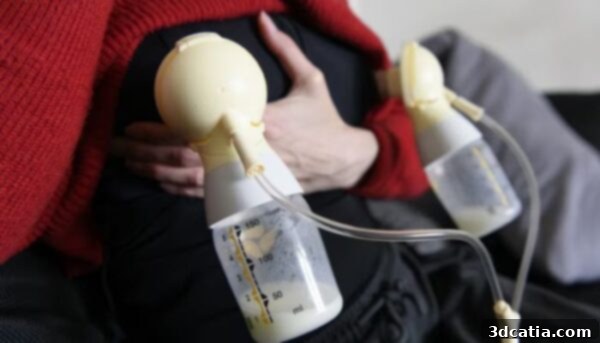
Many mothers have problems breastfeeding, yet the issue has not received much scientific attention to date (Image: Blick)
Advanced 3D Bioprinting: Revolutionizing Tissue Engineering for Breast Milk Research
The ability to precisely fabricate complex biological structures at a micro-scale is where cutting-edge 3D printing technologies truly shine, providing the indispensable tools for this ambitious research. The ETH Zurich team harnessed the power of additive manufacturing to construct their intricate tissue models. They began by carefully processing the extracellular matrix components isolated from bovine udder tissue, transforming them into a sophisticated liquid biomaterial. This bio-ink served as the foundation for their 3D printing endeavors. The fabrication process itself draws parallels with stereolithography (SLA), a widely recognized 3D printing technique renowned for its high resolution and precision. In this method, a focused laser beam is directed with exquisite accuracy onto the liquid biomaterial, selectively curing or solidifying it layer by layer. Within a remarkably short timeframe, often mere minutes, the researchers were able to fabricate highly realistic, three-dimensional micro-structures resembling the natural architecture of milk ducts and the spherical secretory units known as alveoli. Following the structural creation, these intricate artificial ducts were then meticulously enriched with the previously isolated human lactocytes. These crucial milk-producing cells were carefully introduced and allowed to integrate and mature within the biomimetic environment of the 3D-printed structures, laying the groundwork for functional studies.
The initial results from these meticulously engineered 3D-printed breast tissue models have been nothing short of remarkable and highly encouraging. Following their successful cultivation within the artificial ducts, the human lactocytes began to exhibit crucial signs of functionality, actively producing and secreting specific chemical components characteristic of human breast milk. These vital biomarkers included beta-casein, a primary protein found in milk, and milk fat globules, which are essential for infant nutrition and energy. The successful detection of these complex milk components within the in vitro model serves as compelling proof-of-concept, validating the team’s approach and demonstrating the biological relevance of their engineered tissue. It underscores a significant scientific milestone: creating a functional model of milk-producing tissue outside the human body. While the cells are now adept at producing the fundamental building blocks of milk, the ultimate goal of synthesizing complete, artificial breast milk from this model is still a future aspiration. This current project is purposefully designed as a foundational step – a critical stride towards a deeper, unprecedented understanding of the intricate cellular and molecular pathways that govern human milk production. Amelia Hasenauer, a dedicated PhD student pivotal to the team’s progress, articulated the profound potential and human impact of their work: “Our advanced cell culture model is primarily intended to contribute to a significantly improved understanding of the complex milk production process. I am personally aware of countless women who face immense challenges and difficulties with breastfeeding, often leading to frustration and distress. Our innovative model holds the promise that, one day, it could provide crucial insights and help find effective answers and solutions for these mothers.“
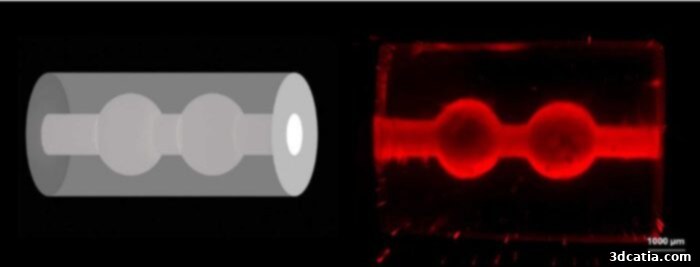
The schematic of a milk duct (left) and the team’s 3D-printed model (right) (Image: ETH Zurich)
Beyond Lactation: Illuminating the Future of Women’s Health Research with 3D Bioprinting
While the immediate focus of Professor Zenobi-Wong’s research is on understanding breast milk production, the implications of their 3D-printed breast tissue model extend far beyond this initial scope, promising to cast a much-needed spotlight on the broader landscape of women’s health. This innovative platform offers immense potential for various critical applications, including robust drug trials and groundbreaking breast cancer research. Currently, many drug development processes rely on animal testing, which often fails to accurately mimic human physiological responses and raises significant ethical concerns. However, by providing a realistic human-specific tissue model, this 3D bioprinting method offers a highly ethical and potentially more predictive alternative for screening new medications and understanding their effects on breast tissue without the need for animal experimentation. This ethical advantage, coupled with the precision and reproducibility of the cell tissue-based tests, is already garnering significant popularity and attention within the global scientific community. Professor Zenobi-Wong highlighted a key future direction for their work, stating, “The next crucial step involves increasing the throughput of milk component collection, which is precisely where the scalability and versatility of 3D printing technologies become indispensable. This will allow us to conduct experiments on a larger scale and gather more comprehensive data.“
Crucially, this project serves as a stark reminder and a powerful catalyst, underscoring the immense and often overlooked gaps in fundamental and applied research related specifically to the female body. The scientific community has, for far too long, operated with a male-centric bias, leading to significant disparities in understanding and treating conditions unique to women. To illustrate this pressing issue, consider Polycystic Ovary Syndrome (PCOS), a pervasive endocrine disorder affecting nearly 1 in 10 women worldwide. PCOS can trigger a cascade of distressing symptoms, including hormonal imbalances, irregular menstrual cycles, infertility, and metabolic issues, yet targeted and effective treatment methods remain woefully understudied and often inadequate. This is precisely the kind of disparity Professor Zenobi-Wong and her dedicated team are determined to rectify. They envision their breast tissue model not only as a tool for lactation research but also as a proof-of-concept that can inspire and pave the way for numerous other opportunities in research directly related to women’s health. Professor Zenobi-Wong passionately articulated the breadth of these unmet needs: “There are so many critical unanswered questions, spanning a wide spectrum of conditions from the debilitating pain of endometriosis to the challenges of mastitis in breastfeeding mothers, and the often heart-wrenching complexities of various fertility issues. Each of these conditions, and countless others, demands and deserves significantly more scientific attention, dedicated research, and targeted funding to improve the lives of millions of women globally.” Their work at ETH Zurich represents not just an advancement in tissue engineering but a profound call to action, urging the scientific world to prioritize and invest in understanding the unique biology and health challenges of women. More information on their research can be found HERE.
What do you think of 3D-printed breast tissue and its potential to advance women’s health research? Share your thoughts in a comment below or connect with us on our LinkedIn and Facebook pages. Additionally, don’t miss out on the latest advancements in additive manufacturing by signing up for our free weekly Newsletter, delivered straight to your inbox. You can also explore all our insightful videos on our YouTube channel. For those particularly interested in more news concerning medical and dental 3D printing, we invite you to visit our dedicated page HERE.
*Photo Credits: ETH Zurich