
Emerging Objects: Pioneering 3D Printed Architecture with Sustainable Materials
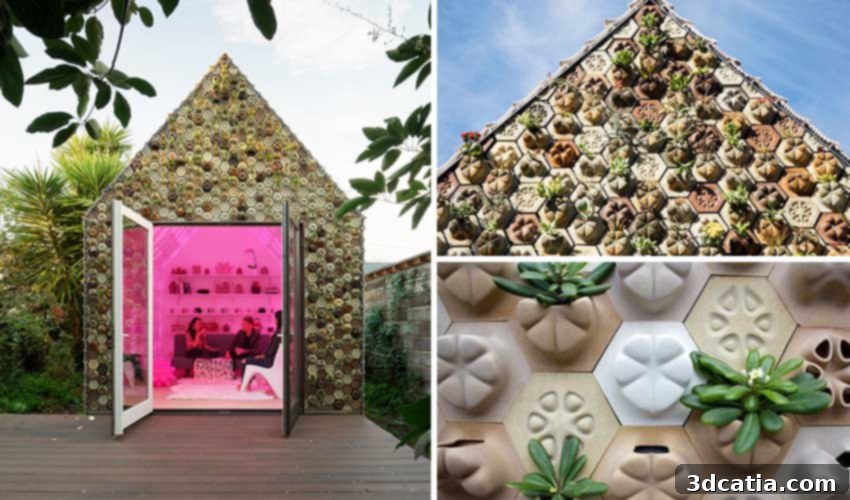
In the rapidly evolving landscape of additive manufacturing, few companies stand out as distinctly as Emerging Objects. Known for pushing the boundaries of what’s possible with 3D printing in architecture and construction, this American company has consistently delivered projects that redefine traditional building methods. Last year, we marveled at their extraordinary Cabin of Curiosities, a structure composed of an astounding 4,500 custom 3D printed ceramic tiles. What made these tiles particularly unique was their innovative composition, featuring a blend of cement, sawdust, salt, and even grape skins – materials typically overlooked in mainstream construction. The intricate design of these tiles imbues the exterior with the organic, textured appearance of a thriving garden, demonstrating a harmonious blend of cutting-edge technology and natural aesthetics.
Emerging Objects has carved a significant niche for itself by specializing in groundbreaking innovations across 3D printing architecture and the creation of bespoke building components. Their extensive portfolio showcases numerous projects that highlight the transformative power of additive manufacturing, enabling designs that would be simply unattainable through conventional construction means. To delve deeper into their philosophy, pioneering work, and future aspirations, we had the distinct privilege of speaking with Virginia San Fratello, the Chief Creative Officer and co-founder of Emerging Objects. In this insightful interview, San Fratello shares the inspiring journey of how Emerging Objects came into existence and how they leverage additive manufacturing to bring their truly original and impactful projects to life, challenging preconceived notions about building materials and design.
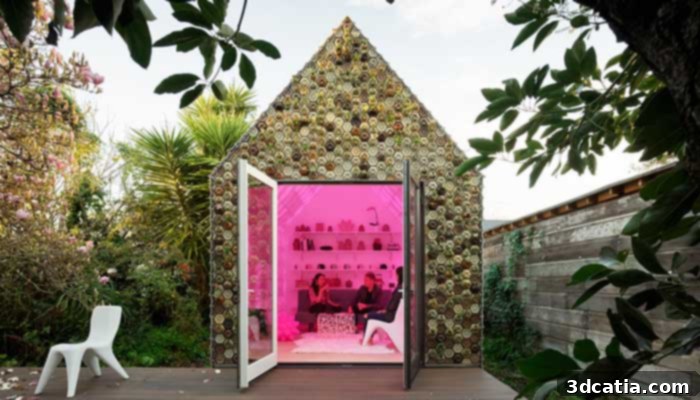
The Cabin of Curiosities composed of 4,500 ceramic tiles | Photo Credits: Emerging Objects
Virginia San Fratello’s Pioneering Path: Early Experiments and the Quest for Custom Materials in 3D Printing
3DN: Can you introduce yourself and your link to 3D printing?
“I’m Virginia San Fratello, Chief Creative Officer and co-founder of Emerging Objects. My personal journey with 3D printing began quite early in the field’s development, specifically back in 2004. At that time, I started experimenting extensively with a Zcorp binder jet printer, which represented a frontier of additive manufacturing. My initial focus was primarily on printing sophisticated architectural models. A notable project from this period involved developing and prototyping the Hydro Wall concept, an innovative idea I had submitted for the prestigious Metropolis Magazine Next Gen Competition. This early engagement with 3D printing was formative, yet it also sparked a critical line of questioning for me.
During those moments, as I was meticulously filling the 3D printer with the proprietary powder mixtures that were commercially available, I vividly remember thinking, ‘Why can’t I just put flour or my own custom powder in this printer?’ This seemingly simple question was, in fact, the seed of a much larger vision. It underscored a fundamental desire to move beyond the limitations of manufacturer-specific materials and explore the vast, untapped potential of unconventional substances in additive manufacturing. This intellectual curiosity propelled me to consider how 3D printing could be democratized and adapted to a broader range of materials.
This vision became a tangible reality several years later. My partner, Ronald Rael, acquired a 3D printer, providing us with the perfect platform to put our experimental ideas into practice. We enthusiastically began to test the boundaries of what could be printed, quite literally putting our own materials into the machine. Our initial ventures involved exploring traditional ceramic substances, starting with readily available ball clays and delicate porcelain. The success of these early tests emboldened us to expand our material research dramatically. We soon moved on to incorporating more unconventional yet sustainable and accessible materials, such as various types of sand, industrial cement, and even common salt. This hands-on, experimental approach to diverse materials not only broadened our creative horizons but also laid the foundational principles for what would eventually become Emerging Objects: a unwavering commitment to material innovation, sustainability, and making 3D printing an accessible tool for truly original architectural and design projects.”
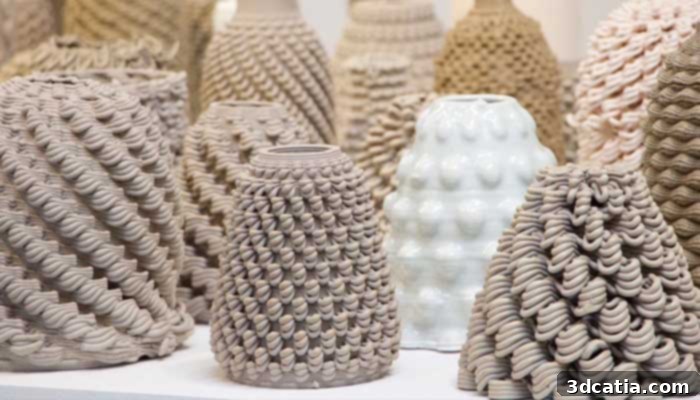
Part of Emerging Objects’ GCODE.Clay series of objects 3D printed in various clays (porcelain, bmix, terra-cotta, and recycled clay) that explore the creative potential of designing with G-code | Photo Credits: Emerging Objects
The Genesis of Emerging Objects: From Art Exhibit to Architectural Revolution
3DN: How did the idea of creating Emerging Objects come about?
“The conceptualization and eventual establishment of Emerging Objects can be traced back to a pivotal project that originated within our broader design firm, Rael San Fratello. The decisive moment came in 2010 when we received a prestigious invitation to participate in the Biennial of the Americas. This was an extraordinary opportunity to showcase innovative design, and we chose to embrace it with a truly audacious idea: we decided to 3D print our entire exhibit using sand as the primary material. This was a radical departure from conventional exhibition design and required significant ingenuity.
To achieve this ambitious goal, we took a highly unconventional approach – we ‘hacked’ our own 3D printer. This involved modifying the machine’s mechanics and software to specifically accommodate and print with sand. This act of customization was absolutely crucial, as it allowed us to circumvent the inherent limitations of proprietary 3D printing materials and the often prohibitive costs associated with outsourcing highly specialized 3D prints. Our ability to adapt and control the printing process from the ground up provided us with unprecedented freedom and efficiency.
For that groundbreaking exhibit, we successfully fabricated an impressive collection of approximately 20 to 30 distinct objects. What was truly remarkable was the sheer cost-effectiveness of this approach; we produced these intricate pieces at a mere fraction of what it would have cost if we had been compelled to use manufacturer-specific materials or rely on external printing services. Beyond the substantial financial savings, this innovative method granted us unparalleled creative and structural flexibility. We were able to design and print small, modular pieces that possessed sufficient structural integrity to be stacked together seamlessly, both horizontally and vertically, allowing us to construct much larger and more complex architectural forms within the exhibit space.
It was during this intensely hands-on and experimental phase that a profound realization dawned upon us: this pioneering technology held immense potential far beyond artistic displays. We recognized that we could strategically apply this innovative process to produce fundamental building blocks, such as custom bricks and tiles. These components, in turn, could be efficiently assembled to create functional walls and, ultimately, entire buildings. This transformative insight was the true genesis of Emerging Objects, shifting our core focus from producing singular design objects to revolutionizing architectural components and, by extension, the future of construction itself. It underscored a belief that materials and tools should be adaptable to the designer’s vision, not the other way around, fostering a new era of material and structural freedom in building.”
Driving Sustainable Construction: Emerging Objects’ Commitment to Material Innovation and Eco-Conscious Design
Emerging Objects’ core philosophy is deeply rooted in exploring the often-overlooked potential of unconventional and locally sourced materials for 3D printing. This commitment extends far beyond mere novelty; it’s a deliberate, strategic choice driven by principles of sustainability, cost-effectiveness, and an unwavering desire to create truly unique and context-responsive architectural solutions. The ability to utilize diverse materials, from industrial byproducts like sawdust and organic waste such as grape skins, to various types of recycled clays and locally available sands, allows for a significantly reduced environmental footprint compared to energy-intensive traditional construction methods. This innovative approach not only fundamentally challenges the established perceptions of what constitutes a ‘building material’ but also opens up entirely new avenues for both architectural design and functional performance.
The Cabin of Curiosities: A Testament to Sustainable Material Alchemy
The Cabin of Curiosities stands as a quintessential embodiment of Emerging Objects’ material-driven philosophy in action. The remarkable structure, formed by 4,500 custom ceramic tiles, is more than just a shelter; it is a profound testament to the possibilities of material alchemy through additive manufacturing. By ingeniously incorporating organic waste like grape skins and common industrial byproducts such as sawdust, alongside traditional binders like cement and salt, Emerging Objects has transformed what might be considered mundane or waste substances into beautiful, functional, and structurally sound building blocks. The resulting tiles boast a unique array of thermal, acoustic, and aesthetic properties. Furthermore, their carefully conceived geometric forms create an exterior façade that intricately mimics the textured richness of a vibrant garden, beautifully illustrating how advanced additive manufacturing, when coupled with thoughtful material science, can produce architecture that is both aesthetically captivating and profoundly environmentally responsible, blurring the lines between nature and technology.
The Cool Brick: A Smart Solution for Passive Cooling in Arid Environments
Another brilliant example of Emerging Objects’ innovative and problem-solving approach to construction is the acclaimed Cool Brick wall. This groundbreaking project directly addresses the critical and escalating need for sustainable cooling solutions, particularly in hot, arid regions prone to extreme temperatures. The ingenious design of the Cool Brick allows it to absorb water within its uniquely porous, 3D printed structure. As ambient air passes through the brick’s intricate internal channels, the absorbed moisture evaporates, leading to a natural evaporative cooling process. This highly efficient passive system effectively lowers the surrounding temperature without any reliance on energy-intensive mechanical air conditioning systems, offering a paradigm shift in climate control.
Inspired by traditional evaporative cooling techniques that have been utilized for centuries in various cultures, the Cool Brick leverages the precision and design freedom of 3D printing to create complex internal geometries that maximize surface area for evaporation. This demonstrates how advanced manufacturing can intelligently reimagine and enhance ancient wisdom to address modern environmental challenges. It’s a striking illustration of how innovative design, astute material science, and the transformative power of additive manufacturing can converge to create highly practical, eco-friendly architectural solutions that actively improve human comfort, significantly reduce energy consumption, and promote sustainability in specific climatic contexts. The Cool Brick is not just a building material; it’s a testament to integrated design thinking for a more sustainable future.
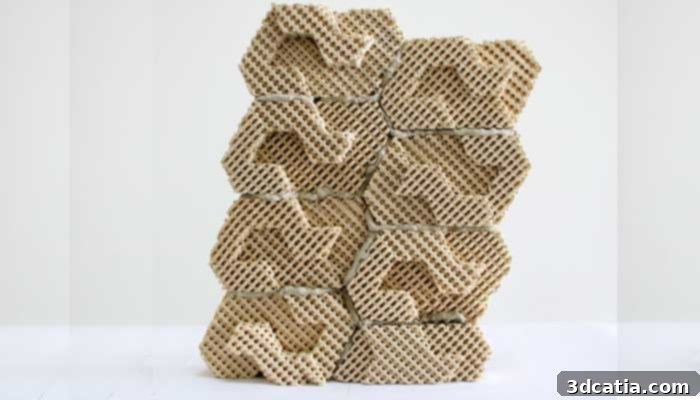
The Cool Brick wall for example is another project. The wall absorbs water and let’s air pass through it, therefore working as a cooling system | Photo Credits: Emerging Objects
Gazing Ahead: Emerging Objects’ Vision for Large-Format 3D Printing and Traditional Adobe Structures in the Colorado Desert
3DN: Can you tell us about the latest project Emerging Objects is working on?
“Absolutely. We are currently deeply engaged in a thrilling new endeavor that promises to push the boundaries of large-format 3D printing even further than ever before. Our dedicated team has been collaborating closely with deltabots, a specialized firm, to develop a highly advanced robotic arm. This arm has been meticulously engineered and calibrated specifically for large-scale additive manufacturing applications, moving beyond components to entire structures. The ambitious and exciting goal for this upcoming summer is to 3D print a very large adobe structure. This isn’t just any construction project; it will be strategically situated in the challenging and high-altitude environment of the Colorado desert, a location specifically chosen for its unique climatic conditions and the profound historical significance of adobe as a traditional, sustainable building material in such arid landscapes.
This next-generation project represents a profound and powerful convergence of several critical domains: it marries time-honored, traditional building techniques with cutting-edge robotic technology, contemporary design principles, deep cultural understanding of local materials, and a forward-thinking vision for the future trajectory of construction. By leveraging adobe, a material with deep historical roots, exceptional thermal mass properties, and inherent sustainability, and combining it with the precision and efficiency of advanced robotic 3D printing, we aim to demonstrate how ancient wisdom can be revitalized, scaled, and optimized for pressing modern needs. The Colorado desert site offers an unparalleled living laboratory to rigorously test the resilience, efficiency, aesthetic potential, and environmental integration of large-scale 3D printed adobe structures. This pioneering work has the potential to unlock entirely new possibilities for sustainable, culturally resonant, and climatically appropriate housing solutions in similar environments around the globe. We firmly believe this project will not only showcase the immense capabilities of our robotic systems but also emphatically highlight how additive manufacturing can contribute significantly to creating environmentally sensitive and contextually rich architecture for the 21st century and beyond, redefining what sustainable housing truly means.”
Democratizing Design and Construction: The Future of Accessible 3D Printing
3DN: Any last words for our readers?
“Indeed. I’d like to emphasize the truly incredible and accelerating progress we’re witnessing in the accessibility of 3D printing technology across the board. Over the past few years, the price point of desktop 3D printers has plummeted dramatically, making them incredibly affordable, with some entry-level models now readily available for as little as $200. This significant reduction in initial investment has effectively opened the door for a much wider and more diverse audience to engage actively with additive manufacturing, successfully moving it from the realm of specialized industrial applications to the homes, schools, workshops of enthusiastic makers, innovative educators, and burgeoning small businesses.
Beyond just the hardware, the materials market for 3D printing is also experiencing an unprecedented renaissance of innovation and diversification. We’re observing an explosion of interesting, often sustainable, and highly functional materials being transformed into printable filaments, expanding far beyond conventional plastics. Imagine the creative and practical possibilities of printing with materials like hemp, various forms of biomass, highly conductive copper, or even authentic wood-infused composites! These rapid advancements mean that designers, artists, engineers, and makers now have an unparalleled palette of materials to work with, fostering greater creativity, promoting environmental consciousness, and enabling truly unique functional properties in their projects. Furthermore, proactive companies like Emerging Objects are actively contributing to this democratization by developing intuitive, user-friendly software specifically geared towards simplifying the complexities of 3D printing. Our ultimate aim is to effectively eliminate the steep learning curve often associated with mastering new software applications, thereby making it significantly easier and more encouraging for novices to confidently enter and explore the vast and exciting world of 3D printing. This sustained focus on simplifying the entire process is absolutely vital for widespread adoption and mainstream integration.
I genuinely believe that with each passing month, we are drawing ever closer to a truly pervasive and integrated 3D printed future. This future isn’t solely about large-scale industrial production or specialized niches; it’s profoundly about empowering individuals, fostering localized manufacturing, encouraging grassroots innovation, and enabling sustainable practices across countless sectors and scales. The increasing accessibility of both the underlying technology and the essential knowledge required to effectively utilize it is an incredibly exciting development. I am profoundly enthusiastic to witness 3D printing become an increasingly ubiquitous, impactful, and indispensable tool, fundamentally transforming how we design, create, innovate, and build in the years and decades to come. It’s a future where creativity is unbounded, sustainable practices are integrated into every layer of creation, and innovation is truly within everyone’s reach.”
Emerging Objects continues to inspire with its visionary approach to 3D printing, consistently demonstrating how additive manufacturing can transcend conventional limits to create sustainable, aesthetically rich, and functionally superior architectural solutions. Their dedication to material innovation, open-source experimentation, and making advanced technology accessible truly sets them apart as leading pioneers in the field, shaping the future of built environments.
For more detailed information on Emerging Objects’ groundbreaking projects and philosophy, you can visit their official website HERE.
What are your thoughts on Emerging Objects’ innovative projects and their bold vision for the future of 3D printing in construction? Do you believe their distinctive approach to custom, sustainable materials will become a mainstream trend in architecture and design? We encourage you to share your valuable insights in a comment below or join the engaging conversation on our Facebook and Twitter pages! Don’t forget to sign up for our free weekly Newsletter to receive all the latest news, updates, and innovations in 3D printing straight to your inbox, ensuring you stay at the forefront of this exciting industry!