
Elevate Your 3D Printing: The Essential Guide to Enclosures for Enhanced Safety, Quality, and User Experience
As the fascinating world of 3D printing continues its rapid expansion, particularly with extrusion-based technologies like FDM (Fused Deposition Modeling), its accessibility grows, bringing these powerful tools into homes, offices, and workshops worldwide. While the creative potential is limitless, so too are the discussions surrounding potential health risks. A significant body of research consistently highlights concerns regarding the release of ultrafine particles (UFPs) and volatile organic compounds (VOCs) during the printing process. These microscopic byproducts, emitted by heated filaments and resins, can pose risks to respiratory health, especially with prolonged exposure in poorly ventilated environments. Fortunately, addressing these concerns and significantly enhancing the overall 3D printing experience is remarkably straightforward. Beyond ensuring adequate general room ventilation, integrating a high-quality 3D printer enclosure is strongly recommended. This isn’t merely about mitigating harmful emissions; an enclosure offers a multifaceted solution that provides crucial thermal stability for prints, safeguards your machine from environmental disturbances, and significantly reduces the risk of accidental contact with hot components or moving parts. In this comprehensive article, we will delve deep into the myriad benefits that 3D printer enclosures offer, from improving air quality to achieving superior print results, and we’ll also highlight some of the noteworthy models and manufacturers currently leading the market.
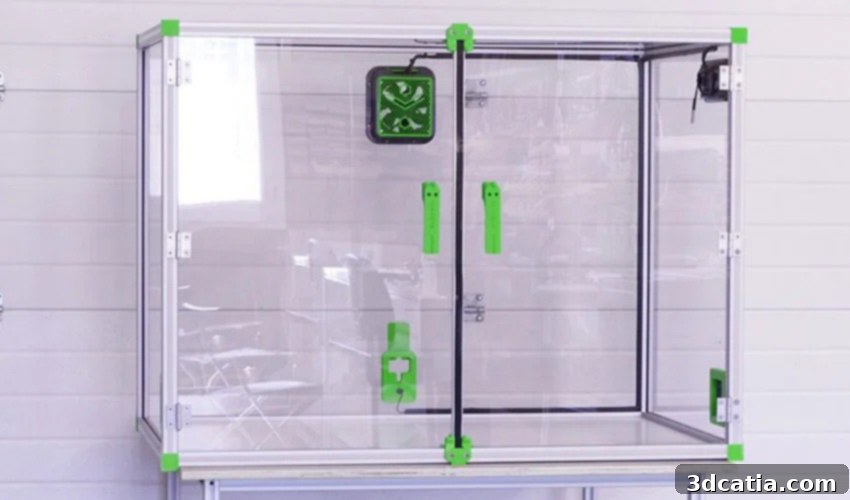
At its core, a 3D printer enclosure is a protective housing designed to surround your 3D printing equipment. Ranging in size from compact units for desktop printers to large cabinets for industrial machines, these boxes are meticulously engineered to provide a controlled environment. The construction materials typically vary, with popular choices including transparent acrylic (Plexiglas) or durable polycarbonate, allowing users to monitor the print process without opening the enclosure. While commonly associated with FDM 3D printers, where they play a vital role in temperature regulation and emission control, enclosures are equally beneficial for resin-based machines such as SLA (Stereolithography) and DLP (Digital Light Processing) printers. For resin printers, their primary function shifts slightly to effectively contain the strong, often unpleasant, odors associated with liquid photopolymer resins and to block ambient UV light, which can prematurely cure the resin.

3D printer enclosures come in a variety of sizes (Photo Credits: Prusa)
Enhancing User Comfort and Safety: A Multifaceted Approach
One of the most immediate and appreciated benefits of integrating a 3D printer enclosure into your setup is the significant improvement in user comfort. Modern 3D printers, while increasingly sophisticated, can still generate considerable noise, particularly during rapid movements of the print head and cooling fan operation. An enclosure acts as an effective sound dampener, significantly reducing ambient machine noise. This is particularly valuable if your printer is situated in a shared living space, a home office, or any environment where noise can be a distraction. The degree of noise reduction will naturally vary depending on the enclosure’s construction and your printer’s specific model, but even basic enclosures offer a noticeable improvement, fostering a quieter, more conducive workspace.
Beyond acoustics, an enclosure provides an essential layer of protection for your valuable equipment. It shields the 3D printer from various external factors that could otherwise compromise its performance or longevity. Dust, a pervasive enemy of electronics and precision machinery, is kept at bay, preventing accumulation on moving parts and delicate sensors. Similarly, an enclosure can protect against harmful UV radiation, which can degrade certain filament types (especially resins) and even impact plastic components over time. Furthermore, in humid environments, an enclosure can help create a microclimate that reduces the printer’s exposure to moisture, which is crucial for sensitive filaments like Nylon and PVA that are highly hygroscopic and absorb moisture from the air, leading to compromised print quality.
A particularly vital function of 3D printer enclosures, especially when working with certain materials, is the effective management of odors. Anyone who has printed with ABS, ASA, or specific types of resin knows that these materials can emit distinct, often pungent and unpleasant, fumes. An enclosure, particularly when equipped with an integrated filtration system, can effectively camouflage and neutralize these odors, dramatically enhancing the working environment. This is paramount for maintaining comfort and reducing irritation, transforming the printing process into a much more pleasant experience.
Finally, and perhaps most critically, 3D printer enclosures are instrumental in mitigating the health risks associated with machine emissions. As previously mentioned, 3D printing, especially FDM with various plastics and resin printing, can release ultrafine particles (UFPs) and volatile organic compounds (VOCs). UFPs, microscopic airborne particles, are small enough to penetrate deep into the lungs, and prolonged exposure has been linked to potential respiratory issues. VOCs are gaseous chemicals that can cause irritation and, in some cases, have more serious long-term health implications. A well-designed enclosure often comes equipped with an integrated filtration system, typically featuring a combination of a HEPA (High-Efficiency Particulate Air) filter to capture UFPs and an activated carbon filter to absorb VOCs. This system effectively ventilates the enclosed workspace, containing and filtering harmful emissions before they can disperse into the broader environment, thereby protecting the user and anyone else in the vicinity. By creating a controlled, contained space, the enclosure facilitates the efficient evacuation and purification of these airborne contaminants, making the 3D printing process significantly safer. Additionally, the physical barrier of an enclosure provides an important safety measure, preventing accidental burns from hot nozzles or heated beds, and shielding users from moving mechanical parts, which is especially important in shared spaces or homes with children or pets.
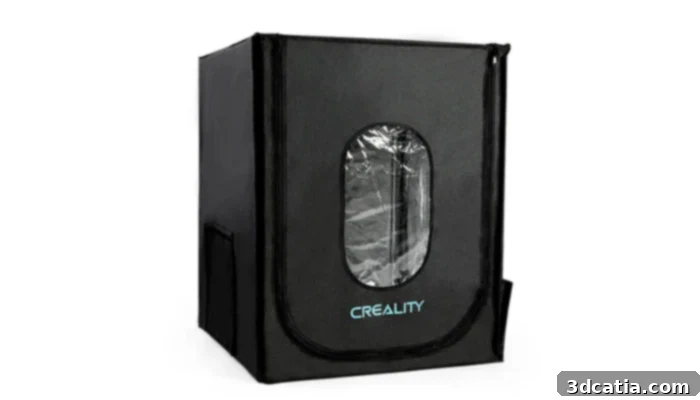
A 3D printer enclosure from Creality (Photo Credits: Creality)
Guaranteeing Superior Print Quality and Reliability
Beyond safety and comfort, one of the most compelling reasons to invest in a 3D printer enclosure is its profound impact on print quality. In 3D printing, especially with FDM technology, precise temperature management is absolutely paramount. Maintaining consistent thermal stability throughout the print process is critical to prevent a host of common print failures, including warping, cracking, and delamination. These issues arise when the printed material cools unevenly or too rapidly, causing internal stresses that pull the part away from the build plate or cause layers to separate. Different materials have varying thermal properties; while PLA (Polylactic Acid) is relatively forgiving, technical thermoplastics such as ABS (Acrylonitrile Butadiene Styrene), ASA (Acrylonitrile Styrene Acrylate), Nylon, and Polycarbonate (PC) are highly sensitive to temperature fluctuations. These advanced filaments typically require a consistently heated build plate and, ideally, an actively or passively heated print chamber to achieve optimal results. An enclosure effectively encapsulates the heat generated by the heated bed and nozzle, creating a stable, warm microclimate around the printing area. This uniform temperature environment allows the material to cool down more gradually and evenly, drastically reducing the chances of shrinkage-related defects and ensuring stronger, more accurate parts.
Moreover, enclosures act as a crucial barrier against environmental drafts. Even subtle air currents in a room can introduce localized cooling, leading to uneven thermal contraction within a print and increasing the likelihood of warping and layer adhesion issues. By isolating the print chamber from external drafts, an enclosure ensures that the material experiences a predictable cooling rate, which is essential for achieving smooth, consistent prints, particularly for tall or intricate geometries. For materials like ABS, which are notoriously prone to warping, an enclosure transforms a challenging print into a routine success, making these advanced materials more accessible to a wider range of users. Furthermore, a stable thermal environment created by an enclosure can indirectly enhance bed adhesion, as it helps maintain the bed’s temperature more consistently, reducing the thermal shock that can cause prints to detach prematurely. In essence, an enclosure serves as a kind of thermal shield, meticulously safeguarding your prints from the capriciousness of ambient conditions and elevating your 3D printing capabilities to a professional standard.
Choosing Your Enclosure: Options and Manufacturers
When it comes to selecting a 3D printer enclosure, the market offers a diverse range of options catering to various needs, budgets, and printer types. Many leading FDM/FFF 3D printer manufacturers, recognizing the immense benefits, have developed their own purpose-built enclosures specifically designed for their machines. Companies like Creality, Prusa Research, and FLSUN offer integrated or aftermarket solutions that perfectly complement their printer lines, ensuring compatibility and ease of installation. These manufacturer-specific enclosures often boast features tailored to their printers, such as optimal dimensions, dedicated mounting points for accessories, and sometimes even integrated electronics for environmental monitoring.
The types of enclosures available vary significantly in design and construction. At the more affordable end of the spectrum, you’ll find soft, tent-like enclosures typically made from flame-retardant fabric. These are lightweight, easy to assemble, and offer basic thermal insulation and dust protection, making them a popular choice for beginners or those with limited space. Moving up, rigid enclosures crafted from acrylic, polycarbonate, or aluminum composite panels provide superior thermal stability, noise reduction, and structural integrity. These can range from simple clear boxes to more sophisticated units with active filtration systems, lighting, and even integrated cameras for remote monitoring. For the intrepid do-it-yourselfer, the internet abounds with creative DIY enclosure designs. From repurposing IKEA Lack tables to custom-building enclosures from wood or aluminum extrusions, the DIY approach offers unparalleled customization and can be a cost-effective solution for those with a knack for building.
Beyond general-purpose enclosures, specialized manufacturers like Alveo3D, a French company, have carved out a niche by focusing exclusively on high-quality, often custom-made, enclosures for 3D printers. Such specialists often provide advanced features, robust construction, and bespoke solutions that can be adapted to virtually any machine size or specific operational requirement, from enhanced filtration to specialized temperature control. When choosing an enclosure, consider your specific needs: the type of materials you print (e.g., highly volatile ones might demand active filtration), your printer’s size, your budget, and the environment in which you print. Whether you opt for an off-the-shelf solution from your printer’s manufacturer, a specialized product, or embark on a DIY project, adding an enclosure is a smart investment that significantly upgrades your 3D printing experience in terms of safety, performance, and peace of mind.
Do you currently use an enclosure for your 3D printer? We’d love to hear about your experiences, tips, and favorite models! Share your thoughts in a comment below or connect with us on our LinkedIn or Facebook pages! Plus, don’t forget to sign up for our free weekly Newsletter to get the latest 3D printing news straight to your inbox. You can also find all our videos on our YouTube channel.
*Cover Photo Credits: Alveo3D