
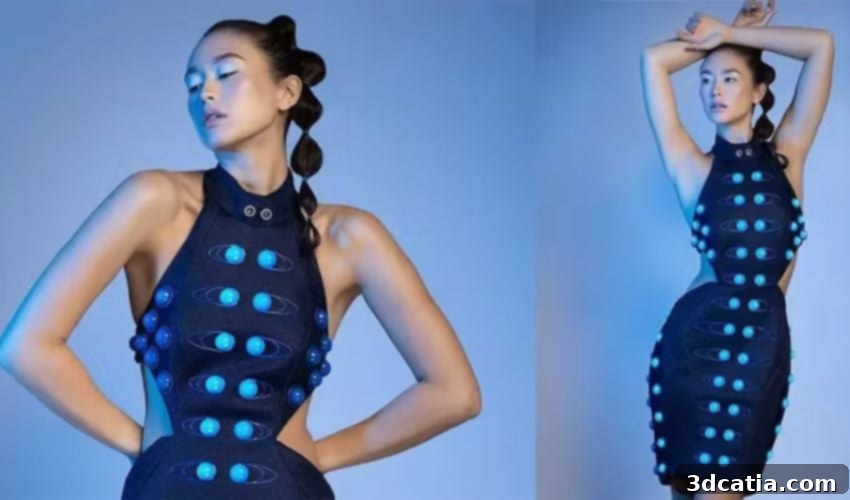
Revolutionizing Fashion: Anouk Wipprecht’s Interactive 3D Printed Dress and the Future of Wearable Technology
The landscape of manufacturing is undergoing a profound transformation, with additive manufacturing, commonly known as 3D printing, increasingly moving from niche applications to mainstream industries. What was once confined to rapid prototyping and industrial tooling is now shaping the future of diverse sectors, and perhaps nowhere is this more vibrantly evident than in the fashion industry. As we’ve seen from various examples, the synergy between innovative design and additive manufacturing technology has paved the way for truly spectacular results, pushing the boundaries of what is conventionally thought possible in clothing and accessories. This evolution is driven by continuous advancements in both material science and 3D printing techniques, empowering fashion designers to experiment with unprecedented freedom. The ability to fuse complex digital designs with physical forms allows for the creation of garments that were once the exclusive domain of science fiction, challenging traditional notions of textile production and aesthetic expression. While the full scope of future projects in this rapidly evolving industry remains to be seen, the groundbreaking designs showcased to date have undeniably captured global attention and ignited imaginations.
Recent showcases at major fashion events around the world perfectly illustrate this exciting progression. At London Fashion Week, for instance, visionary designer Jayne Pierson unveiled her “Ceridwen” collection, a breathtaking display that masterfully integrated Stratasys’ cutting-edge 3DFashion technology. This sophisticated multi-material printing process, combined with Pierson’s profound ingenuity and artisanal craftsmanship, resulted in garments that transcended mere clothing to become genuine works of wearable art. The collection demonstrated how 3D printing could be seamlessly incorporated into textile designs, creating intricate textures and dynamic forms directly onto fabric, previously unattainable with traditional methods. Similarly, at last year’s prestigious Paris Fashion Week, the revered haute couture designer Iris van Herpen, a long-standing pioneer in the realm of 3D printed fashion, collaborated with the iconic ice cream brand Magnum. Their partnership yielded a stunning 3D printed couture dress, designed not only to promote one of the brand’s premium ice creams but also to push the boundaries of sustainable and intricate garment creation, showcasing delicate, organic forms only achievable through additive manufacturing. Building on these pioneering efforts, Formnext 2023 witnessed yet another groundbreaking collaboration: celebrated fashion designer Anouk Wipprecht, known for her fusion of fashion and technology, teamed up with innovative 3D printing company Chromatic 3D Materials. Together, they designed and manufactured a truly revolutionary 3D printed dress, distinguished by its unique domes of LED lights that intelligently respond to their environment, offering an interactive and dynamic sartorial experience.
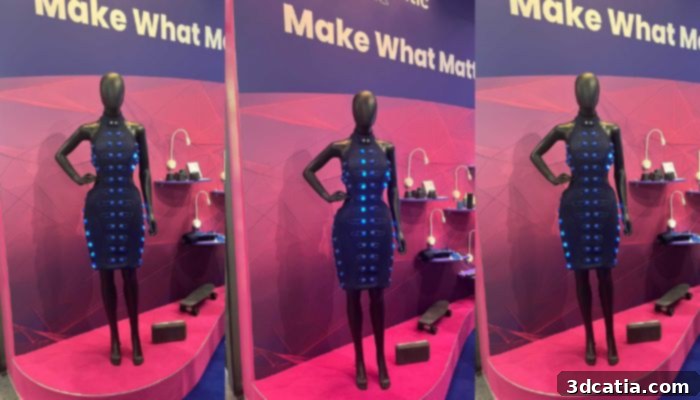
A closer look at the 3D printed dress at Formnext 2023 (Credits: 3Dnatives)
Among the myriad innovations presented at Formnext 2023, Anouk Wipprecht’s interactive 3D printed dress undoubtedly stood out as a highlight, drawing significant attention to the rapidly evolving application of 3D printing in the fashion industry. This creation is not merely an artistic statement; it represents a significant technological leap forward. Its most compelling feature is the precise and direct integration of complex electronic components into 3D-printed elastomers. This direct embedding capability is a game-changer, shattering previous limitations and unlocking boundless possibilities for the imagination in the creation of future garments. No longer are electronics cumbersome additions; they become an intrinsic, seamless part of the fabric itself. The use of motion-activated LED bulbs, dynamically lighting up and responding to the wearer’s movements or external stimuli, serves as a prime illustration of the Dutch designer’s boundless creativity and her relentless pursuit of interactive fashion. This method ensures that the electronics are not only securely housed but also maintain the garment’s flexibility and comfort, essential qualities for wearable technology. The integration opens doors to truly smart textiles, where clothing can adapt, communicate, and even enhance human interaction with the surrounding world.
Anouk Wipprecht herself articulated the profound impact of this collaboration, stating, “Using Chromatic’s 3D materials to print offers numerous possibilities for the fashion industry. For designers like me, who incorporate electronics into our creations, it provides a unique opportunity of embedding and securing electronic parts within the printing process.” This powerful statement highlights the transformative potential for designers who are eager to push the envelope of wearable technology. The traditional challenges of integrating delicate electronics into fabric—often involving bulky casings, rigid wires, and complex manual assembly—are largely circumvented by this direct printing method. The collaboration between Wipprecht and Chromatic 3D Materials stands as a compelling testament to the advanced capabilities of Chromatic’s innovative 3D printing technologies. Through the sophisticated application of additive manufacturing, more than 70 distinct flexible LED domes were meticulously designed and manufactured. Crucially, these components were engineered to be directly attached to the garment’s surface without the need for any traditional adhesives, glues, or cumbersome stitching. This seamless integration ensures not only the aesthetic purity of the design but also enhanced durability and comfort for the wearer, setting a new benchmark for smart fashion.
The extraordinary capabilities demonstrated by Chromatic 3D Materials, particularly through their collaboration with Anouk Wipprecht, have propelled the company to explore exciting new avenues for expansion. Beyond haute couture, Chromatic 3D is now actively considering diverse fields such as high-performance sportswear, cutting-edge accessories, and even advanced vehicle interiors. This strategic diversification is driven by the unique properties of their specialized materials. Unlike many conventional 3D printed materials that can be rigid or brittle, ChromaFlow 70 – the innovative material central to Anouk Wipprecht’s dress – offers a paradigm shift. This remarkable elastomer boasts exceptional heat resistance, ensuring stability and integrity even under varying thermal conditions. Its inherent flexibility allows for intricate designs and comfortable wear, crucial for anything designed to move with the human body. Furthermore, ChromaFlow 70 is distinguished by its high elasticity, capable of stretching up to four times its original size without compromising its structural integrity or returning to its initial form. These combined characteristics make it an ideal candidate for a wide array of consumer goods where durability, comfort, and dynamic performance are paramount. Imagine sportswear that incorporates integrated sensors directly into the fabric, providing real-time biometric data, or interactive accessories that change color or pattern based on mood or environment. In vehicle interiors, this material could enable customizable tactile surfaces, integrated lighting, or even smart components that respond to driver input, truly blending functionality with futuristic aesthetics.
Cora Leibig, founder and CEO of Chromatic 3D Materials, eloquently captured the essence of this pioneering effort, stating, “This collaboration is more than a partnership — it’s a vision coming to life. By merging the genius of Anouk Wipprecht with our innovative 3D printing, we’re setting the precedent for the future of fashion. We are embarking on a journey that amplifies the boundless integration of tech and art, opening doors for endless possibilities and applications in textiles and fashion.” Her words underscore the profound impact of combining visionary design with advanced material science, moving beyond traditional manufacturing limitations to create truly intelligent and responsive textiles. This partnership highlights not just the technical feasibility but the artistic imperative to explore new forms of expression. The implications for the fashion industry are vast, promising a future where garments are not merely static objects but dynamic interfaces that interact with the wearer and their environment. This revolutionary approach enables bespoke, on-demand manufacturing, reducing waste and fostering sustainable practices within a traditionally resource-intensive industry. It paves the way for a new era of personalized fashion, where clothing can be precisely tailored to individual needs, preferences, and even biometric data. The fusion of technology and art, exemplified by Anouk Wipprecht’s dress, heralds a future where fashion is more functional, more interactive, and inherently more sustainable. To delve deeper into the innovative materials and intricate design of this pioneering dress, further information is available by clicking HERE.
The rapid advancements in 3D printing technology are undeniably reshaping the fashion industry, offering unprecedented creative freedom and opening new frontiers for design, functionality, and personalization. From haute couture runways to everyday sportswear, the integration of additive manufacturing is allowing designers to realize visions that were once confined to the imagination. The collaboration between Anouk Wipprecht and Chromatic 3D Materials, culminating in the interactive LED-adorned dress at Formnext 2023, stands as a powerful testament to this transformative era. It showcases how smart materials and integrated electronics can create garments that are not only aesthetically captivating but also intelligent and responsive, blurring the lines between clothing and technology. This evolution promises a future where fashion is dynamic, sustainable, and intimately connected to the wearer’s experience. What are your thoughts on Anouk Wipprecht’s latest 3D fashion design and the broader implications for wearable technology? We encourage you to share your perspectives in a comment below or engage with us on our LinkedIn, Facebook, and Twitter pages! Don’t forget to sign up for our free weekly Newsletter here to receive the latest 3D printing news directly in your inbox. You can also explore all our insightful videos on our YouTube channel for more in-depth content.
*Cover image credits: Chromatic 3D