
The Great Pagoda at Kew Gardens: How 3D Printing Restored Its Iconic Dragons After 230 Years
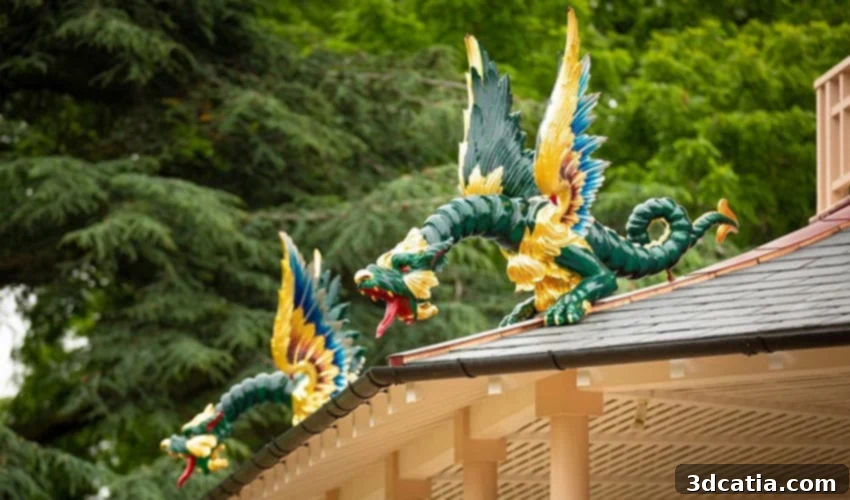
London beckons this summer, inviting visitors to immerse themselves in a blend of historical grandeur and cutting-edge innovation. A highlight of any trip to the capital’s magnificent Kew Gardens is undoubtedly the Great Pagoda, an architectural marvel that has recently undergone a breathtaking restoration. This octagonal, ten-storey tower, originally designed in 1762 by Sir William Chambers, has not only been meticulously brought back to its former glory but has also seen the triumphant return of its iconic dragon guardians – seventy-two of them, reimagined and produced with advanced 3D printing technology after an absence of over 230 years. Today, these vibrant, digitally crafted dragons proudly adorn the Pagoda once more, completing Sir William’s original visionary design and offering a spectacular sight to all who visit.
The Great Pagoda stands as a testament to 18th-century European fascination with Chinoiserie, a decorative style inspired by Chinese art and design. Commissioned by Princess Augusta, the visionary founder of Kew Botanical Gardens, the Pagoda was conceived as a whimsical yet majestic feature within her ambitious landscape gardens. At each corner of its ten tiers, the tower was originally embellished with meticulously crafted painted wooden dragons, adding an exotic flourish and vibrant character to the structure. However, approximately two decades after its completion, these distinctive adornments were regrettably removed during essential roof repairs and, for reasons lost to time, were never replaced. For centuries, the Pagoda stood incomplete, its corners bare, a silent reminder of its missing decorative elements. As a UNESCO World Heritage site, the architectural preservation of Kew Gardens and its structures, including the Great Pagoda, is of paramount importance, necessitating substantial and sensitive restoration work. The responsibility for this intricate project fell to Historic Royal Palaces (HRP), who quickly recognized that reviving these lost dragons would be anything but a straightforward task.
A beautifully restored 3D printed dragon adorns the Great Pagoda.
The Challenge: Recreating 72 Iconic Dragons
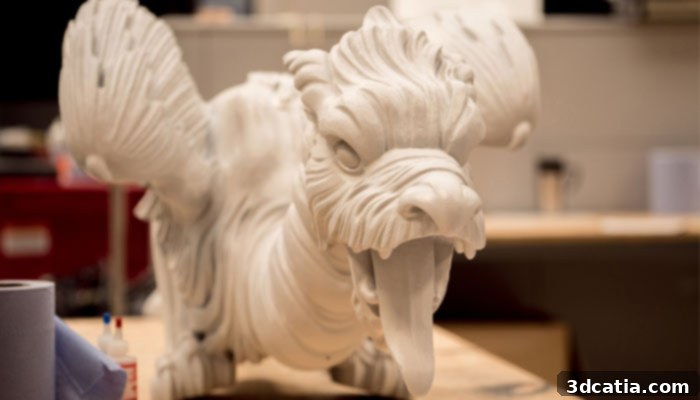
Restoration projects involving historical monuments are inherently complex, often protracted, and frequently come with significant financial implications. The challenge is magnified when the objective is to precisely reproduce original elements that have been lost for centuries, demanding not only design accuracy but also material suitability for long-term outdoor exposure. Traditional methods of recreation, involving skilled artisans carving 72 unique wooden dragons, would have been prohibitively costly, time-consuming, and potentially problematic in terms of ensuring consistent quality and structural integrity. Furthermore, adding significant weight to a centuries-old structure required careful consideration. It became clear that an innovative approach was necessary to overcome these hurdles, and advanced 3D printing technology emerged as the ideal solution to bring these magnificent creatures back to life. HRP turned to the expertise of 3D Systems, leveraging their state-of-the-art Selective Laser Sintering (SLS) technology to create lightweight, durable, and historically accurate replicas of the original dragons.
Craig Hatto, the Project Director at HRP, articulated the reasons behind this pioneering choice: “We turned to 3D Systems for the project’s demanding requirements concerning pace, precise details, and excellent finishes. The engineering acumen of the 3D Systems team, their capability to significantly lighten the dragon statues, and the inherent material durability offered by 3D SLS printing were absolutely critical factors in the success of this monumental restoration.” This strategic partnership underscored a commitment to embracing modern solutions while upholding the highest standards of historical preservation, making the Kew Gardens Pagoda restoration a landmark achievement in cultural heritage.
The Digital Workflow: From Historical Data to Physical Form
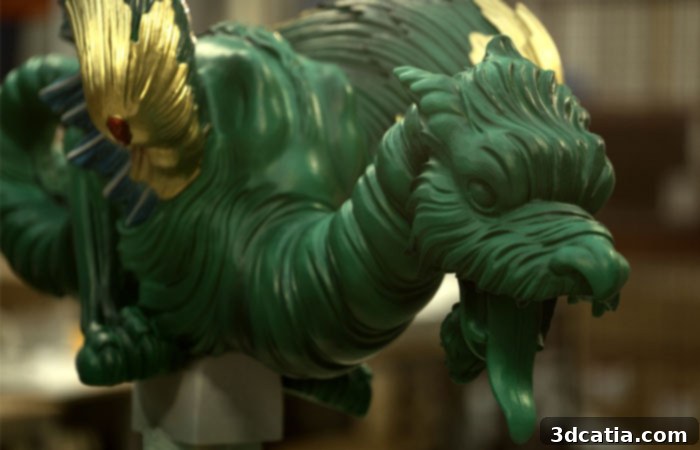
The restoration journey of the Pagoda’s dragons exemplifies a sophisticated blend of digital precision and traditional craftsmanship. The project began with the meticulous scanning of any available historical information or surviving fragments of the original wooden dragons, utilizing advanced tools like the FARO ScanArm Scanner. This crucial step allowed the team to capture precise three-dimensional data, forming the digital blueprint for the new replicas. Once the digital models were established, Computer-Aided Design (CAD) software became indispensable. Through CAD, designers were able to intricately add fine details to the dragons, ensuring their aesthetic fidelity to the original 18th-century designs. More critically, CAD enabled a significant structural optimization: the dragons’ weight was reduced by an impressive 60%. This substantial weight reduction was paramount, as it minimized the additional load placed on the historic 260-year-old tower, thereby safeguarding its long-term structural integrity and ensuring the longevity of the restoration. Furthermore, the adaptability of CAD data allowed for the dragons to be precisely scaled, producing them in a variety of sizes ranging from 1150 mm to 1850 mm in length, each perfectly suited for its specific position on the ten-storey edifice.
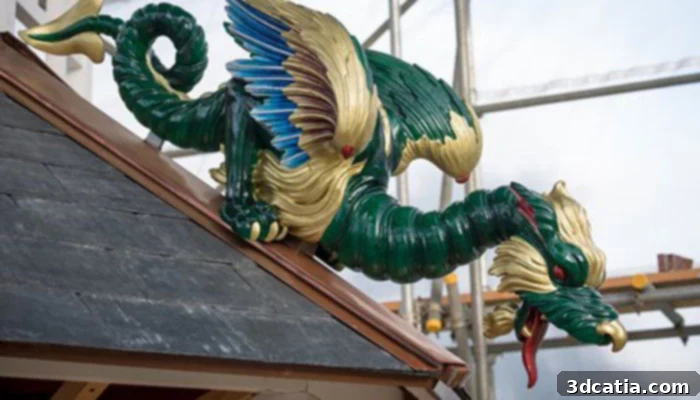
With the digital designs finalized, the 72 dragons were brought into physical existence using 3D Systems’ cutting-edge SLS machines. The material of choice was DuraForm PA, a robust nylon polyamide. This particular material was selected for its exceptional properties, including its durability, resistance to environmental elements, and its ability to be finished to a degree that is strikingly comparable to the original wooden statues. SLS technology allowed for the creation of complex geometries with high precision, producing parts that were both strong and lightweight, perfectly aligning with the project’s dual requirements of historical accuracy and structural consideration. Following the additive manufacturing process, each of the 3D printed parts underwent a crucial final stage: hand-painting. This artistic endeavor ensured that every dragon was imbued with the vibrant colors and gilded finishes reminiscent of their 18th-century predecessors, meticulously bringing them to life and ensuring they visually integrated seamlessly with the Pagoda’s intricate architecture. Phil Schultz, Vice President and General Manager of 3D Systems, eloquently summarized the profound significance of this project: “We often see 3D printing technology applied to groundbreaking new innovations. So, when we have the rare opportunity to literally help write history, it’s incredibly exciting. Through this collaborative effort with Historic Royal Palaces, we’ve been able to introduce a new technology to a historic monument, effectively restoring its former beauty and safeguarding its future for generations to come.” This endeavor highlights the transformative potential of additive manufacturing in preserving and enhancing our shared cultural heritage.
A Legacy Preserved: The Impact of 3D Printing on Heritage Sites
The restoration of the Great Pagoda at Kew Gardens is more than just a refurbishment; it is a powerful demonstration of how pioneering 3D printing technology can revolutionize the field of cultural heritage preservation. By leveraging SLS technology, HRP and 3D Systems have set a new benchmark for combining historical accuracy with modern efficiency. The ability to recreate intricate architectural details like the 72 dragons, while simultaneously addressing structural concerns through weight reduction and material durability, offers a viable and sustainable model for future restoration projects globally. This project showcases how digital fabrication can provide precise, robust, and cost-effective solutions for sites facing similar challenges of decay, loss, or deterioration of original elements. It proves that innovation can serve tradition, ensuring that iconic landmarks like the Great Pagoda continue to inspire and educate for centuries to come, allowing visitors to experience them as their original designers intended.
Stepping into Kew Gardens today and beholding the Great Pagoda with its dragons triumphantly reinstated is to witness history vividly reimagined. The once-bare corners of the tower now burst with color and intricate detail, bringing Sir William Chambers’ original vision to full, spectacular fruition. The dragons, symbols of power and good fortune, not only restore the aesthetic integrity of the Pagoda but also enrich the entire visitor experience, inviting a deeper appreciation for both historical artistry and the ingenuity of contemporary engineering. This successful restoration reinforces Kew Gardens’ status as a premier destination, offering an unparalleled journey through botany, architecture, and technological innovation. It’s an invitation to explore the beautiful gardens and marvel at this historic monument, now more magnificent than ever.
For those interested in delving deeper into the specifics of this remarkable 3D printed dragon project, additional information can be found on the official website of 3D Systems. Further visual insights and details about the restoration process are also available in the embedded video below:
What are your thoughts on the stunning restoration of the Great Pagoda and the use of 3D printing to bring its dragons back to life? We’d love to hear your perspective! Share your comments below or engage with us on our Facebook and Twitter pages. Don’t forget to sign up for our free weekly Newsletter to receive all the latest news and innovations in 3D printing directly in your inbox!