
Advancing Automotive Lightweighting: DOE Awards $3M for Durable 3D Printed Tooling with Cyclic Olefin Resin Composites
The U.S. Department of Energy (DOE) has announced a significant investment of $3 million, awarded to a collaborative team comprising polySpectra, Fortify, the National Renewable Energy Laboratory (NREL), MPI Systems, RePliForm Inc., and Oak Ridge National Laboratory (ORNL). This substantial funding is earmarked for a groundbreaking project focused on the development of highly durable, direct 3D printed tooling, specifically designed for automotive lightweighting applications utilizing advanced Cyclic Olefin Resin-based composites. This initiative aligns perfectly with the DOE’s overarching strategic objectives: to aggressively decarbonize the U.S. industrial sector, accelerate advancements in clean energy manufacturing, and bolster America’s economic competitiveness while fostering greater workforce diversity across the nation.
In an era increasingly defined by the urgent challenges of climate change, the concepts of decarbonization and clean energy manufacturing have transcended mere corporate buzzwords to become critical imperatives for industries worldwide. The DOE, particularly through the pioneering research conducted at institutions like ORNL, has consistently been at the forefront of this transformation. Their efforts have spanned a wide array of research into how various technologies, with a particular emphasis on additive manufacturing, can be leveraged to create more sustainable and cleaner energy solutions. This latest financial commitment from the DOE underscores a profound confidence in the transformative potential of additive manufacturing when applied to tooling. The department’s vision is that Fortify, renowned for its expertise in 3D printers tailored for advanced photopolymer composites, and polySpectra, a leading supplier of exceptionally durable photopolymer resins, will collectively drive significant advancements. Their combined efforts are expected to improve cost-effectiveness, enhance durability, and, crucially, elevate the overall sustainability of manufacturing processes by integrating cutting-edge additive manufacturing techniques with innovative resin-based composites.
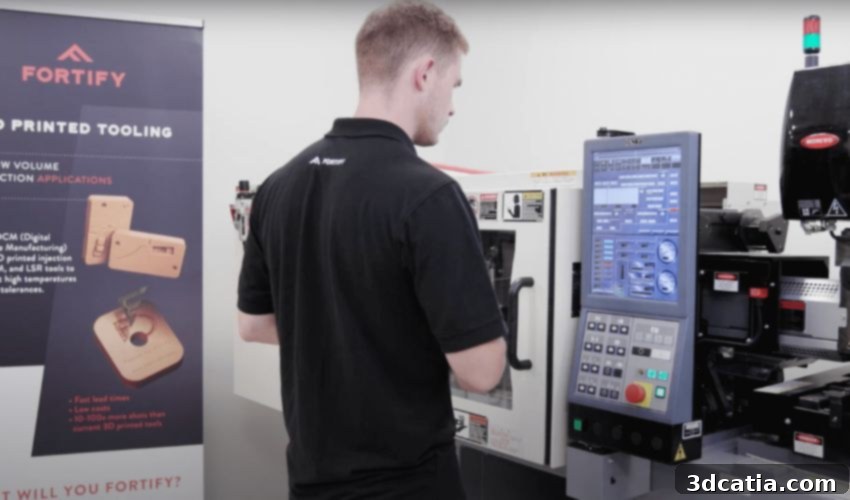
Fortify already has significant experience in the arena of 3D printed tooling. The company combines 3D printed molds with injection molding for robust solutions (photo credits: Fortify)
Pioneering Material Science: Cyclic Olefin Resins for Unprecedented Durability
The core of this ambitious project lies in the innovative application of materials science. Raymond Weitekamp, founder of polySpectra and the principal investigator for this prestigious award, elaborated on the strategic importance of the chosen materials. He stated, “Olefin-based thermoset composites have been utilized for many decades in incredibly demanding applications such as the construction of wind turbine blades and critical fuel cell components. This is largely due to their status as being among the most durable materials currently available on the planet. Under the framework of this research grant, we are set to leverage Nobel-winning chemistry to directly 3D-print these inherently robust composite Cyclic Olefin Resins.”
The reference to “Nobel-winning chemistry” points to the revolutionary advancements in olefin metathesis, a catalytic organic reaction that enables the rearrangement of carbon-carbon double bonds in olefins. This allows for the creation of new, more complex, and highly stable organic molecules and polymers. Applying this advanced chemical understanding to additive manufacturing unlocks the potential to produce materials with superior mechanical properties, thermal stability, and chemical resistance directly through 3D printing. Weitekamp further articulated the paramount objective of the DOE project: “The goal of the DOE project is to bring unprecedented materials durability to additive manufacturing, which will provide the industry with immense leverage for the decarbonization and reshoring of the US manufacturing sector.” This pursuit of extreme durability is not merely an engineering feat; it’s a strategic move to reduce the lifecycle impact of tooling, prolong the service life of manufactured components, and establish a more resilient, localized manufacturing ecosystem within the United States. By enabling the creation of tools that can withstand higher stresses and longer production runs, the project aims to reduce waste, downtime, and the overall carbon footprint associated with industrial tooling.
The Transformative Benefits of Advanced 3D Printed Tooling
3D printed tooling has long been recognized as one of the most impactful applications of additive manufacturing, particularly when integrated with complementary processes such as injection molding. The myriad benefits offered by AM-driven tooling make it an attractive alternative to traditional manufacturing methods. One of the primary advantages lies in the unparalleled design flexibility that additive manufacturing affords. Unlike subtractive manufacturing techniques like CNC machining, which are constrained by tool paths and material removal, 3D printing allows for the creation of highly intricate geometries, including internal features like conformal cooling channels. These channels precisely follow the contours of a mold, enabling more efficient heat dissipation during injection molding, which in turn reduces cycle times, improves part quality, and extends tool life. This flexibility also significantly shortens design iterations, enabling engineers to rapidly prototype and refine tool designs, saving valuable time and material resources.
Beyond design freedom, 3D printed tooling offers substantial advantages in terms of sustainability. Compared to conventional CNC machining, which often generates a considerable amount of material waste in the form of chips and shavings, additive manufacturing is inherently a ‘near-net-shape’ process. It builds parts layer by layer, depositing material only where it’s needed, thereby minimizing scrap and optimizing material utilization. This reduction in material waste directly translates to a lower environmental footprint and can lead to significant cost savings in raw materials. Furthermore, the ability to produce tools on-demand and localize production can shorten supply chains, reduce transportation emissions, and enhance overall manufacturing efficiency. These compelling factors collectively underscore the DOE’s profound interest in harnessing this technology to cultivate more sustainable and resource-efficient manufacturing practices across various industrial sectors.
This project aims to develop additive tooling in the automotive industry, leveraging innovation for efficiency (photo credits: Volkswagen)
Revolutionizing Automotive Lightweighting and Commercial Vehicle Production
The specific focus of this project is to push the boundaries of additive manufacturing tooling until it achieves parity, and ultimately superiority, with traditional CNC tooling in terms of both cost-effectiveness and durability. The ultimate vision is to develop what the consortium describes as a “next generation solution for creating long-lasting inserts for the molding of production volumes of lightweight automotive components from engineering-grade materials, including polymers, composites, and metals.” This ambitious goal addresses a critical need within the automotive industry: the efficient and sustainable production of lighter vehicles. Lightweighting is paramount for improving fuel efficiency in internal combustion engine vehicles and extending the range of electric vehicles, directly contributing to reduced greenhouse gas emissions and lower operating costs.
The innovative tooling developed through this project will facilitate the high-volume production of complex, lightweight parts that are often challenging or impossible to create with traditional methods. By enabling the molding of advanced polymers, composites, and even metal components with enhanced precision and speed, the project directly supports the automotive sector’s transition towards more sustainable manufacturing processes. Ultimately, the work undertaken is expected to profoundly address the demand for advanced methods in commercial vehicle part production, ensuring that future fleets are not only more efficient but also more sustainably manufactured. Moreover, as highlighted in the official press release, the integration of additive manufacturing in tooling will significantly accelerate improvements in transportation vehicle fuel efficiency. This ripple effect will lead to substantial energy savings and a marked reduction in overall emissions across the transportation sector, delivering tangible environmental and economic benefits on a national scale.
Fostering Workforce Diversity and Advancing Rapid Tooling Skills
An equally vital and forward-thinking aspect of this comprehensive project is its commitment to amplifying the representation and participation of underrepresented groups within the automotive manufacturing sector. This critical objective will be realized through the implementation of targeted training and recruitment programs designed to equip individuals with essential skills in additive manufacturing and rapid tooling. By providing pathways to acquire expertise in these cutting-edge technologies, the project aims to cultivate a diverse pool of highly skilled candidates who are well-prepared to enter and thrive in the modern automotive workforce. This strategic focus addresses a long-standing challenge: the lack of representation, particularly among people of color and women, in both STEM fields generally and additive manufacturing specifically.
Investing in workforce diversity is not merely a social equity initiative; it is a strategic imperative for fostering innovation and competitiveness within the industry. Diverse teams bring a wider range of perspectives, experiences, and problem-solving approaches, which are crucial for driving technological advancements and navigating complex manufacturing challenges. By actively engaging and empowering underrepresented groups, the project ensures that the benefits of advanced manufacturing are accessible to a broader segment of society, creating new economic opportunities and contributing to a more inclusive industrial landscape. This forward-thinking plan, therefore, stands to be a genuine and lasting asset for the entire industry, promoting not only technological progress but also social equity and long-term economic resilience. You can delve deeper into the specifics of this initiative by reading the full press release HERE.
What are your thoughts on the U.S. Department of Energy’s proactive efforts to advance 3D printed tooling for automotive lightweighting and beyond? Let us know your insights in the comments below or join the conversation on our LinkedIn, Facebook, and Twitter pages! Don’t forget to sign up for our free weekly Newsletter here to receive the latest 3D printing news directly in your inbox. You can also explore all our informative videos on our dedicated YouTube channel.