
Revolutionizing Neurosurgery: Europe’s First 3D-Printed Bioresorbable Cranial Implant Signals a New Era
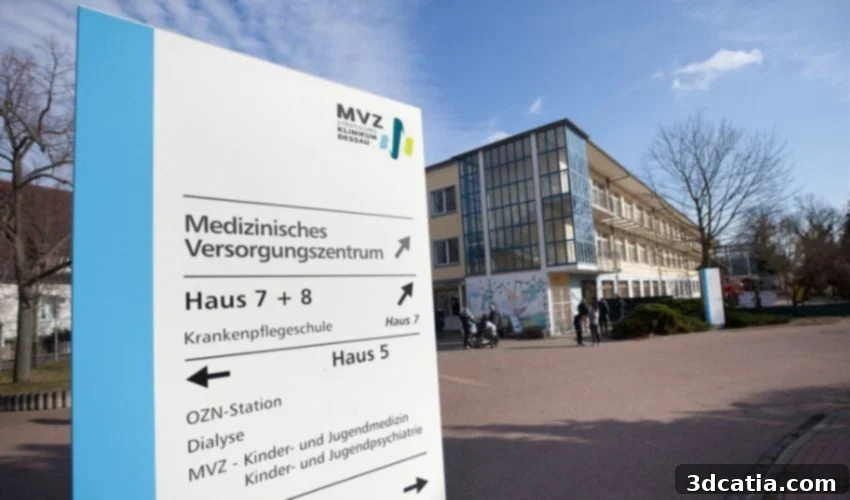
In a groundbreaking medical achievement that marks a significant milestone for European healthcare, neurosurgeons at the Municipal Hospital in Dessau, Germany, have successfully performed the continent’s first implantation of a bioresorbable cranial prosthesis produced using advanced 3D printing technology. This pioneering procedure not only highlights the innovative spirit of German medicine but also positions Dessau at the forefront of reconstructive cranial surgery, a method previously applied only in Asia. The successful operation paves the way for a future where patient-specific, regenerative solutions become the standard in complex neurosurgical interventions, promising enhanced recovery and long-term health benefits for patients.
The intricate surgery, lasting approximately 90 minutes, took place at the end of August, offering a new lease on life for a patient who had suffered a severe traumatic brain injury in late 2023. The injury was a result of a bicycle accident, leading to a critical condition where bleeding occurred between the brain surface and the skull bone. Such complications can be life-threatening, necessitating immediate and decisive action. To alleviate dangerous swelling and halt the bleeding, surgeons initially performed a craniectomy, carefully removing a part of the cranial bone flap. This removed bone was then deep-frozen at a chilling minus 80 degrees Celsius, a standard procedure intended for later reimplantation once the patient’s condition stabilized and the brain swelling subsided.
However, the patient’s journey to recovery encountered an unexpected and challenging setback. Despite initial hopes for a straightforward reimplantation, the body unfortunately rejected its own bone. This rejection presented a complex dilemma for the medical team. Rejection of autologous (patient’s own) bone, while rare, can occur due to various factors, including changes in bone viability or immune responses. This complication left the patient with a significant cranial defect, exposing the brain and posing severe risks of further injury or infection. For nearly 18 months, the patient lived with this condition, during which time the removed cranial bone flap, despite being preserved, had thinned considerably, making it unsuitable for reimplantation. This critical situation demanded an innovative approach, pushing the boundaries of conventional neurosurgical treatments.
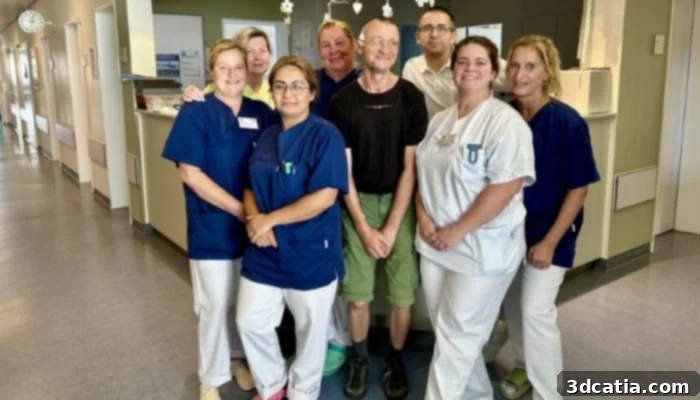
The dedicated care and medical team behind the breakthrough surgery
Faced with this formidable challenge, the surgical team and the patient collectively decided to embark on an unprecedented treatment path for Europe: a bioresorbable 3D-printed implant. This decision underscored a commitment to cutting-edge medical technology and patient-centric care. The innovative approach involved harnessing the patient’s own biological resources. Specifically, the team utilized the patient’s own bone marrow cells to create highly customized 3D biomodels. This personalization is a hallmark of additive manufacturing in medicine, ensuring a perfect anatomical fit and optimal integration with the surrounding tissues. The next crucial step was the collaborative effort with industry leaders Zimmer Biomet and Osteopore, renowned for their expertise in medical devices and regenerative solutions. Together, they meticulously 3D-printed a new cranial flap using advanced bioresorbable materials.
The selection of bioresorbable materials for the implant is central to its revolutionary nature. Unlike traditional implants made from metals or permanent plastics, which remain in the body indefinitely, bioresorbable materials are designed to gradually degrade and be absorbed by the body over time. The true genius of this method lies in the combination of these advanced materials with the patient’s own bone marrow cells. This synergistic approach facilitates a natural regeneration process. Over the coming months and years, the implant is expected to be progressively replaced by the patient’s natural bone tissue. This means that within a maximum of two years, no foreign material should remain within the patient’s body, drastically reducing the long-term risks associated with permanent implants, such as infection, erosion, or the need for future revision surgeries. This approach truly represents a paradigm shift from mere replacement to genuine biological regeneration.
The immediate outcome of the pioneering surgery was nothing short of a resounding success. Just five minutes after the scalp was meticulously closed, the patient awakened, a testament to the precision of the procedure and the resilience of the human body. The patient’s very first instinct upon waking was to gently touch the freshly implanted cranial flap. Their immediate feedback was overwhelmingly positive, describing the new skull as feeling “stable and firm,” an invaluable reassurance after enduring months of uncertainty and physical vulnerability. Christian Hohaus, the Chief Senior Physician of Neurosurgery at Dessau, expressed immense satisfaction regarding the outcome. He remarked, “Everything went very well, and I am pleased that we can now offer this innovative treatment to our patients in Dessau.” His statement reflects not only the success of this particular case but also the profound implications for future neurosurgical practices at the hospital and across Europe.
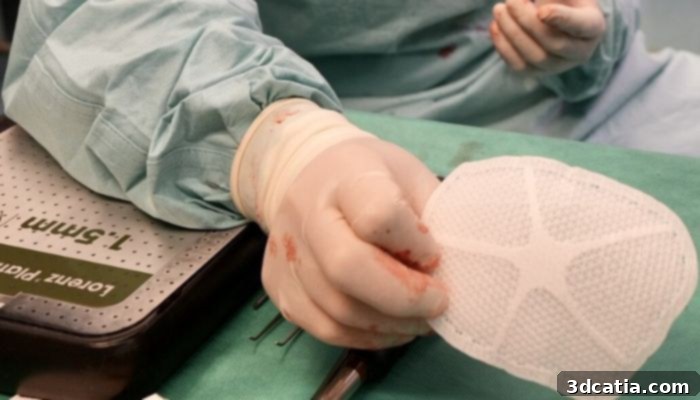
The 3D Printed Cranial Flap
This remarkable operation transcends the individual success story; it heralds a new and transformative era in reconstructive cranial surgery across Europe. The capabilities offered by 3D printing in this context are immense, enabling the creation of implants that are perfectly patient-specific, ensuring an optimal anatomical fit that reduces recovery time and improves functional and aesthetic outcomes. Furthermore, the inherent biocompatibility of the materials used minimizes the risk of adverse reactions, while the goal of full long-term integration into the body is a significant advancement over traditional methods. This breakthrough underscores the potential of combining additive manufacturing with regenerative medicine to deliver truly personalized and highly effective medical solutions.
The successful application of bioresorbable 3D-printed implants has far-reaching implications, promising to significantly expand the scope of neurosurgery in the future. Beyond traumatic brain injuries, such technology holds immense potential for cases involving extensive bone loss due to tumor resections, where surgeons must remove diseased bone alongside cancerous tissue. It could also provide superior solutions for complex skull injuries, congenital cranial defects, or even infections that necessitate the removal of bone. In scenarios where conventional reconstructive methods often reach their limits, this newly established method offers neurosurgeons in Dessau, and hopefully soon across Europe, novel and superior options in the service of their patients. This innovative approach promises improved patient quality of life, reduced complication rates, and potentially shorter hospital stays, representing a significant leap forward for medical science. More in-depth information about this pivotal moment can be found HERE.
As we look to the horizon of medical innovation, the Dessau case powerfully illustrates the profound impact of advanced manufacturing techniques like 3D printing on patient care. The ability to create complex, customized implants from bioresorbable materials is transforming the landscape of medical treatment, moving it closer to a fully personalized and regenerative model. This pioneering spirit extends to other areas of healthcare, from custom prosthetics and orthotics to surgical guides and even bioprinted tissues and organs. The success of this European first serves as a compelling proof-of-concept for the wider adoption of such technologies, fostering continued research and development in bioresorbable implants and patient-specific medical solutions globally.
The question remains: Does bioresorbable cranial prosthetics have a promising future in Europe? We invite you to share your thoughts and insights on this exciting development. Let us know in a comment below or join the conversation on our LinkedIn or Facebook pages! Don’t forget to sign up for our free weekly Newsletter to get the latest 3D printing news straight to your inbox. You can also find all our compelling videos on our YouTube channel. Interested in more medical and dental 3D printing news and advancements? Visit our dedicated page HERE to explore further innovations in this rapidly evolving field.
*All Photo Credit: Städtisches Klinikum Dessau