
Revolutionizing Dental Labs: How Additive Manufacturing Drives Growth, Efficiency, and Accuracy
The landscape of the dental laboratory business has undergone a profound transformation in recent years, with even more significant shifts anticipated on the horizon. Currently valued at an impressive $31.13 billion, according to a comprehensive report from Future Market Insights, this sector is poised for exponential growth. A primary driver for this expansion is the rapidly aging global population. In the United States and many other parts of the world, the demographic aged 65 years or older is expanding at a faster rate than the general population, largely due to declining birth rates and increased longevity. This demographic trend directly translates into a surging demand for a wide array of dental products, including essential prosthetics like dentures, crowns, and bridges. However, before dental laboratories can fully capitalize on this immense opportunity, they must strategically address a series of complex challenges. The most effective pathway to overcoming these hurdles lies in the widespread adoption of advanced additive manufacturing technologies, commonly known as 3D printing.
Dental laboratories are currently navigating significant obstacles to growth, affecting not only the broader market but also their daily operations. On an industry-wide scale, two major trends demand immediate attention. Firstly, there’s a notable increase in market competition, exacerbated by growing lab consolidation. This is occurring at a critical juncture when the dental market is forecasted for rapid recovery and growth after several years of decline. Larger, consolidated labs often benefit from economies of scale and broader service offerings, putting pressure on smaller, independent facilities. To effectively leverage this industry expansion and gain a competitive edge, dental labs must innovate to distinguish themselves within an increasingly saturated market. Standing out requires more than just traditional approaches; it necessitates embracing technologies that enhance efficiency, precision, customization, and overall value for dentists and patients.
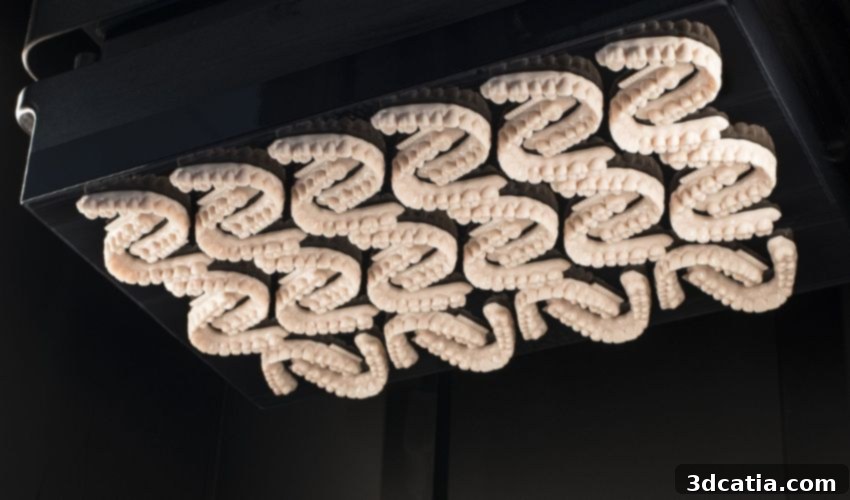
3D printed dentures, like the one pictured, can be precisely customized for each patient and produced significantly faster than many traditional methods, enhancing patient care and lab efficiency.
A second pressing trend impacting the dental industry is the critical shortage of skilled labor. Data from the United States Bureau of Labor Statistics reveals a concerning 20% decrease in the number of dental technicians between 2007 and 2017, with numbers falling from 44,530 to 35,630. This alarming trend has only intensified, particularly in the wake of the COVID-19 pandemic, which further exacerbated workforce challenges across various sectors. Fewer skilled professionals available to craft intricate dental products mean that a highly automated, hands-off digital workflow is no longer just an advantage but an absolute necessity for sustaining production volume and maintaining high quality standards in modern dental labs. Relying on traditional manual methods becomes unsustainable in the face of shrinking talent pools.
Beyond these overarching market trends, dental laboratories also grapple with a multitude of day-to-day operational challenges. These include the persistent pressure of growing material and overhead costs, coupled with an imperative need for highly efficient manufacturing processes capable of consistently producing accurate, high-quality dental parts. Meeting the exacting standards for patient-specific devices while controlling expenditures is a constant balancing act. Addressing these intertwined issues is paramount for any lab aiming to thrive. Transitioning to a comprehensive digital workflow and integrating advanced additive manufacturing technologies, particularly through innovative solutions like those offered by Carbon, is proving instrumental. This strategic shift not only helps dental labs overcome current difficulties but also positions them strategically to maintain and enhance their competitiveness within a market poised for rapid and significant expansion.
How Additive Manufacturing Transforms Dental Labs and Addresses Key Challenges
Given the formidable challenges confronting the dental industry, it becomes abundantly clear why a forward-thinking dental lab, intent on remaining competitive and relevant, would increasingly turn to additive manufacturing. Indeed, the burgeoning popularity of digital dentistry is rooted in its numerous tangible benefits. When considering the pressures of lab consolidation and the severe lack of skilled labor, the strategic implementation of 3D printers offers a compelling solution. These innovative machines empower laboratories to fabricate perfectly customized, high-quality dental products in a fraction of the time traditionally required, often with significantly fewer manual steps and reduced labor dependency. This automation directly alleviates the burden of a shrinking workforce and allows existing technicians to focus on higher-value tasks.
Furthermore, by embracing cutting-edge technologies like additive manufacturing, labs can differentiate themselves, gaining a crucial competitive edge. 3D printing enables the production of parts that excel in speed, consistent quality, unparalleled accuracy, and superior aesthetics, frequently surpassing the capabilities of conventional manufacturing methods. From precise models for aligners and crowns to custom surgical guides and temporary restorations, 3D printing allows for rapid iteration and personalization, meeting the unique needs of each patient with unprecedented efficiency. This capability for customization and rapid turnaround is a significant draw for dentists seeking optimal patient outcomes and streamlined workflows.
Carbon’s innovative 3D printing solutions have garnered widespread acclaim and popularity among dental laboratories eager to seize the opportunities presented by this transformative shift in dentistry. The company is particularly renowned for its groundbreaking Digital Light Synthesis™️ (DLS) technology. This advanced resin-based 3D printing process leverages a unique combination of digital light projection and highly oxygen-permeable optics. By precisely controlling light and oxygen, DLS technology creates parts by growing them continuously from a resin bath, rather than layer by layer. This synergistic approach results in an ultra-fast, remarkably precise, and highly consistent manufacturing process, yielding parts with isotropic mechanical properties and exceptional surface finish—qualities crucial for demanding dental applications.
In fact, a rigorous 2021 Valmont Research study specifically highlighted Carbon printers as being declared “Most Reliable” among other significant accolades. This independent validation speaks volumes about the consistency and robustness of their technology. Crucially, Carbon printers were especially favored by professionals engaged in implant dentistry, a field where absolute accuracy is not just valued but is fundamentally critical for successful patient outcomes and long-term prosthetic stability. The ability to produce highly accurate models for implant planning and placement directly minimizes risks and improves the predictability of complex procedures, reinforcing trust between the lab and the clinician.
Dental model 3D printing on the M3 (left) showcasing precision, and custom night guards made on the M3 Hero (right) demonstrating versatile application for patient-specific solutions.
Ramon Alsua of Unident Lab, a prominent figure in the field, eloquently articulated the significance of this technology, commenting, “I can’t stress enough the importance of consistency and accuracy of models. With the Unident Lab’s specialty being implants, with the tiny components that are used in implant dentistry, we need to be extremely accurate. In the past, this has always been a big challenge. Carbon 3D printers have been a game-changer for us. I am confident that the models that are produced will be right the first time. I know the parts the lab sends to the dentist will be accurate.” This powerful testimonial underscores the transformative impact of Carbon’s technology, particularly in highly sensitive areas like implantology where precision is non-negotiable for patient safety and treatment efficacy.
The reasons behind such strong endorsements are readily apparent. Carbon’s comprehensive Digital Manufacturing Platform offers a wealth of benefits for dental laboratories striving to produce high-quality parts economically and at scale. Key advantages include: a robust and broad portfolio of high-performance resins from leading industry manufacturers, enabling diverse applications from highly accurate models and surgical guides to robust dentures and aesthetic temporaries; advanced network connectivity that facilitates seamless remote monitoring, predictive maintenance, and efficient troubleshooting, minimizing downtime and ensuring maximum operational continuity; dedicated and knowledgeable support teams providing expert assistance throughout the adoption and operational phases, ensuring labs can fully leverage their investment; and unparalleled accuracy validated by rigorous independent studies, including those conducted by Boston University, instilling crucial trust and confidence in the output. This platform is meticulously designed for mid- to high-volume production environments, ensuring scalability and consistency across large batches. Furthermore, Carbon’s innovative subscription model makes it exceptionally convenient and cost-effective for labs to consistently access the precise printer configuration tailored to their specific needs, always featuring the most up-to-date additive manufacturing technology without the burden of large upfront capital expenditures. Each subscription also encompasses concierge-level support, guaranteeing that labs receive personalized assistance to maximize their investment in 3D printing and fully integrate it into their digital workflow. It is for these compelling reasons that numerous discerning dental laboratories have chosen Carbon to meet their evolving digital dentistry requirements, positioning themselves at the forefront of the industry.
Carbon’s Solutions: Enabling Dental Labs to Overcome Growth Inhibitors
A prime example of a dental lab successfully leveraging Carbon’s technology is Ziemek Laboratories. Located in Olympia, Washington, Ziemek operates as a full-service laboratory that has fully embraced digital dentistry, specializing in a diverse range of products including crowns, bridges, implants, and various removable prosthetics. Their adoption of Carbon’s solutions is a continuation of their long-standing legacy of integrating new technologies to ensure unparalleled service and deliver consistently high-quality products to their network of dentists. Through the strategic utilization of Carbon’s M Series printers, Ziemek has effectively addressed its three most significant operational challenges: inconsistency in production outputs, an unpredictable cost structure for manufacturing, and escalating expenses related to dental model production.
Carbon’s M series, including the M3 Hero (left) and M2, are widely popular among dental labs for their reliability and performance in digital dentistry workflows.
Through their partnership with Carbon, Ziemek Laboratories observed a remarkable reduction in the cost of producing dental models. This cost was lowered by at least 12.5%, and in some instances, by as much as 27.5% compared to their previous model production methods. This significant cost-efficiency contributes directly to improved profitability and more predictable budgeting. In addition to these substantial cost savings, Ziemek also experienced a substantial increase in throughput, primarily driven by the accelerated speed of production offered by Carbon’s printers. This enhancement translated into a reduction in production turnaround time by up to an impressive 40%, allowing them to serve their clients faster and take on more cases. This level of success is not unique to Ziemek; it has been mirrored by many other satisfied Carbon customers. For instance, Derby Dental Lab successfully augmented its model production capacity by a significant 60% after integrating Carbon’s advanced technology into its operations. These compelling success stories emphatically demonstrate not only the growing rationale for dental labs to embrace additive manufacturing but also highlight why Carbon’s innovative technology is exceptionally well-suited and highly beneficial for the dynamic and demanding dental market, providing tangible economic and operational advantages.
In conclusion, the future of dental laboratories is intrinsically linked with the adoption of advanced digital solutions. Additive manufacturing, with its inherent capabilities for precision, speed, and customization, stands as a pivotal technology for overcoming the prevalent challenges of increased competition, skilled labor shortages, and rising operational costs. Carbon’s DLS technology and comprehensive digital manufacturing platform offer a robust and reliable pathway for dental labs to not only navigate these complexities but also to thrive, ensuring high-quality patient care and sustainable business growth. As the dental market continues its rapid evolution, embracing such transformative technologies will be crucial for maintaining a competitive edge and meeting the escalating demands of an aging global population, ultimately redefining the standards of modern dentistry.
Do you believe additive manufacturing will play an even more crucial role in helping dental labs face the increasing challenges in a rapidly evolving market? Are you considering adopting Carbon’s solutions for your dental practice or laboratory? We invite you to share your thoughts in a comment below or engage with us on our LinkedIn, Facebook, and Twitter pages! Don’t miss out on the latest advancements – sign up for our free weekly 3D printing Newsletter here, delivered straight to your inbox! For more visual insights, you can also find all our comprehensive videos on our YouTube channel.
*All Photo Credits: Carbon