

AMPOWER Report Unveils Key Trends and Future Growth in the Global 3D Printing Market (2024-2029)
AMPOWER, a leading additive manufacturing consultancy renowned for its profound insights and dedication to accelerating the global adoption of 3D technologies, has once again illuminated the intricacies of the 3D printing industry. The company, a trusted source for comprehensive market studies and reports, has recently released its latest analytical project. This in-depth report meticulously dissects the additive manufacturing sector as a whole, offering a granular view segmented by technology, geographical regions, material consumption, and identifying key market growth potential and emerging trends for 2024 and looking ahead to 2029. Such analyses are crucial for stakeholders, investors, and innovators seeking to navigate the dynamic landscape of 3D printing.
The report reveals a noteworthy finding that, while perhaps not entirely surprising given the broader economic climate, warrants close examination: the additive manufacturing sector experienced a modest 2% growth in 2024. Despite this seemingly conservative figure, the combined polymer and metal segments of the market impressively surpassed a valuation of 10 billion euros, underscoring the substantial scale and economic impact of 3D printing technologies. Intriguingly, amid the general slowdown, the defense sector emerged as a significant outlier, recording a discernible increase in equipment sales. In the context of prevailing geopolitical tensions and evolving global security imperatives, this surge in defense-related additive manufacturing adoption becomes less surprising, yet it prompts a deeper inquiry into the underlying drivers and long-term implications for the industry. What forces are shaping these trends, and crucially, how is the market poised to rebound and accelerate in the coming years?
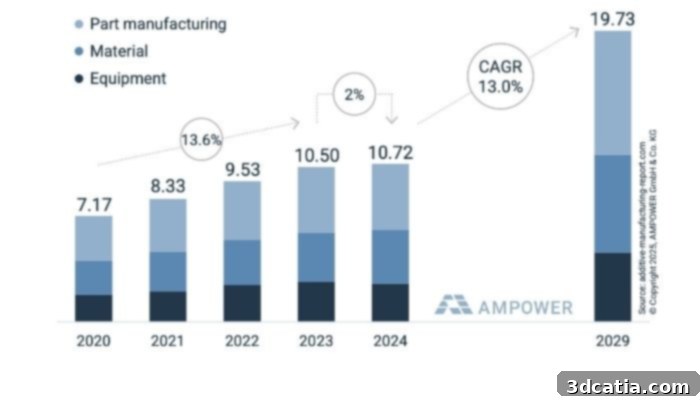
Global market for metal and polymer additive manufacturing from 2020 to 2024 and forecast for 2029 (photo credits: AMPOWER)
Navigating a Challenging Year: The 2024 Landscape
It is imperative to contextualize the 2024 market performance. The year proved to be a complicated period, not solely for additive manufacturing, but for the industrial sector at large. Global economic headwinds, including persistent inflation, supply chain disruptions, and a cautious investment climate, created a challenging environment across various industries. Against this backdrop, the reported 2% growth for the additive manufacturing market, though lower than previous years, can be understood as a testament to its underlying resilience rather than a sign of stagnation. Many sectors grappled with even more significant contractions, making AM’s continued expansion, however slight, a notable achievement. This broader industrial context helps explain why the market’s seemingly modest growth figure should be viewed with a nuanced perspective.
Optimistic Projections: A Strong Rebound on the Horizon
Despite the complexities of 2024, there remains substantial cause for optimism regarding the future trajectory of the 3D printing industry. AMPOWER’s report paints a robust picture for the medium term, forecasting an impressive annual growth rate of 13% year-on-year until 2029. This significant acceleration is projected to elevate the total market value to an astounding 20 billion euros within the next five years. This comprehensive valuation encompasses sales across critical segments: 3D printing machines, a burgeoning array of materials, and the increasing demand for 3D printed parts. This forward-looking forecast underscores the industry’s inherent strength and its capacity to overcome recent challenges, positioning it for substantial expansion fueled by continuous innovation and broadening applications.
Key Drivers of Growth: Polymer and Metal Technologies Lead the Way
Although slightly revised downwards from previous, more ambitious predictions, the anticipated robust growth is expected to be primarily propelled by advancements and increased adoption in both polymer and metal additive manufacturing technologies. The report highlights that sales revenues from these two foundational technological segments are almost identical, indicating a balanced and diversified market dynamic. However, a deeper look reveals subtle but important differences. The polymer technology segment, in particular, derives a significant portion of its revenues from the sales of materials and 3D printed parts, rather than solely from machine sales. This specific revenue distribution is a strong indicator of the polymer sector’s growing maturity and industrialization, signifying that businesses are not just investing in the equipment but are actively integrating polymer 3D printing into their production workflows for end-use components and larger-scale material consumption.
Polymer Additive Manufacturing: Versatility and Maturity
The report further highlights the consistent and growing consumption of polymers across all their primary forms – powder, resin, and filament. This broad usage reflects the versatility of polymer AM, serving diverse applications from rapid prototyping and functional tooling to custom consumer goods and highly specialized medical devices. Among this wide array of materials, PA12 (Nylon 12) continues to reign as the most widely used polymer, especially within Selective Laser Sintering (SLS) solutions. Its popularity stems from its excellent mechanical properties, chemical resistance, and ease of processing, making it a go-to material for industrial-grade polymer parts. SLS technology itself remains the favored choice when it comes to industrial polymer 3D printing due to its ability to produce complex geometries without support structures, resulting in efficient post-processing and robust, isotropic parts. However, the report also points to an increasingly significant trend: the rising demand for TPU (Thermoplastic Polyurethane) powder. TPU’s unique combination of flexibility, durability, and shock absorption properties is driving its adoption in applications such as customized footwear, flexible medical devices, and automotive components requiring elasticity.
Metal Additive Manufacturing: LPBF Dominance and Market Dynamics
On the metal side of additive manufacturing, the trend is unequivocally clear: Laser Powder Bed Fusion (LPBF), sometimes referred to as Direct Metal Laser Sintering (DMLS) or Selective Laser Melting (SLM), is the undisputed powerhouse driving the market forward. LPBF’s ability to produce high-density, complex metal parts with excellent mechanical properties makes it indispensable for critical applications in aerospace, medical, and automotive industries. AMPOWER’s findings reveal a highly concentrated market within this segment, with over 80% of revenues generated by a relatively small group of approximately a dozen key companies. These dominant players primarily include established manufacturers such as EOS, Colibrum Additive, BLT, and Nikon SLM Solutions, all pioneers and leaders in the development and commercialization of LPBF systems. The market study emphasizes that competition within this high-value segment is particularly fierce, with a growing number of players vying for market share by offering increasingly sophisticated metal additive manufacturing processes. This intense competitive landscape naturally raises pertinent questions: Could we anticipate a period of market consolidation in the near future? Such consolidation might lead to strategic partnerships, mergers, and acquisitions, fostering future synergies that could further propel the market forward through shared R&D, expanded product portfolios, and optimized resource allocation. Only time and evolving market forces will reveal the full extent of these potential transformations.
Industry Applications: Defense Leads, Other Sectors Follow
Finally, the AMPOWER report delves into the specific industries that are generating the most significant revenue streams for 3D printing technologies. In 2024, defense-related projects notably recorded the most encouraging results, significantly boosting the overall market. The prevailing geopolitical context globally is identified as a major contributing factor, strongly favoring the accelerated adoption of additive manufacturing within this critical sector. The unique advantages offered by AM, such as on-demand production of spare parts, rapid prototyping for advanced systems, design freedom for specialized components, and the ability to reduce complex supply chains, are proving invaluable to defense organizations seeking strategic independence and operational agility. This trend is not merely a fleeting phenomenon; the report anticipates that defense sector investments in additive manufacturing are set to double by 2029, cementing its position as a long-term strategic driver for the AM industry. Beyond defense, other sectors continue to leverage 3D printing’s benefits:
- Aerospace: Lightweighting structural components, complex engine parts, and bespoke cabin interiors to improve fuel efficiency and performance.
- Medical & Dental: Customized implants, prosthetics, surgical guides, dental aligners, and patient-specific anatomical models, revolutionizing personalized healthcare.
- Automotive: Rapid prototyping of new designs, producing jigs and fixtures for manufacturing, and developing high-performance, lightweight components for electric vehicles.
- Industrial Tooling: Creating customized jigs, fixtures, molds, and patterns that are lighter, more efficient, and produced with shorter lead times.
- Consumer Goods: Personalization of products like eyewear, footwear, and jewelry, catering to individual preferences and accelerating product development cycles.
Conclusion and Outlook
The AMPOWER report provides an indispensable snapshot of the additive manufacturing market, revealing a landscape that, despite a challenging 2024, is poised for significant growth and transformative innovation. The robust forecast of 13% annual growth leading to a €20 billion market by 2029 underscores the enduring potential and increasing industrial integration of 3D printing. With polymer and metal technologies driving this expansion, supported by evolving material science and the strategic adoption within critical sectors like defense, the future of additive manufacturing appears brighter than ever. Understanding these dynamics is crucial for anyone involved in or impacted by this rapidly evolving technological revolution.
What are your thoughts on the latest AMPOWER report and its projections for the 3D printing industry? We invite you to share your insights in a comment below or join the conversation on our LinkedIn, Facebook, and Twitter pages! Don’t forget to sign up for our free weekly Newsletter here to receive the latest 3D printing news straight to your inbox. You can also find all our compelling videos and industry coverage on our YouTube channel for further exploration of this exciting field.
*Cover Photo Credits: Nota3D