
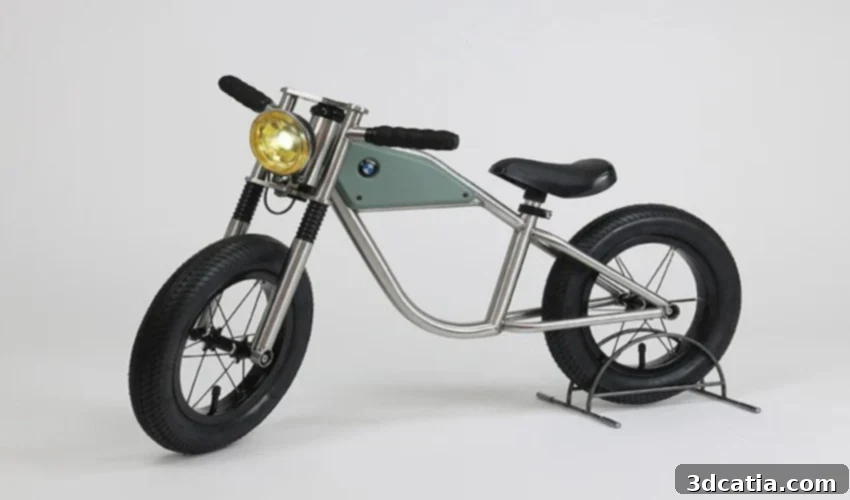
Roel van Heur’s Custom 3D Printed BMW K75 Balance Bike: A Luxury Ride for Young Enthusiasts
Balance bikes have revolutionized how children learn to ride bicycles, offering a foundational experience that focuses purely on balance and steering. Unlike traditional bicycles, they omit pedals, chains, gears, and shifters, allowing young riders to master essential motor skills by propelling themselves with their feet. This intuitive approach builds confidence and coordination, preparing them for pedal bikes without the need for cumbersome training wheels. While the concept of a balance bicycle dates back to 1817 with its German inventor, Karl Drais, the modern interpretation has evolved dramatically. Fast forward to today, and we witness a convergence of classic design and cutting-edge technology in the form of a bespoke BMW K75 balance bike, reimagined by a talented Dutch designer and brought to life with the innovative power of 3D printing. This luxurious creation for children stands as a testament to how far design and manufacturing have advanced over two centuries, blending heritage aesthetics with contemporary production methods.
Roel van Heur, an exceptionally talented Dutch designer known for his meticulous craftsmanship and innovative approach, recently embarked on a passion project that beautifully marries nostalgia with modern manufacturing. Independently, he constructed a stunning BMW K75 balance bike, leveraging the transformative capabilities of 3D printing technology. This endeavor wasn’t his first foray into recreating BMW’s iconic designs; previously, van Heur collaborated with a friend to build a custom K75 Café Racer, a project that showcased his keen eye for detail and commitment to authentic aesthetics. The inspiration for this pint-sized replica stemmed from a heartwarming personal connection: his friend, for whom he crafted the original Café Racer, was expecting a baby. This joyful news sparked Roel’s imagination, leading him to conceptualize a matching balance bike – a miniature version that would perfectly complement the adult-sized K75. To bring this unique vision to fruition, van Heur strategically employed additive manufacturing, a process that not only streamlined the intricate fabrication but also played a crucial role in achieving the same gorgeous, refined look that defined the larger Café Racer. This thoughtful integration of advanced technology allowed for unparalleled design freedom and precision, ensuring every curve and component met his exacting standards.
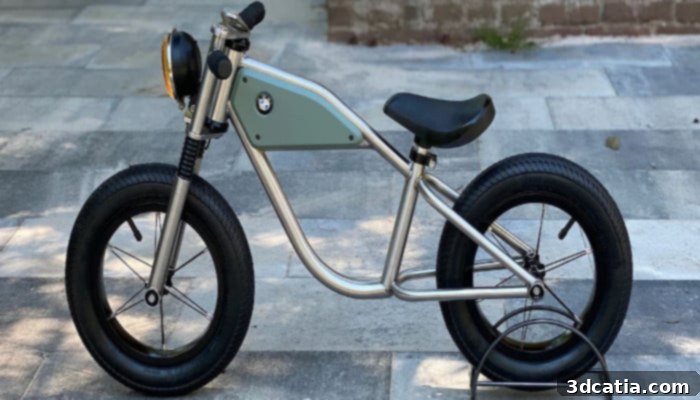
The meticulous journey of creating this custom BMW K75 balance bike began in the digital realm, where Roel van Heur meticulously sketched and refined his design within the CAD (Computer-Aided Design) program SOLIDWORKS. This crucial first step allowed him to envision every dimension, curve, and connection with precision before any physical material was touched. Once the digital blueprint was perfected, van Heur sourced a substantial quantity of high-quality stainless steel tubing, chosen for its durability, timeless aesthetic, and ability to be expertly manipulated. The fabrication process was a testament to traditional metalworking skills, involving the careful bending, precise cutting, and expert welding of the tubing to form the robust frame and forks. Each joint was seamlessly integrated, ensuring both structural integrity and a clean, elegant appearance. Following the welding, the entire structure underwent a painstaking hand-brushing process, lending it an authentic, industrial-chic finish that perfectly resonates with the Café Racer ethos.
To further amplify the bike’s retro charm and pay homage to classic automotive design, a distinctive 3-inch yellow glass headlight was prominently affixed to the front. This specific component, often found as a bolt-on part on vintage cars, instantly imbues the balance bike with a nostalgic character. While its exterior speaks of a bygone era, its internal functionality is entirely modern: an efficient LED light unit, powered by discreetly hidden batteries within the steering tube, ensures both safety and an unexpected contemporary touch. For the wheels, van Heur opted for standard 12-inch balance bike wheels, but elevated their appearance and performance with Kendra tires. His selection was deliberate, driven by their classic tread pattern and the minimalist design of their spokes, which collectively contribute to the overarching aesthetic of a true Café Racer. Every detail was considered, down to the branding: the iconic BMW badge was elegantly etched onto the main body, signifying its lineage and premium quality. Complementing this, van Heur’s own subtly placed yet clearly visible logo graces the top yoke of the bike, a signature mark of the master craftsman behind this extraordinary creation.
The Innovation of Additively Manufactured Components
One of the most compelling aspects of Roel van Heur’s custom balance bike is the intelligent integration of additive manufacturing, commonly known as 3D printing. This revolutionary technology proved indispensable, offering unparalleled flexibility and precision in crafting specific components that would be challenging, if not impossible, to produce with traditional methods. Far from being a mere novelty, 3D printing enabled the creation of functional and aesthetically vital parts, significantly enhancing the bike’s overall design and user experience. Specifically, the elegant faux fuel tank and the protective fork boots were meticulously brought to life through this advanced process.
The faux fuel tank, a cornerstone of the Café Racer aesthetic, exemplifies the benefits of additive manufacturing. Designed and 3D printed in two distinct halves, this modular approach offers remarkable practical advantages. It can be easily unscrewed and replaced, providing a fantastic opportunity for customization. Should the father or child desire a fresh look, perhaps a different color scheme to match evolving tastes or preferences, a new set of tank halves can be effortlessly bolted on. For this particular model, the tank was finished in a vibrant green, perfectly matching the adult-sized BMW K75 Café Racer, forging a delightful visual link between the two bikes. The result is a tank with a graceful silhouette and incredibly clean, simple lines – a true masterpiece that captivates the eye, irrespective of one’s familiarity with motorcycle design. Beyond its visual appeal, the precision afforded by 3D printing ensures a perfect fit and finish, contributing to the bike’s premium feel. The fork boots, another crucial 3D printed element, not only complete the authentic styling but also serve a practical purpose by protecting the fork stanchions from debris, ensuring longevity and smooth operation. The seamless integration of these 3D printed elements underscores van Heur’s mastery in combining diverse manufacturing techniques to achieve a cohesive and outstanding final product.
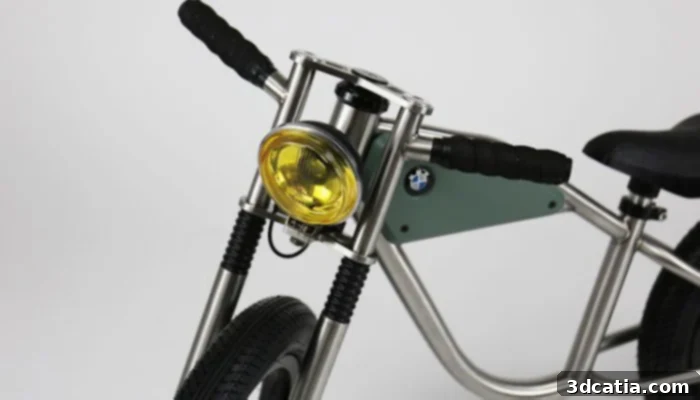
Image credits: Roel van Heur
Interestingly, the automotive giant BMW itself has been at the forefront of embracing 3D printing technologies for several decades. Their pioneering spirit in this field has seen significant investments in additive manufacturing, recognizing its immense potential for innovation, customization, and efficient production. BMW regularly incorporates 3D printed parts into its cutting-edge vehicles, demonstrating a firm commitment to leveraging this technology for both performance and design enhancements. A notable example is the iconic i8 Roadster model, which features a sophisticated 3D printed convertible top. This integration showcases how additive manufacturing can produce complex, lightweight, and durable components that meet the stringent standards of the automotive industry. Given BMW’s extensive history with AM and their continuous pursuit of innovation, it comes as no surprise that they operate a specialized center entirely dedicated to additive manufacturing. This dedicated facility underlines their strategic vision, emphasizing research, development, and industrial application of 3D printing across their entire product range, from concept cars to production models.
In light of BMW’s deep engagement with 3D printing, Roel van Heur’s exceptional success with his luxurious, custom-built balance bike for children could serve as a powerful inspiration. This project beautifully demonstrates how premium design, traditional craftsmanship, and advanced manufacturing can converge to create products that are not only practical and durable but also undeniably beautiful and emotionally resonant. It wouldn’t be far-fetched to imagine a future where BMW, taking a cue from van Heur’s innovative spirit, might consider launching its own line of specialized children’s bikes. Such an initiative could capitalize on the growing market for high-quality, aspirational children’s products, offering young enthusiasts an early taste of the BMW experience. The ability of 3D printing to facilitate rapid prototyping, customized production, and intricate designs makes it an ideal technology for such a venture, allowing for unique models that stand out in the market. This blend of practicality, aesthetic appeal, and brand heritage could position BMW at the forefront of luxury children’s mobility, delivering beautifully engineered bikes that instill a love for riding from a very young age.
What are your thoughts on this extraordinary custom balance bike, masterfully integrating the benefits of additive manufacturing? We would love to hear your opinions and insights! Share your comments below or join the conversation on our official Facebook and Twitter pages. To stay updated with all the latest advancements, innovations, and news in the world of 3D printing, be sure to sign up for our free weekly Newsletter, delivered directly to your inbox!