
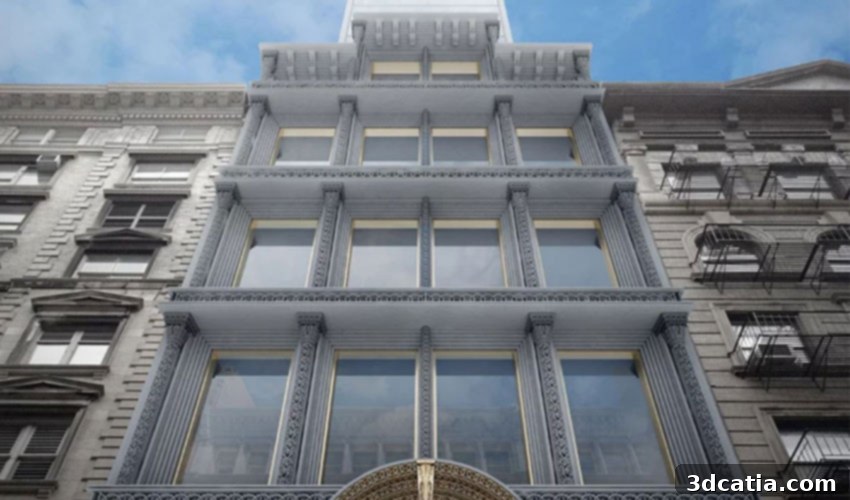
Revolutionizing Architectural Restoration: EDG’s ‘Modern Ornamental’ 3D Printing in New York City
EDG, a distinguished architecture firm based in New York, has pioneered a groundbreaking method of digital sculpture known as “Modern Ornamental.” This innovative approach is fundamentally transforming the field of architectural restoration, most notably demonstrated in its successful application to preserve a historic building in the heart of New York City. At its core, this method leverages the advanced capabilities of 3D printing technology to create intricate and highly precise molds, which are then used to produce robust concrete structures. This not only promises a more accurate and aesthetically faithful restoration but also offers a significantly cheaper and faster process, ensuring the long-term integrity and preservation of architectural masterpieces. By embracing digital fabrication, EDG is setting a new standard for maintaining and revitalizing the urban fabric, proving that cutting-edge technology can breathe new life into historical treasures.
The symbiotic relationship between new technologies and traditional craftsmanship is undeniably growing stronger, undergoing profound shifts in its very nature and potential. Take, for example, the evolution of additive manufacturing, commonly known as 3D printing. Initially conceived for crafting small objects and prototypes, its scope has dramatically expanded. Today, we witness its gradual, yet impactful, application in large-scale endeavors, from constructing entire houses to meticulously restoring delicate architectural details. Artists, artisans, and architects are increasingly embracing these sophisticated digital tools, not as replacements for their skills, but as powerful extensions for new means of expression and unprecedented precision. 3D printing has thus become an indispensable instrument at their disposal, enabling them to perfect their work, push creative boundaries, and achieve results previously deemed impossible or prohibitively expensive through conventional methods. This convergence of digital innovation and skilled artistry defines a new era of possibilities for construction and heritage preservation.
Additive Manufacturing: A Catalyst for Architectural Innovation and Preservation
The EDG firm’s decision to integrate additive manufacturing into their practice was driven by a compelling need to restore the decaying splendor of an old building in New York, a challenge that traditional methods found insurmountable due to cost, complexity, and time constraints. Their proprietary technique, “Modern Ornamental,” represents a fusion of cutting-edge technology and architectural expertise. This method initiates with the use of advanced Computer-Aided Design (CAD) software and sophisticated algorithmic modeling programs. These powerful tools allow architects to develop highly detailed digital renditions of the desired structures and ornamental elements, ensuring absolute fidelity to the original design while also allowing for adaptive improvements where necessary. These precise digital models then serve as the foundational blueprints for the subsequent 3D printing process.
However, rather than directly 3D printing solid architectural components – a process that can often be prohibitively expensive and time-consuming, especially for large-scale features – the EDG team ingeniously opted to create different molds. This strategic choice allows for significant material savings, faster production cycles, and greater flexibility in working with various concrete formulations. For the crucial prototyping phase, where rapid iteration and precise adjustments are paramount, they utilized a MakerBot Replicator Z18. This professional-grade 3D printer enabled them to quickly produce accurate test molds, facilitating iterative design improvements and ensuring that the final molds would meet their exacting standards before full-scale production. This meticulous prototyping process is key to the efficiency and accuracy of the “Modern Ornamental” technique, allowing for cost-effective refinement of complex designs.
The innovative spirit of EDG truly shines through in their material selection and process optimization for these molds. The team elaborates on their extensive findings: “We focused on hollow form plastic molds for economy—to be filled with standard and colored concrete. Through exhaustive experimentation, we found the perfect balance of material cost, efficiency, and strength, ensuring that the molds can be easily reproduced.” This rigorous experimentation allowed them to identify the ideal plastic composites and geometric designs for their molds, minimizing material usage while maximizing durability and reusability. By creating hollow molds, they significantly reduce the amount of 3D printing material required, making the overall process far more economical and sustainable compared to printing solid parts. This approach embodies smart resource management in digital fabrication, a critical factor for large-scale architectural projects where material consumption can quickly escalate costs.
The process continues with the precise engineering of the final concrete elements. Once the 3D printed plastic mold is prepared, it is meticulously inlaid with a laser-cut wire mesh. This internal reinforcement is critical, providing the necessary structural integrity and durability to the final concrete piece, allowing it to withstand environmental stresses and the test of time for decades to come. This combination of an intricate 3D printed form with robust reinforcement ensures both aesthetic fidelity and structural resilience. For the manufacturing of the final large-scale, high-resolution molds used for the permanent installation, EDG collaborated with VoxelJet, a recognized leader in industrial 3D printing. VoxelJet’s advanced VX1000 3D printer was instrumental in producing these complex, high-resolution molds with exceptional accuracy and speed, capabilities that are vital for architectural scale. The actual concrete elements were then produced in-house using specialized Sika concrete, a high-performance material known for its superior strength, longevity, and versatility, developed by a company at the forefront of 3D concrete printing methods.
A significant advantage of this “Modern Ornamental” technique is its remarkable efficiency on-site. According to EDG, these intricate architectural pieces can be produced in less than a day, drastically cutting down restoration timelines compared to traditional, labor-intensive carving or casting methods which could take weeks or even months for similar complexities. This rapid turnaround minimizes disruption to the surrounding urban environment and reduces overall project duration. Furthermore, the digital nature of the molds provides an invaluable benefit for long-term maintenance and future adaptability: architects can easily reprint any mold from a comprehensive digital catalog of stored parts. This means that if an element is damaged, vandalized, or simply requires replacement in the future, a perfect replica can be quickly and affordably reproduced, a distinct advantage that ensures the enduring beauty and structural integrity of the restored building for generations to come. This digital archiving capability marks a paradigm shift in architectural preservation, guaranteeing future reparability with unprecedented ease and cost-effectiveness.
The Restoration of a Historic New York Building: A Case Study in Preservation Innovation
The compelling narrative of the “Modern Ornamental” method truly comes to life in its application to a specific building on Fifth Avenue, a structure dating back to 1940 that faced an imminent threat of demolition. The rationale behind this drastic measure was the exorbitant cost associated with its restoration. The building’s ornate facades, rich with intricate details and historical significance, presented a formidable challenge; reproducing these complex ornaments using typical, conventional techniques was deemed too difficult, too time-consuming, and ultimately, financially unviable. The traditional craft of stone carving or mold-making for such elaborate designs is incredibly labor-intensive, requires highly specialized skills that are increasingly rare in modern construction, and typically incurs staggering expenses, pushing restoration projects beyond feasible budgets and often leading to the regrettable decision of demolition.
In the face of this potential loss of a precious piece of New York’s architectural heritage, EDG decided to intervene, meticulously examining the building for alternative means of restoration that could avert its destruction. John Meyer, the visionary Founder of EDG, articulates the firm’s profound motivation with a clear sense of purpose: “This project began with the simple goal of finding a way to salvage and restore many of the deteriorating architectural treasures in New York City, and around the world. The innate beauty and rich history of these gems were vanishing as the cost of their repair became progressively prohibitive.” This poignant statement underscores the broader mission behind “Modern Ornamental”—to develop sustainable, accessible, and affordable solutions for preserving our global architectural patrimony, ensuring that invaluable cultural landmarks are not lost to economic pressures or the limitations of outdated methods. EDG recognized a universal problem and sought a universal, technologically advanced solution.
EDG’s innovative approach provided the lifeline needed for the Fifth Avenue building. By leveraging their “Modern Ornamental” technique, they successfully created diverse molds that precisely replicated the original facade elements. This digital fabrication method allowed them to achieve an unprecedented level of accuracy and detail, ensuring that the restored sections perfectly matched the existing historical patterns and ornaments in texture, form, and scale. This meticulous attention to historical fidelity is paramount in preservation, and 3D printing enabled it with an efficiency unattainable through traditional means. Crucially, this was accomplished both rapidly and at a significantly lower cost than any conventional method could offer, effectively transforming a demolition candidate into a successful restoration project. The ability to produce complex, historically accurate elements without the extensive labor and material waste associated with conventional techniques not only saved the Fifth Avenue building from demolition but also set a powerful precedent for future preservation efforts globally. This project stands as a testament to how cutting-edge technology, when thoughtfully applied, can bridge the gap between historical accuracy and modern efficiency, safeguarding our shared architectural heritage for future generations to appreciate.
The Future of Digital Fabrication in Architectural Preservation and Urban Development
The success of EDG’s “Modern Ornamental” method in New York City signifies more than just a single building’s rescue; it heralds a new era for architectural preservation and urban development globally. This innovative approach demonstrates the profound potential of 3D printing and digital fabrication to address the mounting challenges of maintaining historical structures and creating sustainable urban environments. By making restoration faster, more cost-effective, and highly precise, EDG has provided a blueprint for cities worldwide grappling with aging infrastructure and the prohibitive costs of preserving their heritage. This methodology is not limited to replication but also enables architects to envision adaptive reuse scenarios with greater creative freedom and structural confidence.
The integration of CAD, algorithmic modeling, and 3D printing allows for an unprecedented level of customization and replication, ensuring that the unique character and intricate details of historical architecture are not only maintained but celebrated. This technology also opens doors for more sustainable construction practices, significantly reducing material waste through precise, on-demand fabrication and enabling localized production of components, which in turn lowers transportation carbon footprints. Furthermore, the creation of digital archives for architectural elements means that an invaluable record of our built environment can be preserved indefinitely, ready to be reproduced whenever needed. This approach offers a robust solution for dealing with damage from natural disasters, wear and tear, or even conflicts, ensuring that cultural identity embedded in architecture can be rebuilt and sustained, safeguarding legacies for centuries.
As 3D technologies continue to advance, their role in the architectural sector is expected to expand exponentially. We can anticipate further innovations in materials, printing speeds, and the scale of achievable structures, potentially leading to fully 3D printed buildings with integrated utilities and advanced functionalities. This ongoing evolution will empower architects, conservators, and urban planners to imagine and implement solutions that blend aesthetic integrity with cutting-edge engineering, fostering urban resilience and cultural continuity. The work by EDG is a shining example of how the fusion of human ingenuity and technological prowess can not only save our past but also shape a more sustainable and aesthetically rich future. It’s a testament to the fact that innovation doesn’t always mean building new; sometimes, it means finding smarter, more efficient, and more respectful ways to honor and restore what already exists, ensuring its place in the modern landscape.
Find more comprehensive information on EDG’s transformative work by visiting their official website.
What are your thoughts on the future of 3D technologies within the architectural and preservation sectors? We invite you to share your insights in a comment below, or join the conversation on our Facebook and Twitter pages! Don’t miss out on the latest advancements and news in the world of additive manufacturing; sign up for our free weekly Newsletter, delivered straight to your inbox!