
Top 5 3D Printing Innovations: Elegoo’s New Printers, Custom Shoes, and Industry Impact
Welcome back to our weekly roundup of the most groundbreaking and exciting developments in the world of 3D printing! As Sunday rolls around once more, we’ve curated the week’s top five videos that highlight the dynamic evolution of additive manufacturing. This week’s edition brings you a closer look at major announcements from industry giants like Elegoo, showcasing their latest Saturn 3 and Neptune 4 printer series. We’ll also delve into the innovative realm of custom additive manufacturing applications, featuring bespoke climbing shoes designed for unparalleled fit. Furthermore, we explore how the additive manufacturing industry is playing a crucial role in accelerating the global energy transition. Highlighting advanced fabrication, we examine Meltio’s cutting-edge Laser Metal Deposition Technology showcased at AMUG 2023. Finally, we provide a practical tutorial on how to optimize an existing STL file for 3D printing using Tinkercad, ensuring smoother and more successful prints. Dive into the videos below to stay informed about the most relevant and impactful innovations shaping the future of 3D printing. Happy Sunday, and we sincerely hope you enjoy this week’s selection!
Top 1: Introducing Elegoo’s New MSLA and FDM 3D Printers – A Leap in Speed and Resolution
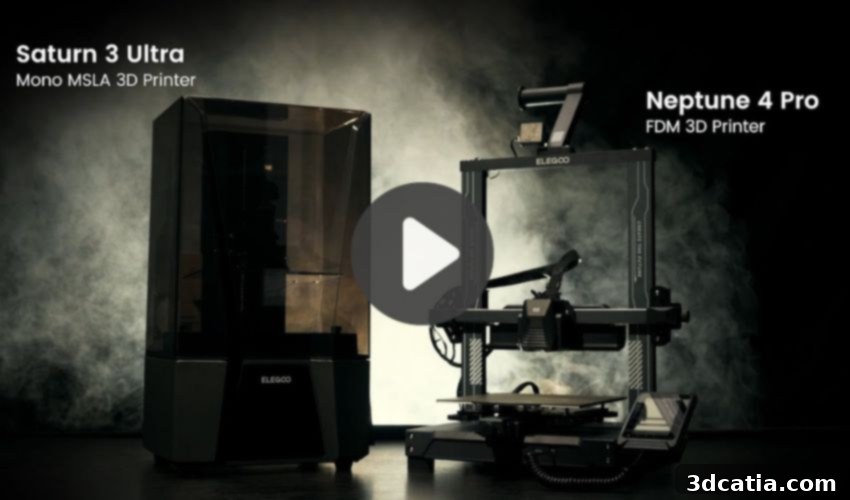
Leading 3D printer manufacturer Elegoo has once again captured the attention of the additive manufacturing community with the grand unveiling of its newest additions to the ELEGOO planet family: the Saturn 3 series and Neptune 4 series. These launches represent significant advancements in both resin (MSLA) and filament (FDM) 3D printing technologies, catering to a wide spectrum of users from hobbyists to professional designers and engineers. The Saturn 3 series, Elegoo’s latest innovation in resin 3D printing, boasts an impressive 12K HD resolution across all models. This marks a substantial upgrade from the traditional 4K resolution commonly found in many resin printers, promising an unprecedented level of detail and fidelity for more lifelike and intricate models. The enhanced resolution is particularly beneficial for applications requiring extreme precision, such as miniatures, jewelry, and high-detail prototypes. Users can expect smoother surfaces and sharper edges, pushing the boundaries of what’s achievable with desktop resin printers.
On the FDM front, the Neptune 4 series introduces the highly user-friendly Klipper firmware, renowned for its ability to unlock superior control and performance from 3D printers. This integration empowers users with advanced features, improved print quality, and most notably, dramatically increased print speeds. The standout machine in this series, the Neptune 4 Pro, is engineered to print up to 10 times faster than its predecessors, reaching blistering speeds of up to 500mm/s, with a recommended operational speed of 250mm/s. Such a leap in speed significantly reduces production times, making the Neptune 4 Pro an attractive option for rapid prototyping and small-batch manufacturing. The Saturn 3 12K series includes the Saturn 3 and Saturn 3 Ultra Mono MSLA 3D printers, each designed to offer specific advantages in resin printing, while the Neptune 4 series comprises the Neptune 4 and Neptune 4 Pro FDM 3D printers, offering robust and fast filament printing solutions. Enthusiasts and professionals alike can mark their calendars, as pre-orders for these exciting new machines are set to commence on June 1st at 2 PM (UTC). The industry eagerly awaits their performance, anticipating how these new Elegoo models will set new benchmarks for accessibility, quality, and speed in 3D printing.
Top 2: 3D Printed Climbing Shoes – The Ultimate in Personalized Performance
For climbers, finding the perfect-fitting shoe is often an elusive quest, yet it’s absolutely crucial for performance, comfort, and injury prevention. Ill-fitting shoes can lead to discomfort, reduced sensitivity on the rock, and even long-term foot issues. This week, we bring you an ultimate solution to this perennial challenge: custom 3D-printed climbing shoes, precisely tailored to an individual’s foot based on a high-resolution laser scan. This fascinating video showcases an innovative process developed by a talented individual, demonstrating how additive manufacturing can deliver unparalleled fit and comfort, a feat traditional manufacturing struggles to achieve. The journey begins with a compelling introduction, setting the stage for the transformative potential of personalized footwear. Following this, the video meticulously details the creation process, moving from an initial laser scan of the climber’s foot to the intricate digital design and development of three distinct shoe models. Each model is engineered to address specific climbing needs and preferences, highlighting the versatility of custom design. The final reveal presents a product that not only fits perfectly but also exhibits exceptional results that conventional climbing shoes simply cannot match.
One of the notable innovations highlighted is a flexible, polymer-based upper section, which conforms seamlessly to the foot’s unique contours, providing a ‘second-skin’ feel that enhances sensitivity and grip. The video offers valuable insights into the printing duration for these complex structures and elaborates on the chosen materials, specifically selected for their durability, flexibility, and grip characteristics essential for climbing. Furthermore, it explores critical design considerations, such as the strategic placement of rubber, the shoe’s overall stiffness, and ventilation, all optimized through the 3D printing process. If you’ve ever struggled to find climbing shoes that truly fit your unique foot shape, this video offers an enticing glimpse into a future where 3D printing and advanced laser scanning converge to create the ultimate personalized climbing shoe. It’s not just about comfort; it’s about unlocking a climber’s full potential by providing footwear that acts as a natural extension of their body. Witness the entire innovative process and explore the immense potential of perfectly fitted climbing footwear by watching this captivating video.
Top 3: Meltio’s M450 – Shaping the Future of Metal Fabrication with Laser Metal Deposition
Meltio is at the forefront of revolutionizing the industrial landscape with its groundbreaking M450 machine, an advanced and versatile laser metal deposition (LMD) tool. This cutting-edge technology is setting new benchmarks in metal additive manufacturing, offering unprecedented flexibility and capability for a wide range of industrial applications. With its sleek, futuristic design and remarkable adaptability, the M450 stands out for its ability to function both as a standalone manufacturing unit and as an integrated module mounted onto a robotic arm. This dual functionality allows it to seamlessly adapt to diverse manufacturing environments, from small-scale workshops requiring precise component fabrication to large industrial setups demanding automation and scalability. The M450 utilizes welding wire as its feedstock, enabling the fabrication of metal parts with incredibly intricate designs and complex internal structures that would be challenging, if not impossible, to achieve with traditional subtractive manufacturing methods.
One of the M450’s most significant and innovative features is its pioneering ability to print with dual wires. This allows for the seamless blending of different metallic materials within a single part, opening up a new realm of possibilities for creating unique composite properties and multi-layered components with varying material characteristics. Imagine parts with a hard, wear-resistant surface and a tough, flexible core, or components with gradient properties that change gradually from one material to another. Meltio’s 3D printed conveyor belt support, showcased in the video, perfectly exemplifies the machine’s capacity for time-saving production and enhanced structural integrity, demonstrating how complex industrial parts can be manufactured efficiently with superior performance. Beyond this, the M450 achieves stunning precision and detail, consistently producing uniform layers as thin as 0.6 millimeters, ensuring high-quality surface finishes and accurate dimensions. Its exceptional flexibility in handling various materials, coupled with the capability to add features to existing parts or perform intricate repairs, establishes Meltio’s technology as a true game-changer in additive manufacturing. By combining the best attributes of advanced 3D printing with robust traditional manufacturing techniques, the M450 is not just building parts; it’s actively shaping the future of metal fabrication, promoting efficiency, material innovation, and design freedom. See more of this incredible technology below!
Top 4: Baker Hughes Additive Manufacturing – Accelerating the Energy Transition
Baker Hughes, a global leader in energy technology, is vigorously driving innovation across its turbomachinery products and services through the strategic application of Additive Manufacturing (AM). Recognizing the transformative potential of AM, Baker Hughes is leveraging this advanced technology to address critical challenges and enhance various aspects of energy production and efficiency. By integrating AM into its operations, the company aims to significantly boost engine performance through optimized designs and lighter components, which in turn helps minimize environmental impact by reducing fuel consumption and emissions. A key focus is on improving gas turbine combustion, where AM enables the creation of complex, high-efficiency geometries for nozzles and other critical parts that can withstand extreme conditions, leading to more complete and cleaner combustion. Furthermore, Baker Hughes is utilizing AM to mitigate hydrogen-related issues, such as embrittlement and leaks, which are crucial for the safe and efficient deployment of hydrogen as a clean energy carrier. This includes developing specialized components and repair solutions for hydrogen infrastructure. Beyond new component fabrication, AM is also being used to upgrade existing equipment and extend the operational life of valuable assets through on-demand part replacement and repair, reducing downtime and waste.
The widespread adoption of additive manufacturing technology by industry leaders like Baker Hughes is proving instrumental in accelerating the global energy transition process. AM facilitates the rapid prototyping and iteration of new, more efficient, and sustainable energy solutions. It enables the creation of lighter, stronger, and more geometrically complex parts that can perform better in demanding energy environments, from advanced turbines to components for renewable energy systems. By reducing material waste, streamlining supply chains, and allowing for on-demand manufacturing of specialized parts, AM contributes significantly to a more sustainable and agile energy sector. This embrace of advanced manufacturing techniques empowers companies to develop and deploy cutting-edge technologies faster, making clean energy solutions more accessible and cost-effective. To gain deeper insights into Baker Hughes’ extensive additive capabilities and their commitment to forging a more sustainable energy future, we highly recommend watching the informative video below!
Top 5: How to Optimize an Existing STL for 3D Printing in Tinkercad – Master Your Prints
Even the most experienced 3D printing enthusiasts encounter challenges, often stemming from poorly optimized STL files. These issues can lead to failed prints, wasted material, and countless hours of frustration. This insightful video tutorial from Tinkercad, a popular and user-friendly online 3D design software, offers step-by-step instructions on how to effectively modify an existing STL file to significantly optimize its 3D printing performance. Whether you’re a beginner looking to improve your print success rate or an experienced user seeking to refine your workflow, this tutorial provides invaluable techniques. The video content comprehensively covers key strategies that will help you achieve superior results from your 3D printer. It starts by guiding you through the crucial process of identifying problematic parts within your 3D model. You’ll learn how to pinpoint areas that commonly pose challenges during the printing process, such as severe overhangs that require extensive support, unsupported features that can lead to warping or collapse, or overly intricate details that may not render correctly.
Once problematic areas are identified, the tutorial delves into practical solutions and modification techniques within Tinkercad. This includes methods for simplifying complex geometries, adding necessary support structures directly into the model, ensuring manifold meshes, and generally enhancing the model’s robustness for printing. The video then transitions to the critical stage of reviewing and exporting the fixed STL. It meticulously guides you through the process of thoroughly reviewing the modified model to ensure its accuracy, structural integrity, and printability, checking for any unintended alterations or remaining issues. Finally, you’ll master how to correctly export the optimized STL file, preparing it for seamless and successful 3D printing. This eliminates common errors and ensures that your printer can interpret the file efficiently. This video tutorial offers valuable insights and practical techniques that can dramatically enhance your 3D printing workflow, saving you time, material, and ultimately, delivering better-quality prints. Dive into the video and start optimizing your STL files for easier, more reliable, and superior 3D printing results using the accessible tools of Tinkercad!
What are your thoughts on Elegoo’s impressive new Saturn 3 and Neptune 4 Series 3D printers? Are you excited about the potential of custom 3D printed climbing shoes, or perhaps intrigued by Meltio’s advancements in metal fabrication? Let us know your opinions and insights in a comment below or connect with us on our LinkedIn, Facebook, and Twitter pages! For the very latest 3D printing news delivered straight to your inbox, don’t forget to sign up for our free weekly Newsletter here. You can also discover all our curated videos and much more compelling content on our dedicated YouTube channel. Stay tuned for more groundbreaking innovations next week!
*Cover photo credits: Elegoo