
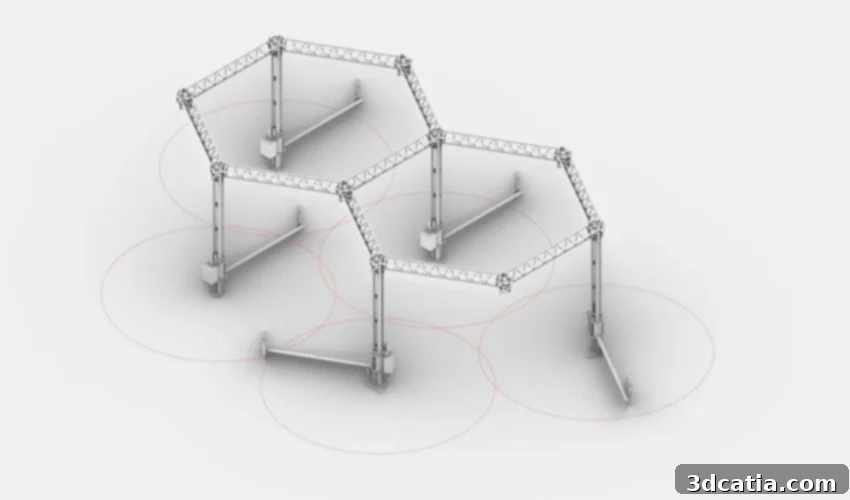
WASP Unleashes the Crane WASP: The Infinite Modular 3D Printer Revolutionizing Construction
The landscape of construction is undergoing a profound transformation, largely driven by advancements in additive manufacturing. At the forefront of this revolution is WASP, an Italian 3D printer manufacturer that has rapidly become a specialist in Fused Deposition Modeling (FDM) technology. Renowned for its innovation and ambition, WASP offers an extensive range of machines, from compact desktop units to colossal industrial printers. The company etched its name into the history books with the unveiling of the BigDelta, a monumental 3D delta printer standing an astonishing 12 meters high and 7 meters wide, capable of extruding concrete to construct entire buildings. Building upon this pioneering spirit, WASP is now once again setting new benchmarks, announcing an groundbreaking solution for the construction sector: the Crane WASP “Infinite 3D printer.” This highly modular machine is meticulously designed to adapt to the evolving demands of modern construction, promising unparalleled flexibility and scalability. Its grand presentation took place on the 6th and 7th of October in Massa Lombarda, signaling a new era for sustainable and accessible housing.
WASP’s journey into large-scale construction 3D printing began in earnest in 2015 with the introduction of its BigDelta machine. The initial vision behind the BigDelta was ambitious yet vital: to facilitate the construction of affordable, sustainable housing solutions for communities worldwide. Just a year after its debut, the Italian company further expanded on this vision, announcing plans to construct an entire ecological village named Shambalha, entirely built using their innovative 3D printing technology. The BigDelta itself was a marvel of engineering, equipped with six modular arms that could be assembled and reconfigured to suit various construction needs. This robust machine was capable of moving a substantial load of 200 kg, and critically, it was designed to be compatible with locally sourced, natural materials such as straw and soil, minimizing environmental impact and construction costs. Recognizing the immense potential and the need for even greater adaptability, WASP embarked on a mission to upgrade its XXL 3D printer, culminating in the unveiling of its latest iteration: the Crane WASP. This evolution signifies a leap forward, bringing even more versatility and efficiency to on-site additive manufacturing.
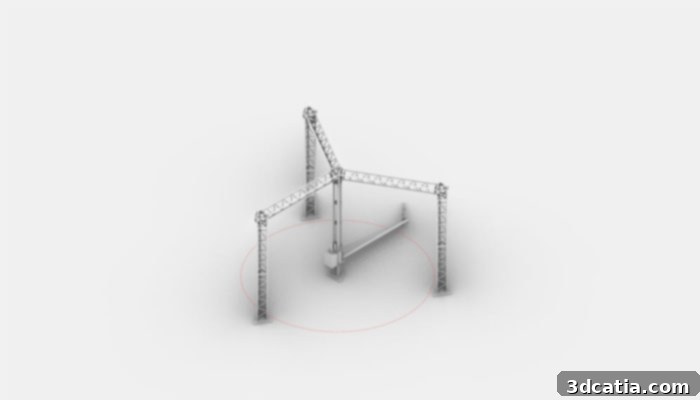
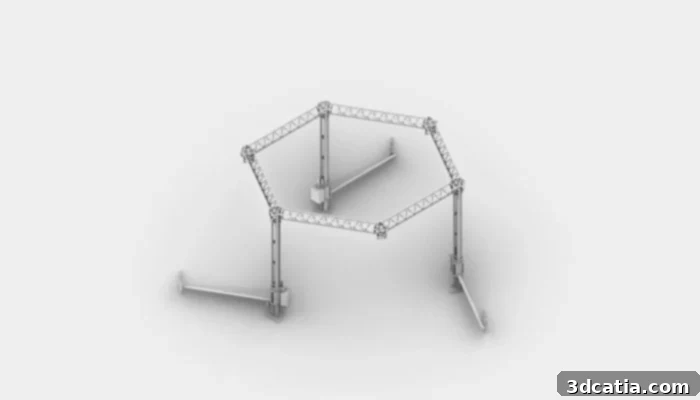
Crane WASP modulates as needed
3D Printing to Infinity: Unlocking Limitless Construction Possibilities
The Crane WASP represents a significant paradigm shift in how we conceive and execute construction projects. At its core, it is a collaborative and modular 3D printer, offering unprecedented flexibility through its various configurations. According to WASP, this innovative system is built around a main base module, which serves as the foundation. To this base, different types of crane modules can be added, each designed to expand the overall printing area incrementally. The basic module alone offers an impressive print volume, capable of operating within a diameter of 6.60 meters and reaching a height of 3 meters. What truly sets the Crane WASP apart is its material versatility; it is engineered to extrude conventional concrete, advanced bio-sourced concrete, and even natural pulp, opening doors to highly sustainable and eco-friendly construction practices. However, the true genius lies in its expandability: by strategically adding ties and additional print arms to the foundational module, the system transforms into what WASP aptly calls an “Infinite Manufacturing System.” This revolutionary design is why it has earned the moniker “Infinite 3D printer.”
The concept of “infinity” in the Crane WASP’s design is not merely hyperbole; it refers to the system’s remarkable adaptability and scalability. The Italian manufacturer elaborates on this key advantage, stating: “It is not necessary to ‘cover’ the entire area involved in the construction with the printing area of the WASP Cranes because they can be reconfigured and can advance with generative attitude depending on the growth and shape of the building. More WASP Cranes, when working together, have a potentially infinite printing area and can be set by the on-site operators following the evolution of the architectural project.” This means that instead of a fixed print volume, the Crane WASP can dynamically adapt to the architectural design as it progresses, moving and reconfiguring itself on-site. This flexibility drastically reduces logistical complexities and allows for the construction of structures of virtually any size and shape. Just like its predecessor, the BigDelta, the Crane WASP is engineered for ease of use, making it simple to assemble on-site and equally straightforward to disassemble once the project is complete, enabling rapid deployment and relocation for diverse projects.
The Power of Modularity: Driving Efficiency and Sustainability in Construction
The modular nature of the Crane WASP is a game-changer for the construction industry. This design philosophy directly addresses many of the challenges inherent in traditional building methods, offering unparalleled benefits in terms of efficiency, cost-effectiveness, and environmental sustainability. For instance, the ability to scale the printing area by adding more crane modules means that projects of varying sizes – from small residential homes to large-scale commercial or public infrastructure – can be undertaken with a single adaptable system. This scalability translates into significant cost savings, as companies no longer need to invest in multiple specialized machines for different project scopes. Furthermore, the Crane WASP’s on-site fabrication capabilities reduce the need for extensive transportation of pre-fabricated components, thereby lowering fuel consumption, logistics costs, and carbon emissions. The collaborative aspect, where multiple Crane WASPs can work in tandem, multiplies the effective printing area and accelerates project timelines, making rapid deployment for housing, disaster relief, or urban development a tangible reality.
Beyond structural integrity, WASP’s commitment to sustainability is evident in the Crane WASP’s material compatibility. The support for bio-sourced concrete and natural pulp is a testament to the company’s vision for ecological building. Bio-sourced concrete, often incorporating binders derived from organic materials, offers a significantly reduced carbon footprint compared to conventional Portland cement-based concrete. Similarly, natural pulp, which can be sourced from agricultural waste or other biodegradable materials, provides an opportunity to utilize local resources, reduce waste, and create breathable, healthier living environments. The Gaia house project, which utilized a mix of earth, straw, and compost, serves as a powerful demonstration of how these materials can be effectively employed to create durable and sustainable structures. By embracing such innovative materials, the Crane WASP not only builds structures but also contributes to a circular economy in construction, aligning with global efforts to combat climate change and promote sustainable development goals.
Realizing the Vision: The Gaia House Project
To prove the immense potential of the Crane WASP in real-world applications, WASP undertook a highly ambitious and significant construction project named Gaia. This innovative house was entirely 3D printed using a unique blend of natural and recycled materials: earth, straw, and compost. The Gaia house served as a powerful testament to the Crane WASP’s capabilities, demonstrating how additive manufacturing can be utilized to construct sustainable, energy-efficient, and affordable housing solutions using readily available local resources. The successful completion of Gaia underscored WASP’s commitment to creating ecological habitats that are not only cost-effective but also environmentally conscious. The house itself was presented to the public on October 6th and 7th in Italy, drawing considerable attention from architects, environmentalists, and industry experts alike. Its exhibition provided tangible proof of concept for the “Infinite 3D printer,” showcasing its ability to transform raw, natural materials into functional and aesthetically pleasing structures. The project offered invaluable insights into the practicalities of large-scale sustainable 3D printing, paving the way for future advancements in eco-friendly construction. Further detailed information about this pioneering event and WASP’s broader vision can be found on the official event page, which chronicles WASP’s “journey to Shambalha” – their long-term goal of creating self-sufficient, 3D printed ecological villages.
Looking Ahead: The Future of 3D Printed Architecture with WASP
The introduction of the Crane WASP “Infinite 3D printer” is more than just another product launch; it represents a significant milestone in the evolution of construction and additive manufacturing. WASP has not only built a machine but has also articulated a clear vision for a future where sustainable, affordable, and customizable housing is accessible to all. The implications of this technology are far-reaching. Imagine rapid deployment of shelters in disaster-stricken areas, the construction of intricate architectural marvels previously deemed impossible, or the creation of entire eco-villages that harmonize with their natural surroundings, all fabricated on-site with minimal waste and maximum efficiency. WASP’s pioneering efforts with the BigDelta and now the Crane WASP position them as key innovators shaping the future of our built environment. Their focus on modularity, material versatility, and on-site adaptive construction is setting new standards for the entire industry, encouraging a shift towards more sustainable, digitally-driven building practices. This technology promises to democratize construction, making it less resource-intensive and more responsive to specific community needs and environmental considerations.
What are your thoughts on the groundbreaking Crane WASP solution and its potential to redefine the construction industry? We invite you to share your insights and opinions in a comment below, or join the conversation on our Facebook and Twitter pages! Don’t miss out on the latest advancements and news in the exciting world of 3D printing; remember to sign up for our free weekly Newsletter to get all the essential updates delivered straight to your inbox!