
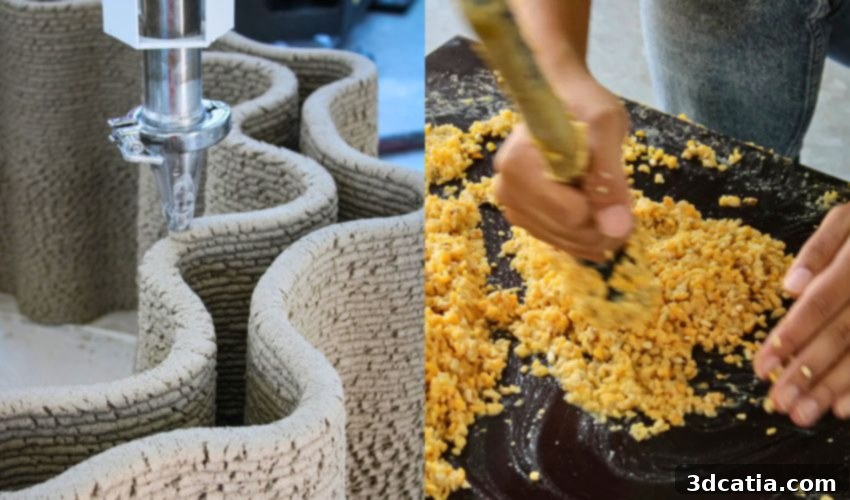
Revolutionizing Construction: 3D Printing with Sustainable Corn-Based Concrete (CORNCRETL)
The construction industry is undergoing a transformative shift, and 3D printing is at the forefront. While speed and automation have long been the primary focus of construction 3D printing, a new and crucial advantage is emerging: the use of sustainable, bio-based, and locally sourced materials. This innovative approach promises to drastically reduce the environmental impact of construction while fostering localized economies and resource utilization.
Traditionally, construction relies heavily on carbon-intensive cement, contributing significantly to global carbon emissions. However, researchers and innovators are actively exploring alternatives that minimize this environmental footprint. Among these pioneering efforts, the Mexico-based collective Manufactura stands out with its groundbreaking development: CORNCRETL. This 3D-printable composite is ingeniously crafted from agricultural by-products, specifically corn waste, and is designed for structural applications. CORNCRETL represents a significant step towards sustainable construction, offering a viable alternative to conventional concrete and paving the way for a more environmentally responsible future.
CORNCRETL’s development showcases a commitment to leveraging readily available, renewable resources while addressing the urgent need for sustainable construction practices. By utilizing agricultural waste, Manufactura not only reduces reliance on traditional cement but also transforms a potential environmental burden into a valuable building material.
CORNCRETL: Blending Ancient Knowledge with Modern Technology
Manufactura, founded in 2022 by Dinorah Schulte, embodies a unique fusion of pre-Hispanic building knowledge and advanced robotic fabrication. The core of their innovation lies in CORNCRETL, a name cleverly combining “corn” and “concrete.” This composite material harnesses the potential of nejayote, a calcium-rich wastewater produced during the nixtamalization process. Nixtamalization, a traditional method of preparing corn, has been practiced for millennia in Mesoamerica. This process involves soaking and cooking corn kernels in an alkaline solution, typically lime water, to improve their nutritional value and flavor.
Instead of being discarded as waste, nejayote is ingeniously repurposed as a key ingredient in the CORNCRETL mixture. Corn remains a staple food in Mexico, resulting in the generation of substantial volumes of organic residue, including nejayote. This abundance makes CORNCRETL a culturally rooted and locally accessible material. By combining nejayote with dried corn husks and stalks, the Manufactura team has created a printable binder that rivals traditional concrete in its structural properties while significantly reducing its environmental impact.
The beauty of CORNCRETL lies not only in its sustainable composition but also in its connection to Mexico’s rich cultural heritage. By incorporating traditional knowledge and utilizing locally available resources, Manufactura is creating a building material that is both environmentally sound and culturally significant. This approach offers a compelling model for sustainable construction in other regions, demonstrating the potential of blending traditional practices with modern technology to create innovative and eco-friendly building solutions.
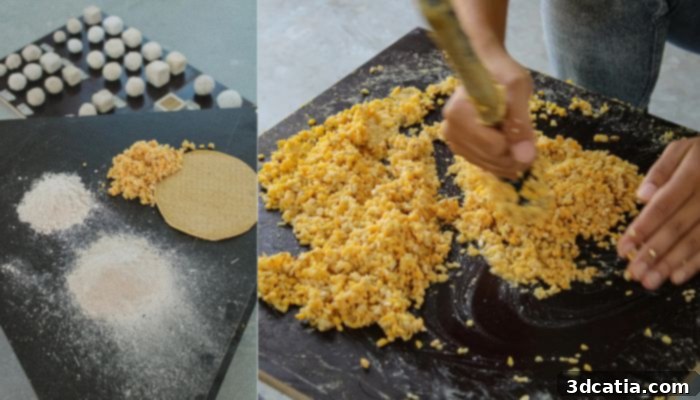
The 3D Printing Process of CORNCRETL
The production of CORNCRETL involves a sophisticated 3D printing process that combines precision robotics with sustainable material science. To create CORNCRETL structures, the Manufactura team employs a KUKA robotic arm, a versatile and adaptable industrial robot widely used in manufacturing and construction. This robotic arm is paired with a WASP Concrete HD Continuous Feeding System, a specialized system designed for dispensing concrete and other viscous materials in a controlled and continuous manner.
The process begins with the preparation of the corn residues. These residues, including corn husks and stalks, are carefully dried, shredded, and milled to achieve a controlled particle size. This precise control over particle size is crucial for ensuring the consistency and printability of the CORNCRETL mixture. The processed corn residues are then blended with a natural hydraulic lime (NHL 3.5) binder and aggregates selected for their suitability for robotic extrusion. Natural hydraulic lime is a type of lime that sets and hardens through a chemical reaction with water, offering a more sustainable alternative to Portland cement.
The resulting mixture is then fed into the WASP Concrete HD Continuous Feeding System, which precisely deposits the material layer by layer, following a pre-programmed digital design. This layer-by-layer deposition eliminates the need for traditional formwork, a significant advantage of 3D printing in construction. Formwork, typically made of wood or metal, is used to mold concrete into desired shapes but generates significant waste. By eliminating formwork, CORNCRETL 3D printing reduces construction waste by an impressive 90%, further enhancing its environmental credentials.
The use of a robotic arm provides unparalleled freedom of motion, enabling the creation of curved surfaces and intricate geometric textures inspired by terrazzo designs. This design flexibility opens up new possibilities for architectural expression and allows for the creation of aesthetically pleasing and structurally sound buildings. After printing, the lime-based material hardens at room temperature within days, a process that requires significantly less energy than the energy-intensive curing process required for traditional concrete. This ambient curing further reduces the environmental impact of CORNCRETL construction.
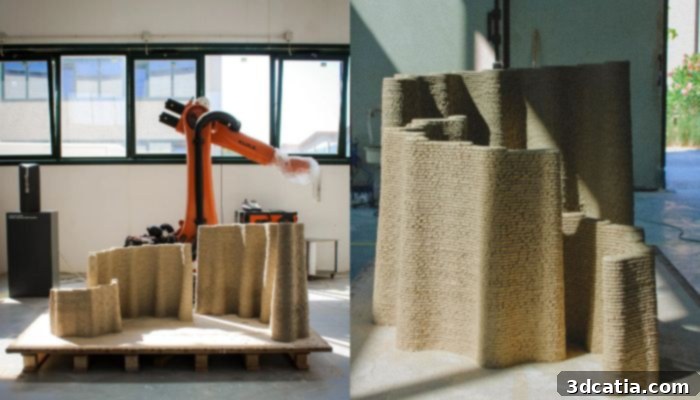
Sustainability and Self-Healing Properties of CORNCRETL
CORNCRETL offers a compelling solution to the environmental challenges posed by the construction industry. According to Manufactura, CORNCRETL can reduce carbon emissions by up to 70% compared with Portland cement. This significant reduction is attributed to two key factors: the use of lime-based chemistry and the low-temperature curing process. Lime production requires less energy than cement production, and the ambient curing of CORNCRETL eliminates the need for energy-intensive heating or steam curing.
In addition to its reduced carbon footprint, CORNCRETL exhibits remarkable self-healing behavior. This unique property arises from the presence of unreacted lime particles within the material. When moisture enters micro-cracks that may develop in the structure over time, these unreacted lime particles recrystallize and partially seal the gap. This self-healing mechanism is a known property of lime binders and enhances the durability and longevity of CORNCRETL structures, reducing the need for costly repairs and maintenance.
The self-healing properties of CORNCRETL contribute to its overall sustainability by extending the lifespan of buildings and minimizing the consumption of resources for repairs. This innovative material offers a compelling example of how sustainable material science can be combined with advanced manufacturing techniques to create environmentally responsible and durable building solutions.
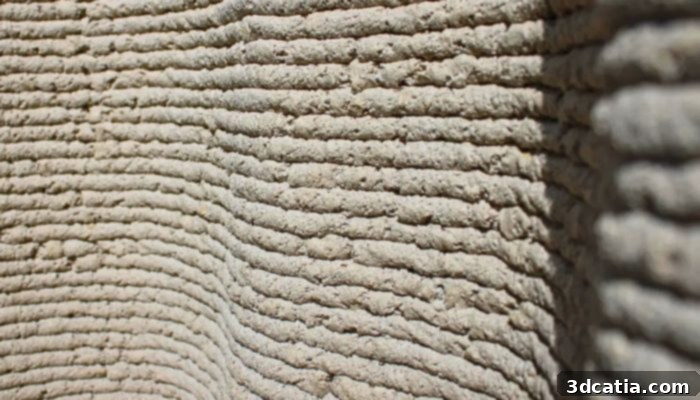
Scaling Local Solutions for a Sustainable Future
The Manufactura team has validated the structural potential of CORNCRETL through rigorous testing and prototyping. They have successfully printed modular wall prototypes up to 80 cm in height and conducted full-scale testing at the Shamballa open-air laboratory in Italy. These tests have demonstrated the material’s ability to withstand structural loads and its suitability for building applications.
CORNCRETL represents a departure from the traditional construction model that relies on standardized, carbon-heavy concrete mixes. Instead, CORNCRETL promotes a decentralized model that utilizes additive manufacturing to process local waste streams in situ. This means that the building material originates from the same place as the structure itself, reducing transportation costs and minimizing the environmental impact associated with long-distance material transport.
The CORNCRETL model empowers local communities to utilize their own resources and address their own building needs in a sustainable and self-sufficient manner. This approach fosters economic development and reduces reliance on centralized supply chains, making construction more resilient and adaptable to local conditions. By embracing local materials and leveraging advanced manufacturing techniques, CORNCRETL offers a pathway towards a more sustainable and equitable future for the construction industry.
The potential of CORNCRETL and other bio-based building materials is immense. By embracing innovation and challenging conventional practices, we can transform the construction industry into a force for positive change, creating buildings that are not only structurally sound and aesthetically pleasing but also environmentally responsible and socially equitable. The future of construction lies in sustainable solutions that harness the power of nature and the ingenuity of human innovation.