
Unlocking the Future of Additive Manufacturing: An In-Depth Look at CoreTechnologie’s 4D_Additive Software
Additive manufacturing, often known as 3D printing, encompasses far more than just the printing process itself. A successful and efficient workflow hinges critically on selecting the right software for model preparation and optimization, as well as robust post-processing capabilities. When embarking on the journey to choose the ideal modeling software for additive manufacturing, several crucial factors must be considered. These include understanding the specific industry applications for the 3D-printed part, evaluating the user’s existing software proficiency, and identifying features that are paramount to the user’s operational needs. The market offers a diverse array of software solutions, among which stands 4D_Additive from the renowned German-French company, CoreTechnologie. Earlier this year, CoreTechnologie unveiled a significant update to 4D_Additive. Eager to understand the tangible benefits and innovations this new version brings to users, we had the privilege of sitting down with Rémi Goupil, Product Manager for 4D_Additive in Germany, to delve into these enhancements and gain insights into the company’s ambitious future plans.
3DN: Could you briefly introduce yourself and elaborate on your connection to additive manufacturing?

Rémi Goupil, Product Manager for 4D_Additive in Germany
Hello, my name is Rémi Goupil, and I serve as the Product Manager for 4D_Additive here in Germany. CoreTechnologie is widely recognized within the 3D CAD interoperability market as a leading global provider of 3D CAD data conversion software. Our fundamental mission revolves around optimizing interoperability, which involves enabling organizations to efficiently share complex engineering data and streamline all processes that rely on 3D data. This expertise forms the bedrock of our additive manufacturing solutions.
Since its inception in 1998, CoreTechnologie has maintained a consistent track record of introducing innovative developments to the industry. We proudly serve over 560 leading technology companies across various sectors, including automotive, aerospace, mechanical engineering, and consumer goods, all of whom develop highly complex products. CoreTechnologie operates as a Franco-German company, with our primary development center located in Lyon, France, and our head office situated in Germany, near Frankfurt. As a native Frenchman, my relocation to Germany was a strategic move designed to foster a robust and seamless connection between our dedicated sales team and our highly skilled development team in France, ensuring excellent communication and collaborative innovation.
3DN: How did 4D_Additive from CoreTechnologie come about?
Approximately four years ago, CoreTechnologie made a strategic decision to thoroughly investigate the burgeoning additive manufacturing market. Through our research, we identified a significant gap: many of the established tools available at the time often relied on outdated data formats and methodologies, primarily based on the triangulated STL format. This presented inherent limitations in terms of file size, accuracy, and overall workflow efficiency, especially as 3D printing began to scale towards industrial applications.
Leveraging our two decades of extensive experience in data conversion and simplification, we recognized a unique opportunity. We believed we could create a truly innovative 3D printing software solution by building it upon our proprietary kernel, which possesses the advanced capability to handle both exact CAD data from all major formats and traditional triangulated data. This fundamental approach allowed us to directly address the longstanding challenges associated with STL files: either cumbersome large files that offered sufficient quality or smaller files plagued by poor accuracy. As 3D printer capacities evolved considerably, gradually integrating mass production capabilities, the size of STL files required for complex industrial parts increased dramatically, exacerbating these issues. The timing was therefore perfect to introduce the advantages of exact and highly compact CAD files to support large build volumes and simultaneously deliver superior accuracy, which is absolutely critical for the industrial production of parts. This imperative was the primary driving force behind the birth of 4D_Additive.
Furthermore, by building upon our existing and proven Graphical User Interface (GUI) concept, we were able to engineer a software that is remarkably intuitive and easy to use. The 3D printing market is increasingly accessible to a broad spectrum of users, from seasoned professionals to those new to additive manufacturing. Consequently, there was a pressing need for a solution that could cater to all user types, while simultaneously ensuring the production of high-quality parts and providing the robust processing power essential for serious, industrial-grade additive manufacturing processes. 4D_Additive was designed to meet these diverse demands, bridging the gap between advanced capabilities and user-friendliness.
3DN: CoreTechnologie released a new version of the software in the middle of this year. What can you tell us about the new features in the 1.4 Update?
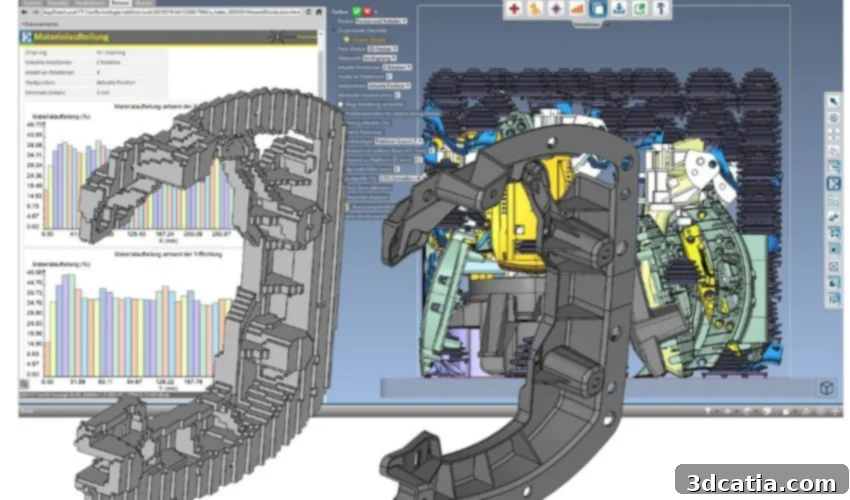
The most significant enhancement in the new 4D_Additive 1.4 software version is undoubtedly the vastly improved nesting functions. Compared to our previous iteration, the software now delivers considerably higher speed, enhanced accuracy, and a superior packing density. This translates directly into more efficient use of build volume and reduced material waste, crucial for cost-effective additive manufacturing. Furthermore, we’ve implemented a new and highly optimized nesting distribution strategy to maximize the utilization of the printer’s build plate. A particularly innovative addition is the new Powercopy nesting function, which facilitates extremely fast packing of identical parts, achieving the absolute maximum packing density. This feature is a game-changer for batch production and serial manufacturing scenarios.
Beyond nesting, we have also integrated the Eosprint 2.0 interface. This direct integration is a major step forward for streamlining workflows, as it now allows print data to be seamlessly sent from 4D_Additive directly to EOS machines without the need for cumbersome detours via other software tools or intermediary file formats. This means that users can now effortlessly read native CAD or STL data, meticulously prepare it for the 3D printing process, and then transmit this optimized data directly to EOS systems, all within a single, unified software environment. This end-to-end capability significantly simplifies the pre-processing stage, reduces potential for errors, and accelerates the overall additive manufacturing cycle, especially for those utilizing EOS technologies.
3DN: What is the primary target audience for 4D_Additive?
Our established customer base primarily includes specialized 3D printing service companies and businesses operating within the prototyping industry, where rapid iteration and precise model preparation are paramount. However, we are increasingly observing a growing trend: mechanical engineering companies are actively acquiring our software. This shift highlights a broader industry movement where more and more components are being designed from the outset as 3D-printable parts, necessitating regular manufacturing through additive processes. In response to this evolving demand, we are intensely focusing our development efforts on enhancing the automation potential for powder bed technologies such such as Selective Laser Sintering (SLS) and Multi Jet Fusion (MJF).
Within these technologies, advanced 3D nesting is a particularly crucial capability for significantly improving productivity and maximizing build platform utilization. In our latest version, we dedicated substantial development time to refining FDM (Fused Deposition Modeling) and DLP (Digital Light Processing) support structures, alongside developing robust G-Code generation for a wide range of major printers. Our overarching goal with 4D_Additive is to provide a comprehensive, singular software solution that can be effectively utilized across all prevalent printing methods and various machine types. This eliminates the need for users to navigate and switch between multiple, disparate software tools, thereby creating a more efficient, integrated, and user-friendly additive manufacturing workflow from design to print.
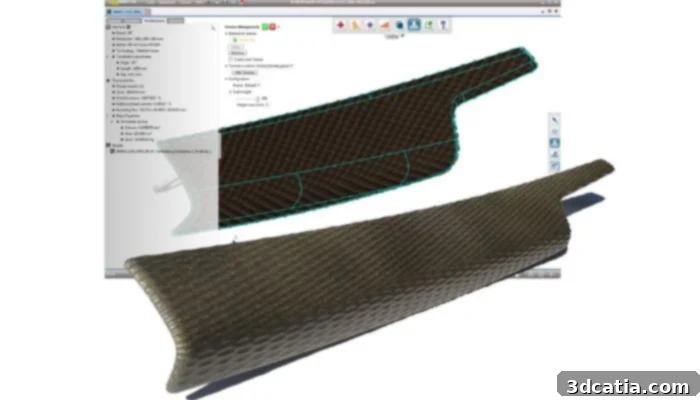
The texture can be chosen using 4D_Additive.
3DN: What exciting projects can we look forward to in the future from CoreTechnologie?
Looking ahead to the upcoming version of 4D_Additive, anticipated for release in November, our development team is heavily focused on several key areas. A major concentration is on advancing support structures specifically tailored for metal 3D printing, a field with increasingly stringent demands for precision and material integrity. We are also dedicating significant resources to developing new AI-based algorithms that will automatically optimize support generation and part orientation. These intelligent algorithms promise to significantly reduce manual effort, improve print success rates, and enhance the overall quality of printed parts by autonomously identifying the most efficient and effective configurations.
Furthermore, this month, we are excited to unveil the initial version of our automatic batch nesting tool. This powerful new feature is designed for easy integration into various web server systems through a Rest API (Representational State Transfer Application Programming Interface). This will allow for automated and highly efficient packing of multiple print jobs, making it ideal for high-volume production environments and integrated manufacturing ecosystems. Finally, we have just completed the development of our SLS (Selective Laser Sintering) build manager, which will provide comprehensive control and optimization for SLS printing processes. Concurrently, we are now actively working on the 4D_Additive API, which is designed to deliver advanced functionalities such as sophisticated 3D nesting, precise slicing, efficient hatching, and intelligent support generation, all packaged within an easy-to-use Software Developer Kit. This API will empower developers and engineers to integrate 4D_Additive’s core capabilities directly into their custom applications and workflows, further expanding its versatility and utility in industrial settings.
3DN: Do you have any final words for our readers?
We firmly believe that 3D printing holds immense potential, particularly as a means to achieve greater independence from the often vulnerable global supply chains. The ability to produce parts locally and on-demand offers a significant strategic advantage for businesses worldwide. In our ongoing conversations with customers, we consistently observe a serious and sustained shift away from traditional production methods, such as injection molding, towards additive manufacturing. This trend is especially pronounced when it comes to manufacturing smaller, highly complex parts, as well as producing small batches efficiently. Additive manufacturing offers unparalleled design freedom and cost-effectiveness for these specific applications, making it an increasingly attractive alternative. We encourage everyone interested to explore the full capabilities of our software and discover how 4D_Additive can transform their production processes. You can find more comprehensive information on our official website HERE.
Have you already had experience with 4D_Additive? We would love to hear your insights! Please share your thoughts in a comment below or connect with us on ourLinkedIn,Facebook, andTwitter pages! To stay completely up-to-date with all the latest developments in the world of 3D printing, don’t forget to sign up for our free weeklyNewsletter here, delivering the freshest news straight to your inbox! Additionally, you can find all our engaging videos and tutorials on our dedicatedYouTube channel.
*All Photo Credits: CoreTechnologie