
Revolutionizing FDM 3D Printing: Dynamic Platforms Slash Waste and Costs
In a significant breakthrough for the additive manufacturing industry, researchers from the University of Southern California (USC) Viterbi School of Engineering have pioneered an innovative method to dramatically reduce material waste and associated costs in 3D printing. This advancement focuses specifically on Fused Deposition Modeling (FDM) technology, which is widely used but often challenged by material inefficiencies. The dedicated team, spearheaded by Yong Chen, a distinguished professor of industrial and systems engineering, and his PhD student Yang Xu, has successfully developed a unique, low-cost, and dynamically controlled surface system for 3D printers. These groundbreaking “Moving Platform 3D printers” fundamentally redefine the FDM process by eliminating the need for traditional support structures, thereby leading to substantial reductions in waste and material consumption. The result is a more sustainable, cost-effective, and efficient 3D printing paradigm, poised to benefit a multitude of industries.
Addressing the Inefficiency of Traditional FDM Supports
Traditional FDM processes, particularly when fabricating complex or intricately shaped parts, are heavily reliant on support structures. These temporary structures are essential for balancing and stabilizing overhanging features and bridging gaps during the printing process. However, their necessity comes with several significant drawbacks that impact efficiency, cost, and part quality. Professor Chen vividly illustrates this inefficiency, commenting, “When you’re 3-D printing complex shapes, half of the time you are building the parts that you need, the other half of the time you’re building the supports. So, with this system, we’re not building the supports. Therefore, in terms of printing time, we have a savings of about 40%.” This statistic highlights the profound impact of support structures on overall print duration and material usage.
Beyond the increased print time, the requirement for supports introduces a subsequent, often laborious, post-processing phase. Once a part is printed, these supports must be manually removed, a process that is not only time-consuming but also prone to human error. This manual intervention can lead to surface imperfections, shape inaccuracies, and even damage to the final part, necessitating additional finishing work or, in severe cases, rejection of the part. Such issues add further to the total time taken to produce a finished component, increase labor costs, and contribute to higher material waste. By ingeniously eliminating the need for these ubiquitous supports, the Moving Platform 3D printer drastically reduces the potential for human error and considerably accelerates the entire additive manufacturing workflow, from digital design to final product.
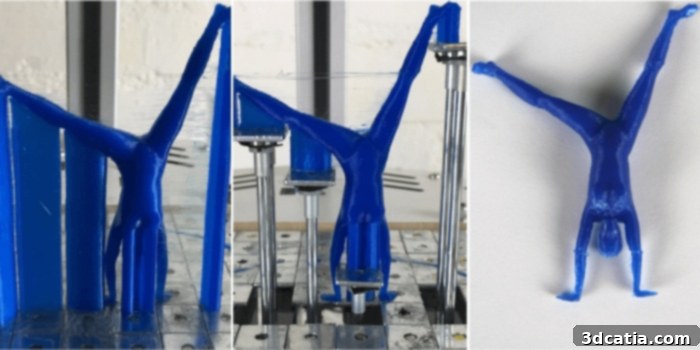
A new dynamically-controlled base for 3D printing (center) will reduce the need for printed supports (left), cutting wastage and saving time. (Photo credit: Yong Chen)
How the Moving Platform 3D Printer Works: A Dynamic Approach to Support-Free Printing
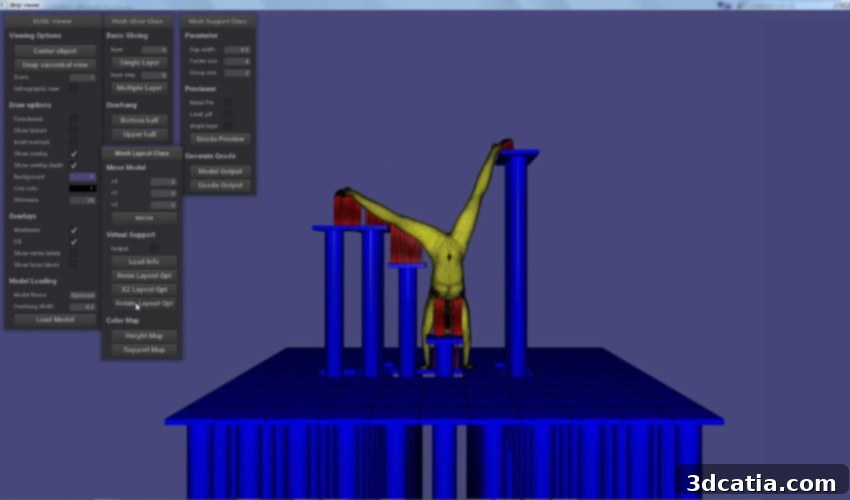
At its core, the Moving Platform 3D printer operates on principles similar to any other FDM 3D printer, extruding thermoplastic filament layer by layer to build a three-dimensional object. However, the pivotal difference, and indeed the essence of this innovation, lies in its intelligent, dynamically controlled build platform. Unlike static build plates, this system is equipped with a unique mechanism that provides adaptable support throughout the printing process. The current prototype achieves this by utilizing a series of individual, motor-driven supports. These supports, which resemble groups of metal pins, are precisely controlled to raise and lower, providing localized support to the part only when and where it is needed.
As the FDM extruder deposits material, the system’s intelligent software monitors the geometry of the part and dynamically adjusts the positions of these pins. This means that instead of printing sacrificial support material that later needs to be removed, the physical platform itself intelligently conforms to the part’s geometry, supporting overhangs and complex features from below. Once the printing process is complete, the user can effortlessly lower and remove these metal pins without any risk of damaging the newly printed product. This ingenious approach completely bypasses the need for printed supports, allowing for clean, support-free prints and streamlining the entire workflow. The dynamic nature of this platform represents a paradigm shift, moving from passive, static support to active, intelligent structural assistance.
Transformative Benefits of Support-Free FDM Printing
The introduction of the Moving Platform 3D printer brings a multitude of benefits that extend far beyond simply eliminating supports. This technology is set to redefine efficiency, cost-effectiveness, and quality in FDM 3D printing, making the process more attractive for a wider range of applications.
Unprecedented Material and Cost Savings
One of the most immediate and impactful benefits is the significant reduction in material waste. With no need to print support structures, a substantial portion of filament that would otherwise be discarded is saved. As Professor Chen noted, up to 40% of printing time can be dedicated to building supports, which directly translates to a proportionate amount of material waste. By eliminating this, manufacturers can achieve considerable cost savings on raw materials. Furthermore, the absence of support removal post-processing reduces labor costs and the need for specialized tools, contributing to a lower overall production cost per part. For businesses operating at scale, these savings can be monumental, directly impacting profitability and allowing for more competitive pricing of 3D printed components.
Accelerated Production and Enhanced Efficiency
Beyond material savings, the Moving Platform 3D printer dramatically cuts down on production time. The 40% reduction in printing time due to the elimination of supports is just one aspect. The subsequent elimination of manual post-processing – which can often take as long as, or even longer than, the print itself for complex parts – further accelerates the entire workflow. This means parts can move from digital design to finished product much faster, improving throughput, reducing lead times, and enabling rapid prototyping and iteration cycles. For industries where speed to market is critical, this efficiency gain is invaluable, allowing companies to innovate and respond to demand with unprecedented agility.
Superior Part Quality and Design Freedom
Traditional FDM supports, when removed, often leave behind blemishes, rough surfaces, or even structural weaknesses on the final part. The Moving Platform system circumvents these issues entirely. Parts printed with this technology emerge with pristine surfaces, free from support scars, requiring minimal to no post-finishing. This not only enhances the aesthetic quality but also improves the functional performance and dimensional accuracy of the printed objects. Moreover, the freedom from support constraints empowers designers to create more complex, organic, and intricate geometries that were previously deemed impossible or impractical to print with FDM, unlocking new levels of design creativity and innovation across various sectors.
Advancing Sustainable Additive Manufacturing
In an era of increasing environmental consciousness, the sustainability aspect of the Moving Platform 3D printer is particularly compelling. By significantly reducing material consumption and waste, the technology contributes directly to greener manufacturing practices. Less material used means less waste generated, and for many common FDM filaments, this translates to a reduction in non-biodegradable plastic waste. Furthermore, the reduced printing time and elimination of post-processing steps also translate to lower energy consumption throughout the manufacturing cycle. This positions FDM, a widely accessible 3D printing technology, as a more environmentally friendly option, aligning with global efforts to minimize ecological footprints in industrial production.
Transforming Industrial Applications and Scalability
This technology holds immense potential for the evolution of additive manufacturing, particularly in its capacity to broaden the appeal and utility of FDM 3D printing across industrial sectors. Professor Chen foresees easy adaptation of the system for large-scale manufacturing in demanding industries such as automotive, aerospace, and yachting. These sectors frequently require the production of large, complex parts where material costs and lengthy production times associated with traditional supports become major inhibitors. The ability to print such components without extensive support structures will be a game-changer.
Chen elaborates on the profound impact: “People are already building FDM printers for large size car and ship bodies, as well as for consumer products such as furniture. As you can imagine, their building times are really long–we’re talking about a whole day. So if you can save half of that, your manufacturing time could be reduced to half a day. Using our approach could bring a lot of benefits for this type of 3D printing.” This highlights how the Moving Platform technology can drastically cut down multi-day printing operations to significantly shorter durations, making large-scale FDM more economically viable and competitive. This efficiency gain not only accelerates product development but also opens doors for FDM to become a primary manufacturing method for end-use parts in high-value, large-format applications, moving beyond its traditional role in prototyping.
Future Outlook and Broader Implications
The USC Viterbi team’s innovation represents a significant leap forward for FDM technology, positioning it more strongly against other advanced additive manufacturing methods. By addressing its inherent inefficiencies, the Moving Platform 3D printer makes FDM a more compelling choice for applications demanding both cost-effectiveness and high-quality finishes. This breakthrough could also inspire further research into dynamic support systems and adaptive manufacturing processes across the broader 3D printing landscape. As FDM becomes more efficient, sustainable, and capable of producing higher quality parts with less human intervention, its adoption in diverse industries, from customized medical devices to architectural components and beyond, is set to expand rapidly. This technology truly embodies a smarter, leaner future for additive manufacturing.
To delve deeper into the specifics of the Moving Platform 3D printer and the research behind it, you can read the full press release HERE.
What are your thoughts on this innovative Moving Platform 3D printer and its potential impact on the industry? We invite you to share your insights in the comment section below or engage with us on our social media channels: Facebook, Twitter and LinkedIn! Stay informed about the latest advancements in additive manufacturing by signing up for our free weekly Newsletter here, delivering the most relevant 3D printing news directly to your inbox!
*Cover photo credit USC Viterbi School of Engineering Youtube