
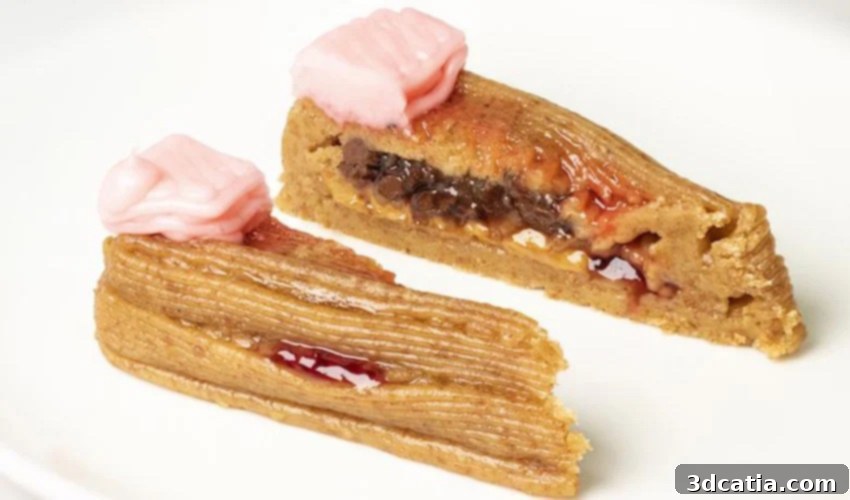
Revolutionizing Desserts: Columbia Engineers Unveil the Future of Food with 3D Printed Cheesecake
While the concept of food 3D printing continues to navigate the complex landscape of culinary acceptance, it undeniably sparks fascinating discussions and poses intriguing questions. Skeptics wonder if a food 3D printer can truly create healthy, appetizing meals, or if it holds the potential to revolutionize our dietary habits and cater to the ever-growing complexities of consumer preferences and specific dietary constraints. To delve into these compelling inquiries, a dedicated team of mechanical engineers at Columbia University’s Creative Machines Lab, under the visionary leadership of Professor Hod Lipson, has been conducting extensive research and experimentation. Their latest breakthrough project elegantly encapsulates the potential of this technology: a meticulously engineered 3D printed cheesecake, composed of precisely seven distinct layers. This innovative dessert was crafted not merely as a culinary novelty, but as a tangible demonstration of the profound benefits offered by food 3D printing, particularly in the critical areas of personalized food customization, enhanced food safety protocols, and precise tracking of ingested nutrients. It represents a significant step towards understanding how additive manufacturing can reshape our relationship with food.
The Visionaries Behind the Edible Innovation
Jonathan Blutinger, a post-doctoral fellow integral to the Creative Machines Lab and the lead contributor to this groundbreaking cheesecake project, embarked on this endeavor with a clear mission: to showcase the undeniable advantages of food 3D printing, a process that, despite its promising potential, often faces skepticism and controversy. Many observers still perceive 3D printed food as unappetizing or view the technology as little more than a passing gimmick with limited practical application. Blutinger, addressing both the lingering obstacles and the compelling benefits of the technology, articulated his insights, emphasizing the foundational ecosystem required for its widespread adoption. “Because 3D food printing is still a nascent technology, it needs an ecosystem of supporting industries such as food cartridge manufacturers, downloadable recipe files, and an environment in which to create and share these recipes,” he explained. This vision extends beyond the mere act of printing, highlighting the need for a comprehensive infrastructure to truly unleash its power. He further elaborated on its practical implications, noting that “Its customizability makes it particularly practical for the plant-based meat market, where texture and flavor need to be carefully formulated to mimic real meats.” This speaks to the technology’s capacity to precisely control material deposition, a feature critical for replicating complex sensory experiences in novel food products. The ability to precisely control the deposition of ingredients, layer by layer, opens doors to creating bespoke textures and flavors that are virtually impossible to achieve with traditional food preparation methods, offering unparalleled precision for the burgeoning plant-based food industry and beyond.
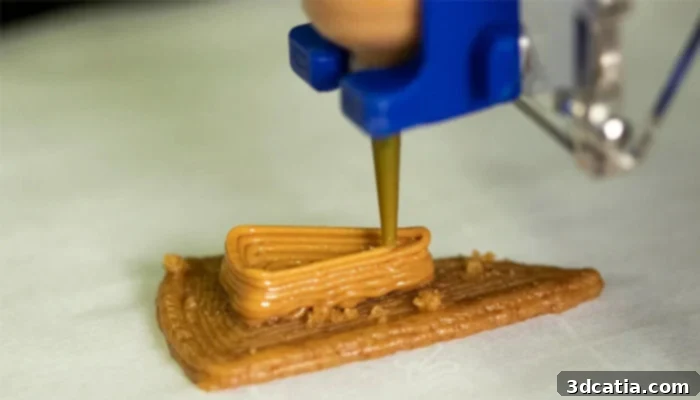
Peanut butter on the graham cracker (photo credits: Jonathan Blutinger/Columbia Engineering)
Engineering the Edible: The Science of Layered Desserts
The creation of this pioneering 3D printed cheesecake was a testament to both culinary creativity and meticulous engineering. The team’s initial challenge involved transforming conventional ingredients into a print-ready, dough-like consistency suitable for extrusion. For this delectable experiment, they sourced readily available ingredients from a local New York grocery store, including graham cracker crumbs, creamy peanut butter, rich Nutella, fresh banana purée, sweet strawberry jam, vibrant cherry drizzle, and a classic frosting. The key to successful 3D printing lies in understanding the material properties and their interaction during the layering process. Therefore, extensive print tests were indispensable to ascertain the optimal printing order for each ingredient. These trials were crucial for establishing structural integrity and visual appeal. For instance, the graham cracker mixture proved to be the most effective as the foundational layer, primarily due to its superior adhesion properties to the machine’s printing tray. This robust base was essential for supporting subsequent layers without collapse. In contrast, viscous ingredients like peanut butter and Nutella were strategically placed as intermediate layers. Their inherent density and semi-solid consistency made them ideal for providing critical support to softer, more fluid materials such as the various jams. The team ingeniously likened the architectural design of their 3D printed cheesecake to that of a conventional building, where strong, supportive structural elements bear the weight and maintain the form of more delicate, fragile components. This thoughtful approach ensured that each layer contributed not only to the flavor profile but also to the overall stability and successful construction of the multi-layered dessert, pushing the boundaries of what is possible in food fabrication. The process involved careful calibration of nozzle size, extrusion speed, and layer thickness for each ingredient, transforming a simple recipe into a complex engineering challenge, demonstrating the incredible precision food 3D printing offers.
Beyond Baking: Personalized Nutrition and Dietary Solutions
The ultimate objective behind creating this sophisticated cheesecake was not to merely disrupt traditional baking practices, but rather to powerfully illustrate how food 3D printing can confer unprecedented control over the precise composition of the food on our plates. This technology holds immense promise for addressing some of the most pressing dietary challenges of our time. Professor Christen Cooper, a distinguished expert from Pace University’s Nutrition and Dietetics department and a valuable contributor to this project, articulated this potential eloquently. She highlighted a significant societal issue: “We have an enormous problem with the low-nutrient value of processed foods.” While acknowledging that 3D food printing, in its current iteration, still produces processed foods, she pointed to a crucial redeeming quality: “perhaps the silver lining will be, for some people, better control and tailoring of nutrition–personalized nutrition.” This personalized approach could involve finely tuning macronutrient ratios (proteins, carbohydrates, fats), micronutrient content (vitamins, minerals), calorie counts, and even precisely managing allergens or specific dietary intolerances on an individual basis. Imagine a future where a diabetic individual could have a dessert printed with precise sugar levels, or an athlete could receive a meal optimized for protein and specific amino acids for recovery, all tailored to their unique physiological needs. The implications for dietary management are profound, moving beyond one-size-fits-all recommendations to truly individualized culinary solutions.
Furthermore, Professor Cooper emphasized another critical application: improving the quality of life for individuals with dysphagia, or swallowing disorders. This condition affects millions globally, often necessitating the consumption of puréed foods, which can be unappetizing and psychologically challenging. 3D food printing offers a transformative solution by enabling the creation of puréed foods that meticulously mimic the familiar shapes and aesthetics of real, unprocessed foods. “It may also be useful in making food more appealing to those with swallowing disorders by mimicking the shapes of real foods with the puréed texture foods that these patients–millions in the U.S. alone–require,” she explained. This ability to restore visual normalcy to modified-texture diets can significantly enhance patient dignity, stimulate appetite, and contribute positively to their overall well-being, transforming mealtimes from a chore into a more enjoyable and recognizable experience. The psychological benefits of eating food that *looks* like what it’s supposed to be, even if its texture is modified, are immense and can greatly impact patient compliance and nutritional intake. This aspect alone highlights the technology’s humanitarian potential, extending its reach far beyond mere novelty.
Enhancing Food Safety and Traceability
Beyond personalization, food 3D printing introduces unparalleled advancements in food safety and traceability, areas of paramount concern for consumers and regulators alike. The inherent precision of additive manufacturing means that ingredients can be added in highly controlled, selected, and measured quantities. This precise control minimizes the risk of contamination often associated with manual handling and conventional large-scale food production. A closed-system printing environment can further reduce exposure to pathogens and allergens, enhancing overall hygiene. Imagine a scenario where every single component of a meal, from its origin to its deposition, is digitally logged. This capability fundamentally transforms traceability. With 3D printing, each ingredient’s batch number, supplier, expiration date, and even the exact time and location it was printed into a dish could be meticulously recorded. This level of granular data offers an unprecedented ability to track food products from farm to plate. In the event of a foodborne illness outbreak or a recall, pinpointing the source of contamination would become exponentially faster and more accurate, limiting public health risks and economic losses. This technology empowers manufacturers and consumers with a transparent, verifiable chain of custody for every bite, fostering greater trust and accountability within the food supply chain. The ability to audit every printed meal effectively creates a digital fingerprint for each food item, ensuring a new era of food safety and transparency.
The Future of Culinary Exploration and Beyond
By enabling the precise deposition of food materials, layer by layer, in specific and measured locations, the food 3D printer has the potential to unlock entirely new culinary experiences. This technology could fundamentally redefine how we conceive of and interact with our food. Envision a world where consumers can meticulously customize every aspect of their meal: choosing not just ingredients, but also precise ratios of flavors, tailoring the texture to their preference (e.g., crispy, chewy, soft), and designing intricate visual aesthetics that elevate dining into an art form. The consumer could truly be the architect of their own plate, selecting exactly what they want to eat, down to the molecular level, if desired. This paradigm shift empowers individuals to transcend the limitations of pre-packaged or traditionally prepared foods. Chefs could utilize 3D printers as innovative tools to create complex geometries and flavor combinations previously deemed impossible, pushing the boundaries of haute cuisine. For home cooks, it could simplify meal preparation by automating ingredient assembly, while for food service industries, it promises efficiency, waste reduction, and unparalleled customization options for diners. From nutrient-dense meals for astronauts in space to perfectly balanced diets for elite athletes, or even just a fun, personalized dessert for a child’s birthday, the possibilities are vast and exciting. The integration of artificial intelligence and machine learning with food 3D printing could lead to intelligent systems that learn individual preferences and health needs, suggesting and printing optimized meals automatically. So, is this vision a far-fetched myth or an impending reality? Only time will truly tell the full extent of this technology’s impact on our daily lives and our relationship with food. What is certain, however, is that the journey towards a more personalized, safe, and innovative culinary future has already begun.
What are your thoughts on this revolutionary 3D printed cheesecake and the broader implications of food 3D printing? We’d love to hear your insights! Share your comments below or engage with us on our LinkedIn, Facebook, and Twitter pages! For the latest updates and breaking news in the world of additive manufacturing, don’t forget to sign up for our free weekly Newsletter here, delivered straight to your inbox. You can also explore all our fascinating videos and interviews on our YouTube channel, where we continually explore the frontiers of 3D printing innovation.
*Cover Photo Credits: Jonathan Blutinger/Columbia Engineering