
Potholes No More: The Future of Urban Infrastructure with Self-Repairing Cities and Autonomous 3D Printing Drones
The persistent challenge of deteriorating urban infrastructure – from ubiquitous potholes to extensive road closures and frustrating traffic jams caused by ongoing maintenance – is a reality familiar to commuters worldwide. These issues not only create daily inconveniences but also impose significant economic burdens and environmental costs. However, a revolutionary approach leveraging the cutting-edge capabilities of 3D printing, sophisticated drone technology, and advanced robotics promises to consign these problems to the past. This vision is rapidly materializing through pioneering research, notably a new project at the esteemed University of Leeds in the United Kingdom, which is at the forefront of developing “Self-Repairing Cities.” By combining autonomous drones with precise 3D scanning and additive manufacturing techniques, this initiative aims to conduct road construction and repair work completely autonomously, often during off-peak hours like nighttime, minimizing disruption and maximizing efficiency.
The potential of 3D printing alone has already been demonstrated through a multitude of awe-inspiring projects, particularly within the dynamic construction industry. We’ve witnessed the emergence of entire 3D printed houses in innovative urban centers like Dubai and the forward-thinking city of Eindhoven, showcasing the technology’s capacity for rapid, customized, and sustainable building. Beyond residential structures, 3D printed bridges, such as those found in the Netherlands, exemplify its application in complex infrastructural elements. The synergy between 3D printing and drone technology further propels innovation, exemplified by developments like the Fly Elephant – a groundbreaking concept of a flying 3D printer designed for aerial fabrication and maintenance. This convergence of technologies forms the bedrock of the “Self-Repairing Cities” concept, pointing towards a future where infrastructure actively manages and resolves its own maintenance needs.
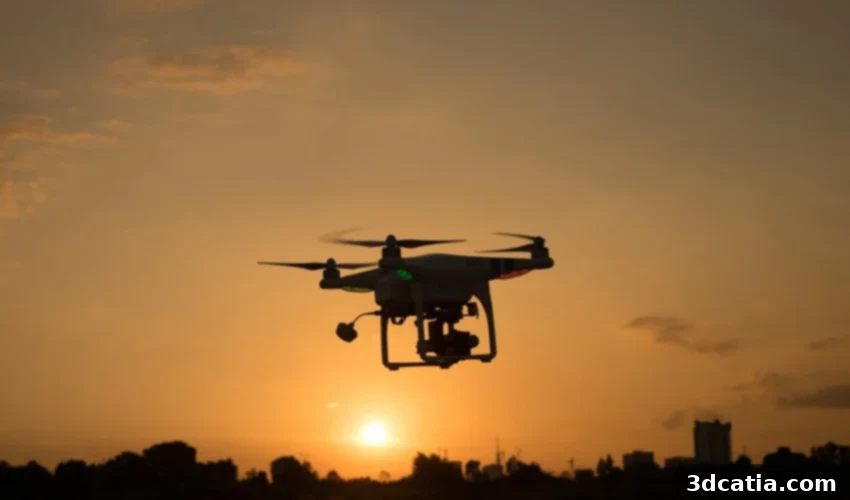
Over the next few years, robotic 3D drones will be tested on British roads as part of the “Self-Repairing Cities” initiative (© Bernd Wustneck).
Pioneering the Future: Combining 3D Printing, Robotics, and Drone Technology for Urban Resilience
The foundational premise of the University of Leeds project centers on equipping drones with advanced robotic capabilities, enabling them to execute road repairs with minimal to no human intervention. This sophisticated process begins with a high-resolution 3D scan of the road surface. These scans meticulously identify and map out defects, ranging from minor cracks to more significant potholes, creating a precise digital blueprint of the damage. Once the damage is assessed, the autonomous drone, integrated with a specialized 3D printing module, then navigates to the exact location. It proceeds to repair the identified damage by 3D printing asphalt or other suitable composite materials directly onto the affected area. This targeted, on-demand repair system is designed to address issues proactively, preventing small imperfections from escalating into costly and dangerous structural failures. The initial phase of this groundbreaking initiative will primarily focus on tackling minor road damage and superficial cracks in the asphalt, recognizing that early intervention is key to long-term road integrity and preventing greater, more disruptive damage from developing.
The Visionary Perspective: Economic and Social Impact
Professor Philip Purnell, a distinguished academic at the University of Leeds and a driving force behind this ambitious endeavor, articulates the profound implications of the “Self-Repairing Cities” project. He emphasizes that “This project is not only scientific in nature but also has an economic and social impact.” This statement underscores the multifaceted benefits extending far beyond mere technological advancement. Economically, autonomous road repair promises substantial cost savings by reducing labor expenses, optimizing material usage, and minimizing the need for extensive, expensive reconstruction projects in the long run. Socially, the project aims to improve urban living conditions dramatically. Imagine a future with fewer traffic delays, smoother commutes, enhanced road safety, and significantly less noise and pollution associated with traditional roadworks. The ability to conduct repairs autonomously, particularly during off-peak hours like nighttime, means cities can maintain their critical infrastructure without disrupting the daily lives of their inhabitants, fostering a more efficient and pleasant urban environment for everyone.
One of the primary advantages of this autonomous system lies in the flexibility to conduct repairs efficiently during nighttime hours, significantly reducing traffic disruption and enhancing public safety (© Rob Browne / Walesonline).
From Vision to Reality: The Roadmap to Autonomous Infrastructure
While the deployment of 3D-printing drones for localized road repairs marks an exciting and crucial first milestone, it represents just the beginning of the broader, overarching goal of the “Self-Repairing Cities” initiative. The dedicated team at the University of Leeds has set an ambitious target: by the year 2050, they envision a future where all forms of pothole damage across the UK can be detected and repaired completely autonomously by intelligent robotic systems. This long-term vision encompasses a comprehensive network of sensors, drones, and ground-based robots working in concert, constantly monitoring infrastructure health and initiating repairs as needed, creating a truly resilient and responsive urban fabric. The evolution of this project will undoubtedly be fascinating to observe, as it moves from controlled testing environments to widespread adoption on British roads and potentially, global urban landscapes. The integration of artificial intelligence for predictive maintenance, advanced material science for durable repairs, and sophisticated swarm robotics for large-scale operations are all areas of active research that will shape the trajectory of this transformative endeavor. The promise is clear: a future where infrastructure degradation is a thing of the past, and urban areas seamlessly maintain themselves, adapting to wear and tear without human intervention.
To delve deeper into the intricate details of the “Self-Repairing Cities” project and gain further insights into its ongoing developments, we encourage you to visit the university’s official website. Additionally, the video below offers a compelling visual overview of this innovative concept, illustrating the potential impact of autonomous road repair on urban living:
The Impact of Autonomous Infrastructure: A Paradigm Shift
The implementation of self-repairing infrastructure promises a paradigm shift in how cities are managed and experienced. Beyond the immediate benefits of fewer potholes and smoother rides, the economic ripple effects are significant. Reducing the frequency and scale of human-led repair crews translates into lower operational costs for municipalities, freeing up resources for other essential public services. Furthermore, the proactive nature of autonomous repair means issues are addressed before they become critical, averting larger, more expensive rehabilitation projects. This not only saves taxpayer money but also contributes to the longevity and safety of critical transport networks. Environmentally, the reduction in traffic congestion from road closures means lower carbon emissions and improved air quality. The precision of 3D printing also allows for optimized material usage, minimizing waste and promoting more sustainable construction practices. Socially, the removal of human workers from hazardous roadside environments during adverse conditions or late hours significantly enhances safety. Commuters will benefit from more reliable travel times and less stress, ultimately leading to a higher quality of life in urban areas.
Challenges, of course, remain. The development of robust, weather-resistant materials for 3D printed asphalt, ensuring the long-term durability and structural integrity of autonomous repairs, is paramount. Regulatory frameworks for drone operation in urban airspace, particularly for construction purposes, will need to evolve. Furthermore, public acceptance and trust in fully autonomous systems are crucial for widespread adoption. However, the University of Leeds project, along with similar initiatives globally, is systematically addressing these challenges, pushing the boundaries of what is technologically feasible and socially acceptable. The future vision is one where our cities are dynamic, intelligent entities, constantly monitoring, diagnosing, and repairing themselves, setting a new global standard for urban resilience and smart infrastructure.
Would you like to live in a “Self-Repairing” city, where advanced technology ensures smooth, safe, and efficient urban travel? We invite you to share your thoughts and perspectives! Let us know in a comment below or join the conversation on our Facebook and Twitter pages. Don’t forget to sign up for our free weekly Newsletter, where you can receive all the latest news, innovations, and developments in the fascinating world of 3D printing delivered straight to your inbox!