
Shanghai’s Groundbreaking Retractable 3D Printed Bridge: Pioneering Smart Urban Infrastructure
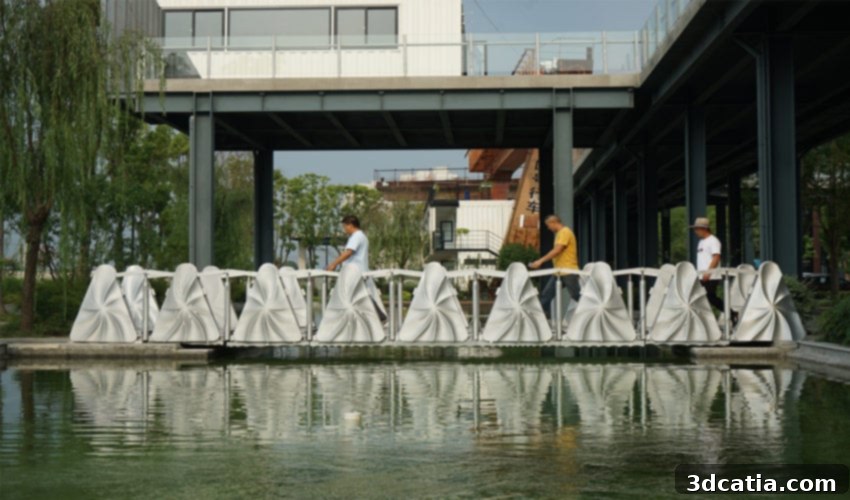
In a monumental leap for urban infrastructure and additive manufacturing, the bustling industrial heart of Shanghai, specifically Wisdom Bay Park in the Baoshan district, has become the stage for a world-first: the debut of a fully retractable 3D printed bridge. This innovative structure marks a significant evolution from the area’s existing 3D printed concrete bridge, which has stood since January 2019. What truly sets this new marvel apart is its unprecedented ability to fold and unfold on demand, offering unparalleled flexibility and adaptability for urban spaces. Measuring an impressive 30.6 feet (9.34 meters) in length, this pioneering bridge is ingeniously segmented into nine distinct sections, further enhanced by 36 unique 3D printed triangular panels, each meticulously crafted with its own distinctive design and aesthetic.
The Baoshan district of Shanghai has long established itself as a vibrant epicenter for advancing 3D technologies, consistently fostering an environment ripe for innovation in additive manufacturing. Its commitment to this cutting-edge field is evident through various initiatives, including housing a dedicated museum solely focused on 3D printing and being home to one of China’s longest 3D printed bridges, stretching an impressive 96 feet (26.3 meters) in length and nearly 12 feet (3.6 meters) in width. Beyond these significant landmarks, the district serves as a strategic hub for approximately 20 prominent market players in the additive manufacturing sector, including XEV, a forward-thinking manufacturer that has established its pivotal R&D center within this innovative ecosystem. This latest achievement, the retractable 3D printed bridge, pushes the boundaries of what’s possible even further. A dedicated team of engineers and designers has conceived and brought to life a bridge that is not only partially fabricated using advanced 3D printing techniques but also boasts remote control capabilities via Bluetooth, heralding a new era of intelligent, responsive infrastructure.

The bridge retracts in just one minute, showcasing its remarkable agility and engineering.
Aptly named “Transformer,” drawing inspiration from the iconic shape-shifting robots, this marvel of engineering measures precisely 30.6 feet (9.34 meters) in length, 4.9 feet (1.5 meters) in width, and 3.6 feet (1.1 meters) in height, with a total weight of approximately 1873.93 pounds (850 kg). Its core functionality lies in its nine retractable segments, all of which can be effortlessly controlled with the simple press of a single button. However, the true innovation and visual intrigue come from its 36 exquisitely designed and 3D printed panels. These panels are not merely structural components but represent a paradigm shift in architectural and engineering design, showcasing the immense potential of additive manufacturing to create complex geometries and unique textures previously unattainable with traditional construction methods. The seamless integration of these panels into the bridge’s retractable mechanism is a testament to sophisticated design and precise fabrication, making the “Transformer” a functional piece of art.
At the helm of this revolutionary project is Lu Bin, the distinguished chief designer, whose vision and expertise brought the “Transformer” bridge to fruition. Lu Bin explains that each of the 36 intricate panels was brought to life using advanced 3D printing techniques with a highly durable and recyclable composite material. While the specific composition is presumably polyester carbonate, it was supplied by a reputable German manufacturer, emphasizing a global collaboration in sustainable innovation. A cornerstone of this project’s philosophy was the imperative to minimize its ecological footprint. 3D printing emerged as a perfect solution, inherently reducing waste by using only the necessary material and allowing for the on-demand creation of components. Beyond its environmental benefits, this technology also afforded unparalleled creative freedom, enabling the design and production of complex, novel shapes and unique textures that adorn each individual panel. Although the precise 3D printing process employed remains undisclosed, it is widely speculated that an extrusion technology was utilized, given its suitability for large-scale composite printing. Remarkably, the entire design and fabrication of all these sophisticated panels were completed in an astonishingly short timeframe of just three days, underscoring the efficiency and speed that additive manufacturing brings to complex construction projects.
The rapid realization of the panels highlights a critical advantage of 3D printing in infrastructure: significantly accelerated production cycles. Traditional manufacturing processes for such bespoke, intricate components would typically require extensive tooling, molds, and lead times, translating into higher costs and prolonged project schedules. With additive manufacturing, designs can be iterated digitally and then printed directly, reducing intermediate steps and waste. This agility is particularly valuable for innovative projects like the “Transformer” bridge, where custom parts with complex geometries are essential for both functionality and aesthetic appeal. The ability to quickly produce and integrate these components allows for faster prototyping, testing, and final assembly, pushing the boundaries of construction timelines and demonstrating a viable path for future rapid deployment infrastructure.
Despite its innovative lightweight design and retractable nature, the “Transformer” bridge does not compromise on strength or safety. The chief designer proudly states that the bridge is engineered to support a substantial total load of one ton, equivalent to the combined weight of approximately 20 adults. This robust load-bearing capacity underscores the exceptional structural integrity achieved through the combination of advanced composite materials and intelligent 3D printing techniques, ensuring it can safely serve its intended purpose in a public park setting. A striking demonstration of its advanced engineering is its deployment speed; the designer claims that the bridge can fully unfold from its compact, retracted state in an astonishingly brief period of just one minute. This rapid transformation makes it highly efficient for managing pedestrian flow or creating temporary access as needed. Furthermore, safety remains paramount, as the bridge will be equipped with an automatic gravity warning system, providing an additional layer of security by monitoring its structural stability and alerting to any potential issues. Set to become accessible to the public later this month, the “Transformer” bridge promises to be not only a functional piece of urban infrastructure but also a captivating showcase of future-forward engineering and design.
Additive Manufacturing’s Transformative Role in Modern Infrastructure
The “Transformer” bridge in Shanghai is a potent symbol of how additive manufacturing is revolutionizing the construction and infrastructure sectors. Its retractable functionality demonstrates a move towards more dynamic and responsive urban planning. Traditional bridges are static structures, but a retractable one offers flexibility for various scenarios, from temporary closures for events to opening up waterways for larger vessels. This adaptability is critical in densely populated urban environments where space is at a premium and demands on infrastructure are constantly evolving. 3D printing facilitates such complex mechanical designs by allowing for the creation of intricate, custom-fit components that would be challenging and costly to produce with conventional methods. The precision and design freedom inherent in 3D printing enable the seamless integration of moving parts and sensors, making smart infrastructure like this bridge a tangible reality.
Furthermore, the project’s emphasis on a recyclable composite material aligns perfectly with global pushes for sustainable development. Additive manufacturing inherently promotes material efficiency by building objects layer by layer, generating significantly less waste compared to subtractive manufacturing processes. When combined with eco-friendly materials like the polyester carbonate used here, 3D printed infrastructure can drastically reduce its environmental impact over its lifecycle. This not only includes the manufacturing phase but also potential end-of-life recycling. The ability to create lightweight yet strong structures also contributes to sustainability, as it reduces the energy required for transportation and potentially for the operation of moving parts. This holistic approach to sustainability, from material selection to manufacturing process and functional design, positions 3D printing as a key enabler for green construction practices.
Looking Ahead: The Future of Smart and Adaptive Urban Spaces
The successful deployment of Shanghai’s retractable 3D printed bridge opens up a myriad of possibilities for future urban development. Imagine cities where bridges can automatically adjust to changing traffic demands, or where temporary pedestrian crossings can be quickly erected and dismantled for public events, disaster relief, or urban regeneration projects. This level of adaptability was once confined to science fiction but is now within our grasp thanks to advancements in 3D printing and smart control systems. The integration of Bluetooth technology for control and advanced safety features like the gravity warning system heralds a new generation of “smart bridges” that are not only functional but also intelligent and responsive to their environment and users.
This project serves as an inspiring blueprint for engineers, architects, and urban planners worldwide. It demonstrates that combining innovative design with cutting-edge manufacturing technologies can lead to infrastructure solutions that are more efficient, sustainable, and adaptable than ever before. As 3D printing technologies continue to evolve, becoming faster, more robust, and capable of processing an even wider range of advanced materials, we can expect to see an accelerating pace of innovation in public works. From customizable modular housing to intricate urban furniture and dynamic pedestrian pathways, the “Transformer” bridge is just the beginning of how additive manufacturing will reshape our built environment, making our cities smarter, more resilient, and ultimately, better places to live.
What are your thoughts on this groundbreaking 3D printed retractable bridge in China? We invite you to share your perspectives in a comment below or join the conversation on our Facebook and Twitter pages. Don’t forget to sign up for our free weekly newsletter, ensuring you receive all the latest news and innovations in 3D printing delivered directly to your inbox!