
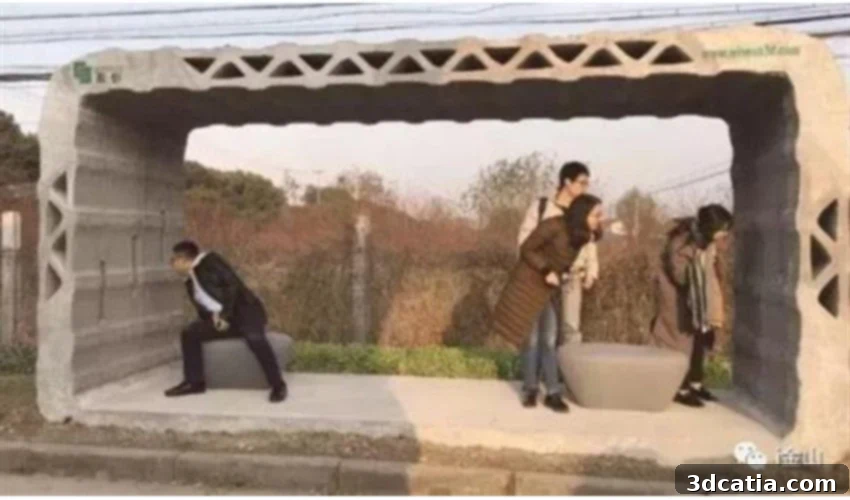
Revolutionizing Urban Infrastructure: China’s 3D Printed Bus Shelters Pave the Way for Sustainable Cities
Additive manufacturing, commonly known as 3D printing, is no longer a futuristic concept confined to laboratories; it is a rapidly expanding technology profoundly impacting a multitude of sectors worldwide. Its journey from prototyping small components to producing intricate metal parts, fabricating entire houses within 24 hours, and carving a significant niche in advanced manufacturing has been nothing short of extraordinary. This relentless evolution signals a paradigm shift in how we approach production, design, and construction. The latest compelling demonstration of this technology’s versatility, however, takes a surprisingly practical turn: the creation of 3D printed bus shelters in China, complete with integrated seating and desks. This innovative project is particularly exciting as it showcases the tangible application of 3D printing in critical urban infrastructure, offering a glimpse into a smarter, more sustainable future for public amenities.
WinSun Leads the Way: The 3D Printed Bus Shelter Project
The pioneering force behind this remarkable development is the Chinese construction giant, WinSun Construction. Their recent accomplishment involves the 3D printing of an unconventional yet highly functional bus shelter located in Fengjing, Jinshan, China. This initiative is not merely about convenience; it stands as a shining example of environmental stewardship. The distinctive bus shelter was meticulously 3D printed using recycled waste materials, setting an impressive precedent for sustainable construction practices. By repurposing waste, WinSun is actively contributing to waste reduction, minimizing landfill burden, and promoting a circular economy within the construction industry. Furthermore, the thoughtfully designed structure ensures practicality for commuters, comfortably accommodating more than six people at a time, providing a safe and sheltered space whether they are waiting for public transport or simply seeking refuge from inclement weather. This fusion of innovative design, practical utility, and environmental consciousness truly positions the project as a benchmark for future urban development.
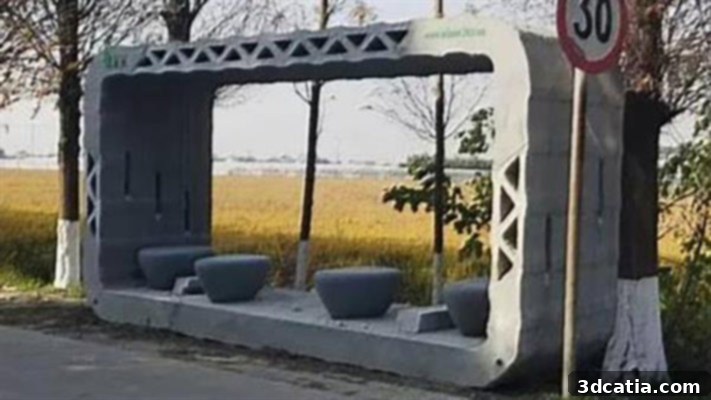
The cutting-edge 3D printed bus shelter in China, showcasing innovation in public infrastructure.
Rapid Fabrication: From Digital Design to Urban Reality in a Single Night
Perhaps one of the most astonishing aspects of this Chinese bus shelter project is the incredible speed of its fabrication. The entire structure was 3D printed in an astonishingly short timeframe – just one night. While this particular shelter was not printed on location, but rather fabricated off-site and then transported to Fengjing, this method highlights a significant advantage of large-scale additive manufacturing. Off-site printing allows for a controlled environment, ensuring optimal quality, precision, and efficiency without being hampered by weather conditions or on-site logistical challenges. The components can be produced rapidly in a factory setting and then swiftly deployed and assembled, drastically reducing construction timelines and minimizing disruption to public spaces. This rapid production capability holds immense potential for accelerating infrastructure projects, offering a cost-effective and time-efficient alternative to traditional building methods.
WinSun Construction is not content to merely demonstrate current capabilities; they are actively experimenting with design iterations and planning substantial upgrades for these shelters. Their vision extends beyond basic desks and chairs, aiming to integrate advanced features that align with the concept of smart cities. Imagine future bus shelters equipped with real-time digital transit information, integrated Wi-Fi hotspots, charging ports for mobile devices, or even solar panels to provide sustainable energy for lighting and smart features. Furthermore, this isn’t WinSun’s first foray into sustainable 3D printed public amenities; they have previously successfully fabricated a restroom using the same environmentally friendly, recycled materials. These pioneering projects collectively serve to illustrate WinSun’s audacious ambition: to demonstrate that entire small towns, comprising various essential structures, can be efficiently and sustainably created using the transformative power of 3D printing and additive manufacturing. This vision could revolutionize affordable housing initiatives, disaster relief efforts, and the rapid development of urban areas globally.
The Broader Impact: Sustainability, Efficiency, and Design Freedom in Construction
The implications of projects like WinSun’s 3D printed bus shelters stretch far beyond local convenience, pointing towards a future of construction that is fundamentally more sustainable, efficient, and creatively unbound. The commitment to using recycled waste materials is a critical step towards addressing the global challenge of construction waste, which accounts for a significant portion of landfill content. By transforming inert waste into valuable building resources, WinSun exemplifies a circular economy model, drastically reducing material acquisition costs and the environmental footprint associated with traditional material production. This not only conserves natural resources but also lessens energy consumption and carbon emissions throughout the construction lifecycle.
From an efficiency standpoint, the ability to fabricate structures like these bus shelters in a single night is game-changing. This rapid turnaround significantly cuts down on labor costs, reduces project lead times, and minimizes disruption to urban environments. For municipalities and urban planners, this means faster deployment of essential public infrastructure, enabling quicker responses to community needs and accelerating urban development timelines. Moreover, 3D printing offers unparalleled design freedom, allowing architects and engineers to create complex, organic shapes and highly customized structures that would be either prohibitively expensive or impossible to achieve with conventional construction methods. This flexibility means that public amenities can be better integrated into their surroundings, offering enhanced aesthetics and improved ergonomic functionality tailored to specific local requirements.
Looking ahead, WinSun’s vision of constructing entire small towns using 3D printing technology is a bold but increasingly plausible aspiration. Such an approach could revolutionize how we address global housing crises, facilitate rapid reconstruction after natural disasters, or develop new settlements with unprecedented speed and cost-effectiveness. The controlled, digital nature of 3D printing also promises higher precision and consistency in construction, leading to potentially more durable and resilient structures. As the technology continues to mature, we can anticipate further advancements in material science, allowing for even stronger, lighter, and more adaptable building composites. These innovations, exemplified by projects like the 3D printed bus shelter, are positioning additive manufacturing as a key driver for the next generation of urban planning and sustainable living.
Witness the innovative design and construction of the 3D printed bus shelter in more detail by viewing this compelling video below:
What are your thoughts on these groundbreaking 3D printed bus stops and the future they represent for urban development? We’d love to hear your perspective! Share your comments below or engage with us on our Facebook and Twitter pages. Don’t miss out on the latest advancements and news in the world of additive manufacturing; sign up for our free weekly Newsletter to receive all the crucial updates directly in your inbox!