
Titomic Unveils World’s Largest 3D Printed Titanium Drone: A Landmark in Aerospace & Defense Additive Manufacturing
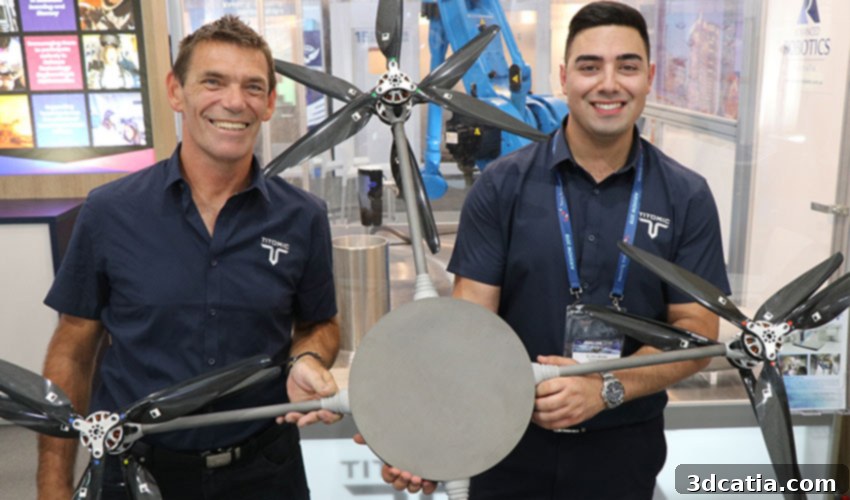
In a groundbreaking demonstration of advanced additive manufacturing capabilities, Titomic, a prominent Australian manufacturer of 3D metal printers, has recently captured global attention with the unveiling of an astonishing 3D printed titanium drone. This unmanned aerial vehicle (UAV), boasting an impressive 1.8-meter diameter, has been lauded by the company as the largest of its kind on the market. This monumental achievement not only redefines the boundaries of drone design and production but also showcases the immense potential of Titomic’s large-scale manufacturing solutions, particularly for high-stakes applications within the military and aerospace sectors.
The creation of such a massive and sophisticated titanium drone was made possible through the use of Titomic’s state-of-the-art XXL machine. This industrial-grade additive manufacturing system is engineered to fabricate parts of extraordinary dimensions, capable of producing components up to 9 meters long, 3 meters wide, and 1.5 meters high. Beyond its impressive build volume, the machine also boasts an exceptional throughput, capable of depositing material at a rate of 29 kg per hour. This unparalleled combination of size and speed positions Titomic at the forefront of large-format metal additive manufacturing, enabling the rapid prototyping and production of complex structures that were previously unfeasible.
While the concept of combining 3D printing and drones is not entirely new, as this innovative manufacturing method has long been employed in the development of various pilot-free aircraft across military and sports industries, Titomic’s latest offering represents a significant leap forward. Traditionally, 3D printing has allowed designers to reimagine drone structures, introducing intricate geometries that optimize aerodynamics, reduce overall weight, and consequently enhance performance. However, the sheer scale and choice of material for Titomic’s drone truly distinguish it. Never before has such a large device been conceived and successfully produced using titanium through additive manufacturing, making Titomic’s initiative a compelling and pivotal moment in the industry.
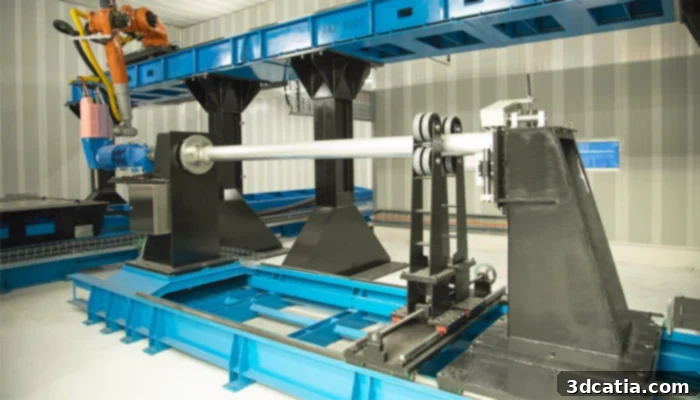
The machine based on the TKF process | Photo Credits: Titomic
Titomic Kinetic Fusion: The Technology Behind the Giant Titanium Drone
At the heart of Titomic’s ability to create such a groundbreaking drone lies its patented Titomic Kinetic Fusion (TKF) technology. This proprietary process stands out in the additive manufacturing landscape due to its unique approach, which is based on a cold spraying method. Unlike traditional metal 3D printing techniques that rely on melting and fusing powdered metals with lasers or electron beams, TKF operates by spraying metal particles – in this case, titanium – onto a substrate at incredibly high speeds. The kinetic energy generated from this high-velocity impact causes the particles to deform and bond together, forming a robust and dense structure without melting.
This cold spray process offers several distinct advantages, particularly when dealing with high-performance materials like titanium. By avoiding high temperatures, TKF minimizes thermal stresses, warping, and material degradation that can often plague other metal additive manufacturing methods. This results in parts with superior material properties, including enhanced strength, ductility, and fatigue resistance, which are critical for demanding applications in defense and aerospace. Furthermore, the high deposition rates achievable with TKF technology allow for the rapid production of large-scale parts, directly addressing one of the major challenges in industrial additive manufacturing.
Why Titanium? The Material of Choice for High-Performance UAVs
Titomic strategically opted for titanium as the primary material for their record-breaking drone, a decision driven by titanium’s exceptional properties that are ideally suited for critical applications. Titanium is renowned for its outstanding strength-to-weight ratio, meaning it offers high structural integrity while remaining remarkably light. This characteristic is paramount for drones, where every gram saved contributes to increased payload capacity, extended flight range, and improved maneuverability. For a large-scale UAV like Titomic’s, optimizing weight without compromising structural integrity is a non-negotiable requirement.
Beyond its strength-to-weight benefits, titanium also boasts excellent corrosion resistance and the ability to withstand extreme temperatures, making it a robust choice for military and security operations where UAVs might be exposed to harsh environmental conditions. The Titomic team further emphasizes that the additive metal construction technique, coupled with titanium, enables them to design and produce ballistic protection that is both more robust and lighter than conventionally manufactured alternatives. This enhanced protective capability is a significant advantage for military-grade drones, potentially improving survivability in hostile environments. Looking ahead, Titomic’s TKF technology is not limited to titanium; the company anticipates being able to work with a diverse range of metal alloys, including stainless steel, Inconel, and tungsten carbide, opening up a plethora of new applications across various industries.
Transforming Defense and Aerospace: A New Era for Australian Manufacturing
The launch of this massive 3D printed titanium drone is more than just a technological feat; it represents a significant step forward for Australian manufacturing innovation and its contribution to the global defense industry. Jeff Lang, Managing Director of Titomic, articulated this vision, stating: “We are delighted to work with the global defense industry to combine Australian resources, manufacturing and innovation, which will increase our ability to provide more modern technologies to Australia and its defense forces.” This statement underscores Titomic’s commitment to leveraging domestic capabilities to enhance national security and position Australia as a leader in advanced manufacturing.
This pioneering 3D printed drone is likely just the beginning of what Titomic plans to achieve. The successful development and demonstration of this large-scale UAV pave the way for the creation of even larger and more powerful military and aerospace devices. The ability to rapidly prototype and produce complex, high-performance components from advanced materials like titanium, at an industrial scale, offers unprecedented flexibility and speed for defense contractors and aerospace companies. This could significantly shorten development cycles for new aircraft and enhance the capabilities of existing platforms, providing a strategic advantage in rapidly evolving technological landscapes.
The implications extend beyond just drones. Titomic’s large-format metal additive manufacturing technology could revolutionize the production of various critical components for aircraft, satellites, and ground-based defense systems. Imagine lightweight yet incredibly strong structural elements, custom tooling, or on-demand spare parts that can be manufactured locally, reducing reliance on complex global supply chains. The potential to combine multiple materials, as Titomic suggests with stainless steel, Inconel, and tungsten carbide, further expands the design possibilities, allowing for functionally optimized parts with tailored properties for specific applications, such as wear resistance or extreme temperature performance.
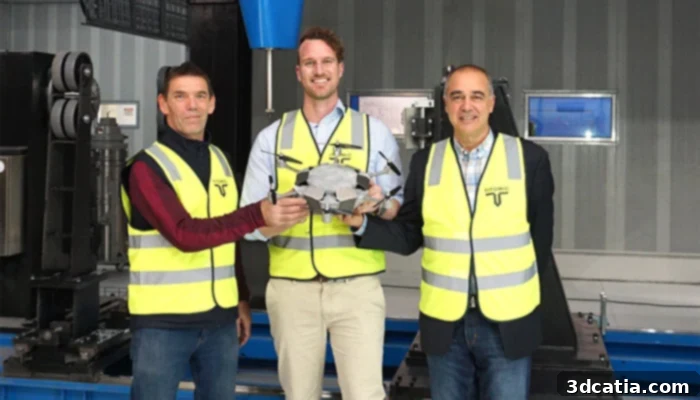
From left to right: Titomic’s CTO, Jeff Lang; TAUV’s founder, Nathan Kalisch; Titomic’s CEO, Gilbert Michaca, holding the 3D printed drone | Photo Credits: Titomic
The Future of Large-Scale Metal Additive Manufacturing
Titomic’s achievement with the 1.8-meter titanium drone underscores a broader trend in additive manufacturing: the increasing demand for large-format capabilities. As industries recognize the benefits of 3D printing for rapid prototyping, complex geometries, and material optimization, the need to produce larger functional parts at production speeds becomes critical. Titomic’s XXL machine and TKF technology are perfectly positioned to meet this demand, not just in defense and aerospace, but also in sectors such as automotive, marine, oil & gas, and industrial tooling, where large, high-strength metal components are essential.
The ability to scale up additive manufacturing processes while maintaining the integrity and performance of advanced materials like titanium marks a significant milestone. It moves metal 3D printing beyond niche applications for small, intricate parts into the realm of true industrial-scale manufacturing. This shift has profound implications for supply chain resilience, cost efficiency, and the agility of industries to innovate and respond to market demands. Furthermore, the environmental benefits of additive manufacturing, such as reduced material waste compared to subtractive methods, become even more pronounced with large-scale production, contributing to more sustainable manufacturing practices.
In conclusion, Titomic’s unveiling of the world’s largest 3D printed titanium drone is a testament to the transformative power of advanced additive manufacturing. It highlights how innovative technologies like Titomic Kinetic Fusion are pushing the boundaries of what is possible, opening up new horizons for design, production, and application in critical sectors like defense and aerospace. This achievement not only solidifies Titomic’s position as a leader in large-scale metal 3D printing but also signals a new era for Australian manufacturing innovation on the global stage. As the technology continues to evolve, we can anticipate even more extraordinary developments from companies like Titomic, shaping the future of advanced engineering and production.