
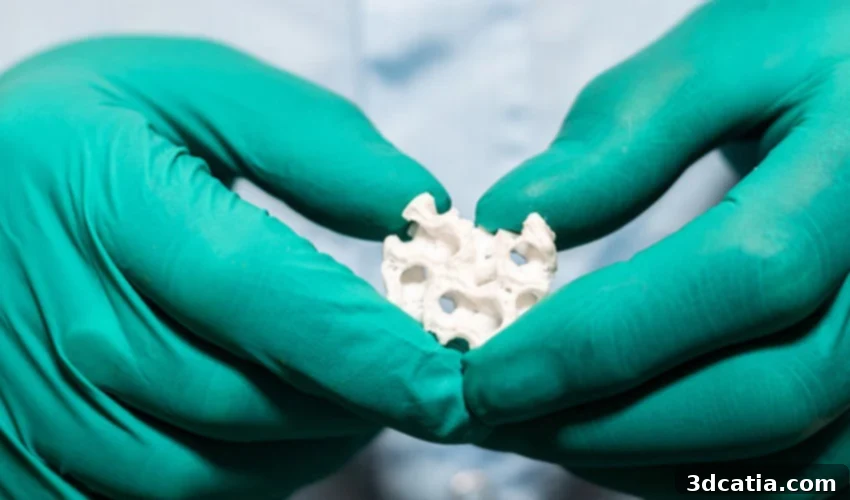
Revolutionary Bioprinting in Space: ESA’s Mission to Safeguard Astronaut Health on Deep-Space Journeys
The ambition of deep-space exploration, particularly missions to Mars, presents unprecedented challenges for human health and medical care. Astronauts embarking on such multi-year voyages will be beyond the immediate reach of Earth-based medical facilities, necessitating self-sufficient, innovative solutions for any health emergencies that may arise. Recognizing this critical need, the European Space Agency (ESA) is at the forefront of developing groundbreaking processes for bioprinting human tissues directly from cells. This cutting-edge research aims to provide astronauts with on-demand, effective medical treatments far from home, ensuring their well-being and the success of future interstellar missions.
In a pioneering collaboration, ESA has teamed up with the esteemed Dresden University of Technology Hospital and the innovative company Blue Horizon. Together, these dedicated teams have achieved a significant milestone: successfully developing the first bioprinted human skin and bone samples under conditions simulating those found in space. This monumental achievement involved working “backwards,” or simulating microgravity, to test the efficacy of bioprinting in an environment where gravity is fundamentally different from Earth’s. The initial results are remarkably conclusive, offering tremendous hope and very good news for the future health and safety of astronauts venturing into the cosmos.
The Imperative for Space Bioprinting: Ensuring Astronaut Health Far from Earth
The concept of bioprinting research conducted in space is not entirely novel. Even aboard the International Space Station (ISS), researchers have long been engaged in studies exploring cellular development, including the growth of cancer cells, utilizing bioprinting technologies to create intricate biological models. However, ESA’s current focus takes this research a critical step further, concentrating specifically on the comprehensive care provided to astronauts during extended missions. The ultimate goal is to equip them with potent and immediate remedies for a wide array of medical conditions, entirely independent of any intervention or resupply from Earth. This self-sufficiency is paramount for missions like a journey to Mars, where communication delays and vast distances make traditional medical evacuation or supply drops virtually impossible.
Long-duration spaceflight inherently poses numerous health risks to astronauts. Prolonged exposure to microgravity leads to significant physiological changes, including bone density loss (osteoporosis), muscle atrophy, and cardiovascular deconditioning. Furthermore, the increased radiation levels outside Earth’s protective magnetosphere can cause cellular damage, potentially leading to burns, compromised skin integrity, and an elevated risk of cancer. In such a remote and challenging environment, even minor injuries or conditions could escalate into life-threatening emergencies if not treated promptly and effectively. This underscores the urgent need for advanced, adaptable medical solutions that can be deployed on site, making bioprinting an indispensable tool for future space exploration.
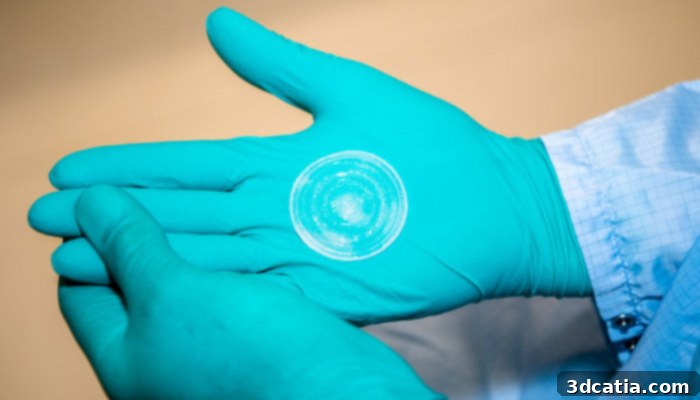
A bioprinted skin sample | Photo credits: ESA – SJM Photography
Innovating Bioink: Harnessing Astronaut Plasma for Self-Sustaining Medicine
One of the most ingenious aspects of this research involves the selection and preparation of the ‘bioink’ – the material used by the bioprinter to create living tissues. Nieves Cubo, a leading researcher from the University of Dresden, explains that blood plasma serves as an ideal, nutrient-rich biological ink. Crucially, this liquid component can be collected directly from the astronaut in need, offering an entirely autologous (self-sourced) solution. This eliminates the significant logistical challenges and risks associated with transporting donor tissues or complex biological materials from Earth, and, more importantly, it virtually eradicates the risk of tissue rejection, a common and severe complication in traditional transplant procedures.
However, working with plasma presents its own set of formidable challenges, especially in the context of space. Plasma naturally possesses a very fluid consistency, making it difficult to precisely manipulate and print, particularly under the chaotic conditions of weightlessness where liquids behave unpredictably. To circumvent this critical obstacle, the research teams devised an innovative solution: they added methylcellulose and alginate to the plasma. These two natural agents, commonly found in plants and algae, are highly effective in increasing the viscosity of the final biological ink, giving it the necessary consistency for stable and accurate bioprinting. Their natural origin also means they can be easily transported to space without complex storage requirements, further enhancing the practicality of this approach.
Simulating Microgravity: The “Upside-Down” Bioprinting Technique
To rigorously test their methodology, the researchers employed a unique “upside-down” bioprinting technique. This ingenious approach allowed them to replicate and understand the characteristics and challenges of a space environment on Earth, specifically addressing how materials behave under conditions simulating microgravity. Using this method, they successfully bioprinted both skin and bone samples from the prepared mixture of cells and bioink. The development of these foundational tissues represents a massive stride towards being able to mend and replace damaged biological structures in space.
Nieves Cubo elaborated further on the intricate process of bone bioprinting, highlighting the complexity and scientific precision involved. “The production of the bone sample involved the printing of human stem cells by adding bone cement to calcium phosphate as a structural support, which is then absorbed during the growth phase.” This sophisticated technique ensures that the printed bone tissue has the necessary structural integrity from the outset, while the calcium phosphate provides a scaffold that supports the stem cells as they differentiate and grow into functional bone, eventually being absorbed as the natural bone matrix forms. This mimics the body’s natural healing and regeneration processes, making the bioprinted tissue highly compatible and effective.
Future Horizons: From Samples to On-Demand Organs for Space Travelers
The scope of this project extends far beyond merely creating skin and bone samples. Researchers are also deeply engaged in meticulously understanding the logistical and infrastructure requirements for implementing such advanced medical capabilities onboard a spacecraft. This includes a clear understanding of the type of facilities, specialized equipment, sterile operating environments, and trained personnel that would be required. The vision is to integrate fully functional bioprinting labs into future long-duration missions, capable of responding to a wide spectrum of medical emergencies.
Looking further into the future, the scientists are actively considering the possibility of creating even more complex tissues for transplants. This ambitious trajectory envisions a time when bioprinting could lead to the production of entire organs for astronauts, representing the pinnacle of in-situ medical self-sufficiency. Imagine a scenario where a damaged kidney or heart could potentially be bioprinted and transplanted, offering a life-saving solution in the vast emptiness of space, thousands of miles from the nearest hospital.
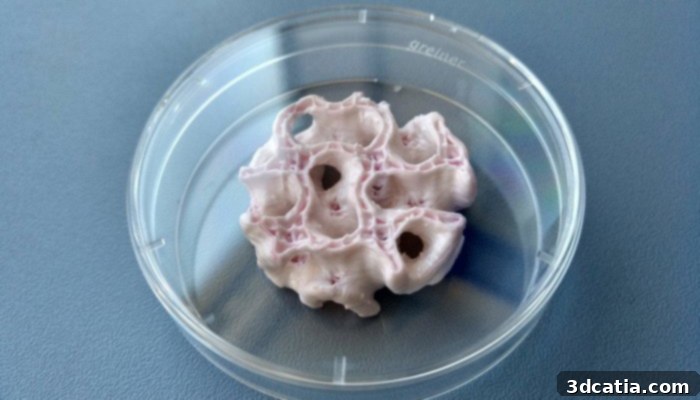
The bone sample is gradually growing | Photo credits: University Hospital of Dresden Technical University
Tommaso Ghidini, who serves as the head of ESA’s Structures, Mechanics and Materials Division and is a key supervisor for this transformative project, articulated the profound implications of this technology. “A 3D bioprinting capability will allow astronauts to respond to medical emergencies as they arise, offering immediate and tailored solutions.” He provided compelling examples: “In the case of severe burns, for example, new skin could be bioprinted directly and applied, instead of being grafted from another part of the astronaut’s body. Traditional grafting causes secondary damage that, critically, does not heal easily in the challenging orbiting environment, potentially leading to further complications and prolonged recovery.”
Ghidini continued, illustrating another vital application: “In the case of bone fractures – a risk made significantly more likely by the debilitating effects of weightlessness in space – a replacement bone section could be precisely inserted.” The inherent beauty and safety of this approach lie in the source of the biological material: “In any such medical emergency, the bioink would come directly from the astronaut himself, making rejection of the graft virtually impossible and ensuring optimal compatibility. This autologous approach is a cornerstone of the medical self-sufficiency required for deep-space missions.” This personalized medicine aspect ensures that the astronaut’s body will readily accept the bioprinted tissue, minimizing complications and maximizing recovery potential.
Challenges and the Path Forward for Bioprinting in Space
While the ESA team is understandably confident and highly optimistic about the initial results and the future potential of this research, they also acknowledge that the journey to full implementation will be a long one. This groundbreaking research will likely require several more years of dedicated effort, meticulous testing, and continuous refinement before it can be reliably deployed for crewed missions. The complexities of adapting highly sensitive bioprinting machinery for the harsh realities of space – including radiation, vibration, power limitations, and the ever-present challenge of microgravity – are considerable. Furthermore, rigorous validation of the long-term viability and functionality of bioprinted tissues in the human body under spaceflight conditions will be essential.
Nevertheless, this project builds upon the tremendous successes and rapid advancements witnessed in bioprinting on Earth. Researchers are continually pushing the boundaries of what is possible, creating increasingly complex and functional tissues for various terrestrial medical applications. The hope is that these advancements, combined with the dedicated efforts of ESA and its partners, will enable humanity to extend these capabilities far beyond terrestrial boundaries, truly revolutionizing medicine for space travelers. While we await the reality of 3D printed skin and bones becoming standard medical practice in spaceships traversing the solar system, more detailed information about this incredible initiative can be found by exploring the official ESA resources HERE.
What are your thoughts on this incredible new research into bioprinting for space missions? Do you believe it’s the key to unlocking long-duration human presence in deep space? We invite you to share your insights and opinions in a comment below or engage with us on our Facebook and Twitter pages! And don’t forget to sign up for our free weekly Newsletter, to receive all the latest news and breakthroughs in 3D printing technology delivered straight to your inbox!