
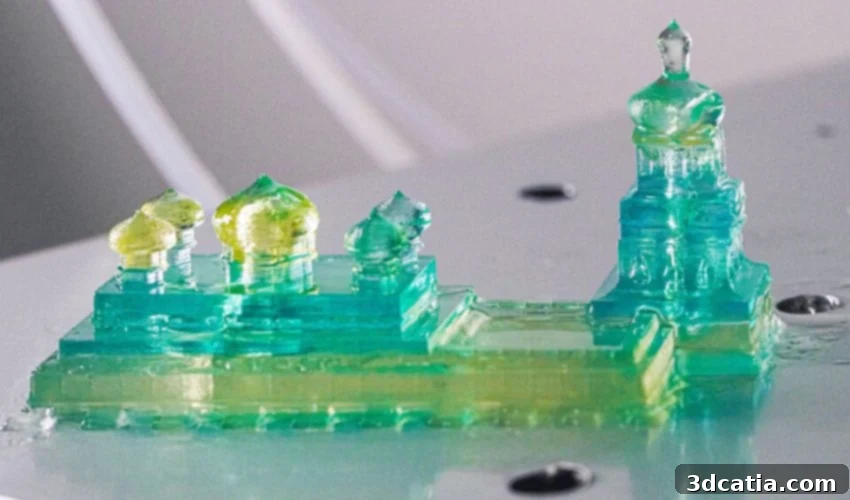
iCLIP: Stanford Engineers Revolutionize Multi-Material 3D Printing with Unprecedented Speed
The landscape of additive manufacturing is continuously evolving, pushing the boundaries of what’s possible in design and production. A groundbreaking innovation from Stanford engineers, spearheaded by renowned researcher Joseph DeSimone, promises to redefine these limits once again. They have unveiled a novel 3D printing method known as injection continuous liquid interface production, or iCLIP. This advanced technology boasts an impressive speed, reportedly 5 to 10 times faster than the quickest high-resolution printers currently available on the market. Beyond its remarkable velocity, iCLIP introduces a transformative capability: the ability for users to integrate multiple types of resin into a single, cohesive part, opening up a new frontier for complex, multi-functional objects.
For those familiar with the advancements in 3D printing over the past decade, the name CLIP might resonate. Continuous Liquid Interface Production was a pioneering technology first introduced in 2015 by Joseph DeSimone and his esteemed colleagues. This original method laid the foundational principles upon which Carbon, a leading innovator in additive manufacturing, was built. While Carbon’s proprietary technology has since been rebranded as Digital Light Synthesis (DLS), and DeSimone transitioned from his CEO role in 2019 to serve as Chairman of the Board of Directors, the core tenets of CLIP technology remain influential. iCLIP represents a significant leap forward from its predecessor, specifically designed to enable sophisticated multi-material resin printing. It achieves this by ingeniously combining the established principles of traditional CLIP with the dynamic, active injection of different resins precisely where and when they are needed during the printing process.
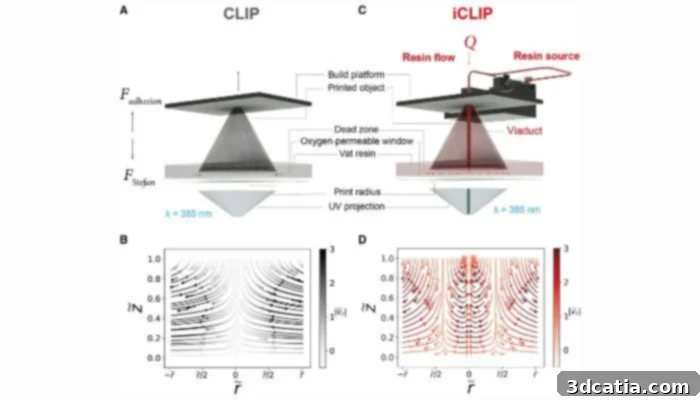
Photo Credits: Stanford University
Unveiling iCLIP: The Mechanics Behind a Revolutionary 3D Printing Method
At its core, iCLIP is a sophisticated vat photopolymerization method that harnesses ultraviolet (UV) light to cure liquid resins layer by layer. However, its genius lies in its ability to address and overcome several perceived limitations of the original CLIP technology, all while retaining and enhancing its core advantages. A key feature carried over and improved upon in iCLIP is the integration of a specialized “dead zone” – a meticulously controlled, ultra-thin layer of oxygen. This oxygen layer plays a crucial role by significantly inhibiting the photopolymerization process at the interface, thereby greatly decreasing the adhesive forces that typically occur during the resin curing stage. These adhesion forces are a common bottleneck in traditional resin 3D printing, slowing down the process considerably. By effectively eliminating them, iCLIP can achieve unprecedented printing speeds. Indeed, the engineers’ research paper positions the original CLIP itself as belonging to a “third generation” of vat photopolymerization, lauded for its speed and other benefits compared to earlier methods. Yet, even CLIP had its drawbacks, primarily being restricted to relatively low-viscosity resins and, crucially, lacking the capability for true multi-material printing within a single object.
This latest iCLIP process directly addresses these critical limitations. The innovation centers around the integration of precision-mounted syringe pumps, which actively inject additional resins at specific, strategic points throughout the printing process. This active injection mechanism serves a dual purpose. Firstly, it further contributes to the reduction of adhesive forces, by an astonishing two orders of magnitude according to experimental data. This dramatic decrease in adhesion not only facilitates even faster printing speeds but also effectively eliminates common defects and failures often encountered in resin 3D printing. Secondly, and perhaps most significantly, the ability to introduce different resins dynamically enables true multi-material printing. This capability is a game-changer, as it has historically been a significant challenge, if not impossible, with conventional vat photopolymerization methods. With iCLIP, engineers can now design and fabricate parts with varying material properties, textures, and functionalities seamlessly integrated into a single, complex component.
Joseph DeSimone, who holds the prestigious Sanjiv Sam Gambhir Professorship in Translational Medicine and is a distinguished professor of radiology and chemical engineering at Stanford, articulates the profound impact of this invention: “This new technology will help to fully realize the potential of 3D printing. It will allow us to print much faster, helping to usher in a new era of digital manufacturing, as well as to enable the fabrication of complex, multi-material objects in a single step.” This vision underscores the transformative power of iCLIP, not just as an incremental improvement but as a catalyst for a paradigm shift in how products are designed and manufactured. The immediate next frontier for the research team is the development of sophisticated software capable of precisely optimizing the fluid distribution network for each unique part. This intelligent software will ensure that resins are injected with unparalleled accuracy and efficiency, maximizing both the speed and the material versatility of the iCLIP system. Further in-depth details of this research are openly available for download in the comprehensive article published in *Science Advances*, which can be accessed HERE.
The Transformative Potential of iCLIP: Industries, Innovation, and the Future of Manufacturing
The implications of iCLIP’s advancements in speed and multi-material capabilities are vast and far-reaching, promising to revolutionize numerous industries. The ability to print 5 to 10 times faster translates directly into significantly reduced production times and costs, making additive manufacturing a more viable solution for large-scale production runs and rapid prototyping in industrial settings. This acceleration is crucial for sectors where time-to-market is a critical factor, such as consumer electronics, automotive, and aerospace. Products can be iterated and produced with unprecedented efficiency, fostering a culture of rapid innovation and accelerating product development cycles.
Perhaps even more profound is the multi-material aspect of iCLIP. This capability allows for the creation of parts with strategically varied mechanical, electrical, or chemical properties within a single print. Imagine medical devices with rigid structural components seamlessly integrated with soft, biocompatible sections, or electronic housings that incorporate both insulating and conductive pathways directly during manufacturing. This opens up entirely new design paradigms, enabling engineers to create highly functional, complex parts that were previously impossible or extremely difficult to produce using traditional manufacturing methods or even earlier 3D printing technologies. The freedom to design with multiple materials not only optimizes performance but also simplifies assembly processes, as multiple components can be consolidated into one.
Compared to other additive manufacturing processes, iCLIP stands out due to its unique combination of attributes. While some fused deposition modeling (FDM) systems can handle multiple materials, they often struggle with fine resolution and speed, especially for complex geometries. Stereolithography (SLA) and Digital Light Processing (DLP) offer high resolution but are typically limited to single-material resins and face challenges with speed due to adhesive forces. iCLIP bridges this gap, delivering high resolution, exceptional speed, and unparalleled multi-material versatility, positioning it as a leading contender for advanced applications where performance and complexity are paramount. This technological convergence makes iCLIP a pivotal development in the ongoing evolution of 3D printing.
The market impact of iCLIP is expected to be substantial. In the medical field, it could lead to the rapid production of customized prosthetics, implants with varying stiffness, and sophisticated surgical tools. The automotive industry could benefit from lightweight, multi-material components that enhance fuel efficiency and safety. Aerospace applications, requiring parts with specific thermal or electrical properties in different zones, would find iCLIP incredibly useful. Furthermore, the consumer goods sector could see a boom in personalized products, from custom-fitted footwear with varying sole densities to intricate artistic designs that blend different material aesthetics. iCLIP is not just an incremental improvement; it is a foundational technology poised to unlock a new generation of engineered products across a multitude of industries.
What are your thoughts on iCLIP and its potential to shape the future of digital manufacturing? We’d love to hear your perspective! Share your comments below or connect with us on our LinkedIn, Facebook, and Twitter pages. Don’t miss out on the latest advancements in 3D printing; sign up for our free weekly Newsletter here to get the news delivered straight to your inbox! You can also explore all our insightful videos on our YouTube channel.
*Cover Photo Credits: Stanford University