
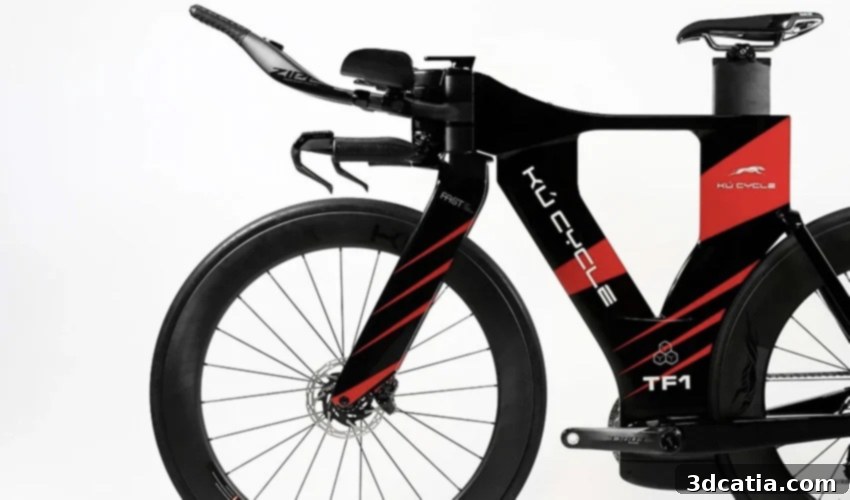
3D Printing Revolutionizes Triathlon Bikes: Unleashing Peak Performance with Kú Cycle’s Custom Kú TF1
In the hyper-competitive world of triathlon, where every second counts and the pursuit of marginal gains is relentless, speed is unequivocally the ultimate objective. While an athlete’s dedication, training, and physical prowess are undeniably paramount, the quality and innovation of their equipment play an equally critical role in achieving maximum velocity and efficiency. This intense demand for peak performance continuously drives companies within the cycling industry to push the boundaries of design, materials science, and manufacturing processes. Amidst these advancements, 3D printing, also widely known as additive manufacturing, has rapidly emerged as a game-changing technology, offering unprecedented capabilities for creating incredibly lightweight, robust, and highly customized components tailored to elite athletic demands.
The transformative impact of 3D printing on high-performance cycling is already evident through several groundbreaking projects that have captured the industry’s attention. A leading example is Pinarello’s BOLIDE F HR 3D, a bicycle lauded as the world’s fastest, which strategically integrates sophisticated 3D printed parts. These components are meticulously designed not only to optimize aerodynamics but also to ensure a perfect, personalized fit for the rider, thereby maximizing power transfer and comfort. Similarly, the innovative collaboration between Mythos and IXO has resulted in the production of an advanced bicycle stem, expertly crafted using state-of-the-art metal additive manufacturing techniques. These pioneering initiatives unequivocally underscore the cycling industry’s growing confidence in 3D printing’s capacity to redefine traditional manufacturing limitations, leading to previously unimaginable levels of performance and personalization for athletes.
Following in these innovative footsteps, it is now Kú Cycle’s turn to harness the transformative power of 3D printing for the manufacture of its latest flagship product. This forward-thinking, Netherlands-based company has set an ambitious vision: to design and produce a high-performance bicycle that is not merely fast but also perfectly suited and customized to the unique biomechanics and preferences of individual cyclists. To realize this ambitious goal, Kú Cycle embarked on a strategic partnership with QDP, a renowned company specializing in developing cutting-edge plastic solutions for a diverse range of complex applications. Further bolstering their development efforts, they joined forces with Carbon, a globally recognized leader in advanced 3D printing technology. The culmination of this powerful and synergistic collaboration is the Kú TF1, a custom-made triathlon bike engineered from the ground up to redefine athlete performance, comfort, and integration.
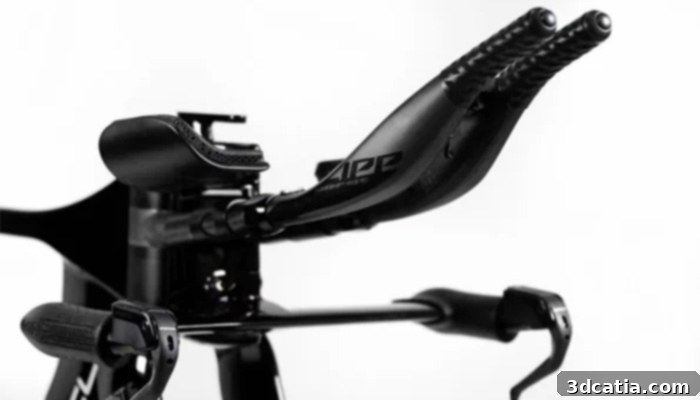
The Kú TF1 features precisely engineered 3D printed components, including armrests, grips, and the shifter, designed for optimal rider ergonomics and performance (photo credits: Carbon)
The Kú TF1: Precision Customization for Unrivaled Cycling Performance
The name Carbon has become synonymous with innovation in additive manufacturing, particularly within the dynamic world of sports equipment. This esteemed 3D printer manufacturer has an extensive and impressive track record, having consistently demonstrated its capabilities by contributing to the creation of numerous high-performance sports equipment across a wide array of athletic disciplines. Carbon’s notable achievements include the development of a 3D printed baseball glove, the iconic FutureCraft 4D shoe produced in collaboration with adidas, and the pioneering creation of the world’s first field hockey helmet liner, among many other groundbreaking applications. Their proven expertise in engineering durable, highly customized, and performance-enhancing components made them the unequivocal choice for Kú Cycle and QDP, who were seeking the best partner to bring the ambitious Kú TF1 project to life.
It was precisely because of Carbon’s established reputation for innovation and reliability that QDP strategically engaged their expertise to manufacture several crucial components for the Kú TF1. Faced with the inherent challenges of developing intricate parts rapidly while simultaneously ensuring a significant reduction in overall manufacturing costs, Carbon’s revolutionary Digital Light Synthesis™ (DLS) 3D printing solution presented itself as the optimal answer. This advanced additive manufacturing technology offers substantial advantages over conventional production methods, facilitating unprecedented efficiency in rapid prototyping, iterative design refinement, and direct digital manufacturing. Furthermore, Carbon’s comprehensive ecosystem, which includes the powerful Carbon Design Engine™ software, provided QDP engineers with the essential tools to design, simulate, and optimize complex lattice structures. These intricate, bionic designs, which are virtually impossible to produce with traditional manufacturing techniques, are fundamental in achieving the perfect equilibrium of stiffness, shock absorption, and lightweight characteristics – all vital attributes for a truly competitive and comfortable triathlon bike.
Optimizing Rider Comfort and Performance Through Advanced Materials and Design
The fundamental philosophy driving the Kú TF1’s development by Kú Cycle and QDP was centered on crafting a truly bespoke bicycle. The primary objective was to ensure that the bike was not only impeccably adjusted for the cyclist’s optimal comfort during long durations but also significantly enhanced their performance on the racecourse, allowing them to push their limits. This dual focus on unparalleled ergonomics and decisive athletic advantage meticulously guided every stage of the design process. Particular attention was devoted to the most critical interface points between the rider and the bike: specifically, the handles and armrests. These components are of paramount importance for precise bike control, maintaining stability at high speeds, and, perhaps most crucially, ensuring rider comfort throughout the grueling and demanding nature of triathlon events.
The design and engineering team recognized that these specific rider-contact devices demanded a unique combination of contradictory properties. They needed to be exceptionally rigid to guarantee precise steering and unwavering bike handling, providing the rider with complete control even during aggressive maneuvers, sharp turns, or challenging terrains. Simultaneously, these components had to deliver superior comfort, effectively minimizing rider fatigue, absorbing road vibrations, and preventing any discomfort or pressure points that could detract from performance, especially over extended periods in the aerodynamic tuck position. To satisfy these stringent and complex requirements, an exhaustive series of rigorous tests and material evaluations were conducted. Ultimately, Carbon’s EPU 41 material emerged as the unequivocal choice. This highly elastic polyurethane not only met all the specified mechanical requirements for optimal rigidity, impact absorption, and durability but also demonstrated exceptional resistance to sweat, chemicals, and UV exposure. This sweat-resistance property is a critical factor, given the intense physical exertion and exposure to various environmental elements encountered during triathlon races, ensuring the longevity and consistent high performance of these vital custom components over time.
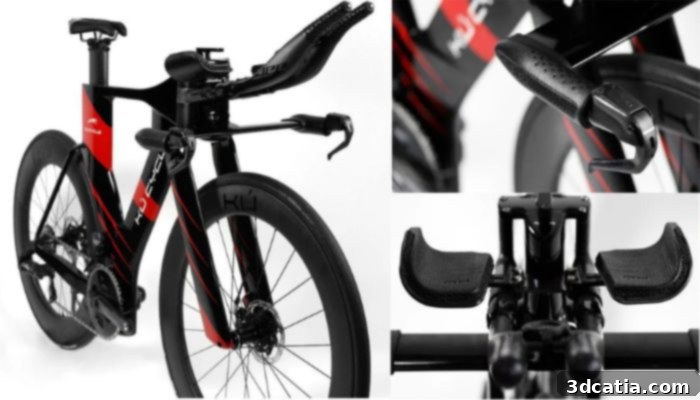
The final Kú TF1 bike proudly integrates a variety of meticulously 3D printed parts, prominently featuring advanced arm pads and innovative lattice grips, all engineered for superior performance and seamless rider interaction (photo credits: Carbon)
Accelerated Development and Cost Efficiency with Additive Manufacturing
Beyond the critical rider contact points, other essential components of the Kú TF1 also benefited immensely from the precision and flexibility afforded by 3D printing technology. For example, the bike’s sophisticated gearshift system, a vital element for seamless power transfer, efficient energy management, and strategic adjustments during a race, was meticulously optimized using Carbon’s EPX 82 material. This high-strength epoxy resin is highly regarded for its exceptional stiffness, outstanding temperature resistance, and long-term durability, making it an ideal choice for components that endure high mechanical stress and demand flawless, precise functionality. By leveraging direct and detailed feedback from professional cyclists, QDP was able to precisely tailor the 3D printed gearshift part, ensuring it was as accurate, responsive, and ergonomically perfect as possible for each individual rider. This iterative design and customization process, powered by the agility of additive manufacturing, dramatically shortens traditional development cycles and allows for rapid, on-demand modifications.
One of the most compelling and transformative advantages demonstrated by Carbon’s 3D printing solution in the Kú TF1 project was the remarkable acceleration of the manufacturing timeline. Kú Cycle and QDP were able to progress from the initial design concept to a fully functional, high-performance prototype in an astonishingly short period—just one month. This stands in stark contrast to the several months, often extending to half a year or even longer, typically required when employing traditional manufacturing techniques such such as injection molding or complex CNC machining for custom, intricate parts. While specific financial figures detailing cost savings were not publicly disclosed, the inherent efficiencies of additive manufacturing technology, including significantly reduced tooling costs, minimal material waste, and the ability to produce complex geometries in a single step, played a crucial role in minimizing overall production expenses. This powerful combination of unprecedented speed, limitless customization potential, and enhanced cost-effectiveness firmly establishes why 3D printing is rapidly becoming an indispensable tool for innovators and leaders in the competitive cycling industry.
Elite Athlete Endorsement and Kú Cycle’s Ambitious Future
Since its official debut, the Kú TF1 has undergone rigorous evaluation and testing by some of the most discerning and elite athletes in the world. Several accomplished Ironman and triathlon world champions have had the exclusive opportunity to experience the custom-built bike firsthand in demanding competitive environments. According to reports from Carbon, the feedback received from these top-tier athletes has been overwhelmingly positive and highly satisfactory. This strong and resounding endorsement from elite athletes not only validates the innovative design principles and cutting-edge manufacturing approach but also powerfully reinforces the Kú TF1’s promise of delivering a tangible and decisive performance advantage to its riders.
Looking confidently towards the future, Kú Cycle has outlined ambitious plans for the Kú TF1. Over the course of the next 12 to 18 months, the company aims to significantly scale up its production capabilities, with a strategic target of manufacturing between 500 and 1,000 bikes. This controlled and meticulous expansion strategy is designed to ensure that each custom-built bike maintains its exceptional standard of quality, precision engineering, and personalized fit, continuing to cater impeccably to the unique and demanding needs of serious triathletes globally. The resounding success of the Kú TF1 marks a pivotal and exciting moment in the broader integration of 3D printing into high-performance sports equipment, powerfully demonstrating how advanced manufacturing technologies can lead to the creation of products that are not only faster, lighter, and more durable but also intimately tailored to enhance individual human potential and athletic achievement. For more comprehensive and in-depth information on the Kú TF1 and its innovative features, interested individuals are encouraged to click HERE to explore the detailed case study provided directly by Carbon.
What are your thoughts on Kú Cycle’s groundbreaking application of 3D printing technology in the development of the Kú TF1 triathlon bike? We’d love to hear your valuable perspective and insights! Please feel free to share your comments below or connect with our vibrant community on our LinkedIn, Facebook, and Twitter pages! And don’t forget to sign up for our completely free weekly Newsletter here to receive all the very latest 3D printing news and industry updates directly to your inbox! You can also find all our compelling and informative videos on our dedicated YouTube channel.
*Cover Photo Credits: Carbon