
Top 5 3D Printing Innovations: Exploring This Week’s Breakthroughs in Additive Manufacturing
Welcome to our weekly roundup of the most captivating developments in the world of 3D printing! As technology continues to push boundaries, additive manufacturing is consistently delivering groundbreaking innovations across diverse sectors. From critical challenges in law enforcement to the thrill of high-speed racing, the precision of culinary arts, and even the ambitious realm of space exploration, 3D printing is proving its transformative power. This week, we dive into five remarkable stories that highlight the versatility and immense potential of this technology. Join us as we explore how 3D printed “ghost guns” are creating complex issues for police, witness Markforged’s ingenious application in a jet engine dragster, marvel at Columbia University’s delicious 7-layer cheesecake experiment, discover the future of reinforced concrete with TAM, and celebrate Relativity Space’s monumental launch of the world’s first 3D printed rocket. Get ready for an inspiring journey through the latest in additive manufacturing.
1. The Rising Threat: 3D Printed Guns Pose Difficulties for Canadian Police
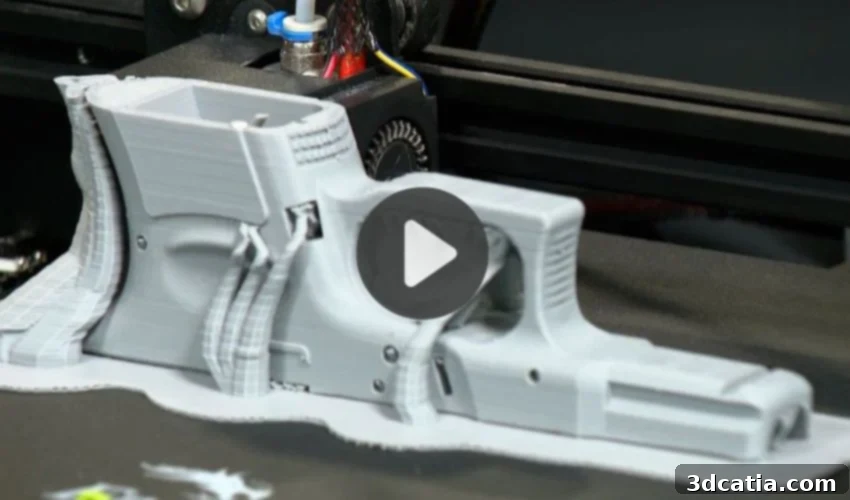
The proliferation of 3D printed firearms, often referred to as “ghost guns,” is increasingly becoming a significant concern for law enforcement agencies worldwide, and Canada is no exception. Recently, police in New Brunswick, Canada, made a startling discovery during a drug and weapon raid: two 3D-printed handguns. This incident underscores a growing challenge for authorities who are grappling with the impact of modern technology on violent crime. The Toronto Police Service and the Royal Canadian Mounted Police (RCMP) have voiced escalating apprehension regarding these illegally manufactured firearms. Their primary concern stems from the fact that these weapons lack serial numbers, making them incredibly difficult to trace and detect, thus earning them the moniker “ghost guns.”
The ease with which these firearms can be produced is another alarming factor. Blueprints and instructions for manufacturing functional guns are readily available online, accessible to anyone with a 3D printer and the intention to create one. This accessibility bypasses traditional gun control measures and poses a significant threat to public safety. While the issue of 3D printed weapons has been noted globally for some time, it appears to be escalating in Canada, prompting urgent discussions about legislative responses and enhanced surveillance. The implications are far-reaching, affecting crime prevention, border security, and community safety. Understanding this evolving threat is crucial for both law enforcement and the public. To delve deeper into this critical issue and understand the full scope of the problem facing Canadian police, watch the video below:
2. High-Octane Innovation: Markforged 3D Prints Custom Parts for a Jet Engine Dragster with Larsen Motorsports
Imagine a world where speed is king and every component must withstand extreme forces. Welcome to the exhilarating realm of jet engine drag racing! These aren’t your average race cars; they are powerful machines propelled by jet engines, capable of reaching mind-boggling speeds in mere seconds. In such an intense environment, precision and reliability are paramount. A single flawed part could lead to catastrophic failure, making material science and engineering absolutely critical. Josette Roach, one of only five female jet dragster drivers globally, understands this necessity more than most. Her quest for ultimate performance and safety led her and Brian Tocci of Larsen Motorsports to embrace the cutting-edge capabilities of additive manufacturing.
They turned to Markforged, a leader in industrial 3D printing, leveraging their advanced technologies, including their renowned Simulation software, to create a custom steering wheel. This isn’t just any steering wheel; it was meticulously designed and 3D printed to fit Josette’s hands perfectly, ensuring optimal grip, comfort, and control during her high-speed endeavors. Markforged’s technology allowed for the creation of lightweight yet incredibly strong parts, often using reinforced composites, which are essential for components under immense stress. This partnership showcases how additive manufacturing can revolutionize custom part creation for highly demanding applications, enhancing both performance and driver safety in extreme sports. Witness the meticulous process and incredible results of this collaboration by watching the video below:
3. Culinary Innovation: The Future of Software-Controlled Cooking with 3D Printed Cheesecake
Could 3D printers one day revolutionize our kitchens, perhaps even replacing traditional cooking utensils with a new era of software-controlled culinary creation? This intriguing question was at the heart of an experiment conducted by researchers at Columbia University this week. Their innovative approach involved using 3D printing technology to create a stunning and complex 7-layer cheesecake. While food 3D printing has gained considerable attention in recent years, its widespread adoption in everyday cooking still seems a distant prospect. However, this experiment highlights the immense potential and unique benefits that additive manufacturing can bring to the culinary world.
The scientists aimed to showcase how 3D printing allows for unprecedented control over food’s texture, shape, and even nutritional composition. Imagine being able to precisely layer different ingredients, control the exact ratios of flavors, and even customize the density of each bite. This level of precision is virtually impossible with conventional cooking methods. Beyond novelty, food 3D printing offers tantalizing possibilities for personalized nutrition, creating meals tailored to specific dietary needs or preferences. It could also open doors for intricate culinary designs, innovative textures, and even sustainable food production by minimizing waste and optimizing ingredient use. This sophisticated cheesecake is more than just a dessert; it’s a glimpse into a future where technology empowers chefs and home cooks alike to push the boundaries of gastronomic art and science. Don’t miss the video below to see how these researchers meticulously crafted their incredible 3D printed cheesecake:
4. Building the Future: 3D Printing Reinforced Concrete Becomes a Reality
While the concept of 3D printing concrete has gained traction in the construction industry for its speed and design flexibility, the challenge of incorporating reinforcement, crucial for structural integrity, has remained a significant hurdle. This week, Twente Additive Manufacturing (TAM), a vanguard in construction 3D printing, announced a groundbreaking innovation that changes everything: the new TALR system (TamCord Automated Layer Reinforcement). This pioneering system makes it possible to 3D print *reinforced* concrete, a world-first that promises to deliver even stronger, more durable, and resilient homes and infrastructure. This development marks a monumental leap forward, addressing one of the most persistent limitations of additive manufacturing in construction.
The TALR system integrates reinforcement directly into the 3D printing process, ensuring that the concrete structures possess the necessary tensile strength and stability typically achieved through traditional rebar placement. This not only enhances the structural performance of 3D printed buildings but also accelerates construction timelines, reduces labor costs, and minimizes material waste. The ability to create complex, structurally optimized designs with embedded reinforcement opens up new architectural possibilities and makes 3D printing a more viable and competitive option for large-scale construction projects. From affordable housing solutions to complex infrastructure, the impact of reinforced 3D printed concrete is poised to be transformative. In the video below, the visionary lead developers behind this revolutionary system provide an in-depth explanation of its ingenious mechanics and share the inspiring journey of its creation:
5. Into the Cosmos: Relativity Space’s 3D Printed Rocket Achieves Historic Liftoff
“A small step for man, a giant leap for… 3D printing!” This week, the additive manufacturing sector buzzed with unprecedented excitement as Relativity Space achieved a monumental feat: the successful launch of the world’s first 3D printed rocket. While the Terran 1 rocket ultimately did not reach orbit during this inaugural flight, its ability to achieve liftoff represented a colossal milestone for 3D printed rockets and for the space industry at large. This event proved the viability of using large-scale metal 3D printing, specifically Relativity Space’s innovative Stargate factory, to manufacture complex and critical aerospace components.
Relativity Space’s ambitious mission is to entirely 3D print rockets, from engine components to the entire fuselage, significantly reducing the number of parts and dramatically cutting down lead times for manufacturing. The Terran 1, composed of 85% 3D printed mass, demonstrated that complex structures built with additive manufacturing can withstand the immense stresses and forces of a rocket launch. Although reaching orbit remains the ultimate goal, the successful liftoff validates the fundamental technology and opens up a new paradigm for space exploration. This approach promises faster iteration cycles, lower production costs, and greater flexibility in designing future spacecraft. It heralds a new era where rockets can be built on demand, potentially enabling more frequent and affordable access to space for satellites, research, and future human missions. Witness this historic moment and the incredible power of additive manufacturing in action by watching CNET’s video of the full launch below:
What are your thoughts on the increasing concern surrounding 3D printed ghost guns in Canada? Or perhaps you’re more excited about the advancements in culinary 3D printing or the future of space travel enabled by additive manufacturing? We invite you to share your perspectives and engage with us in the comments section below, or connect with us on our LinkedIn, Facebook, and Twitter pages! Don’t miss out on the latest and most impactful news from the world of additive manufacturing. Be sure to sign up for our free weekly Newsletter here to receive all the freshest 3D printing updates directly in your inbox! You can also explore our extensive library of videos and insights on our dedicated YouTube channel. Happy watching and stay innovative!