
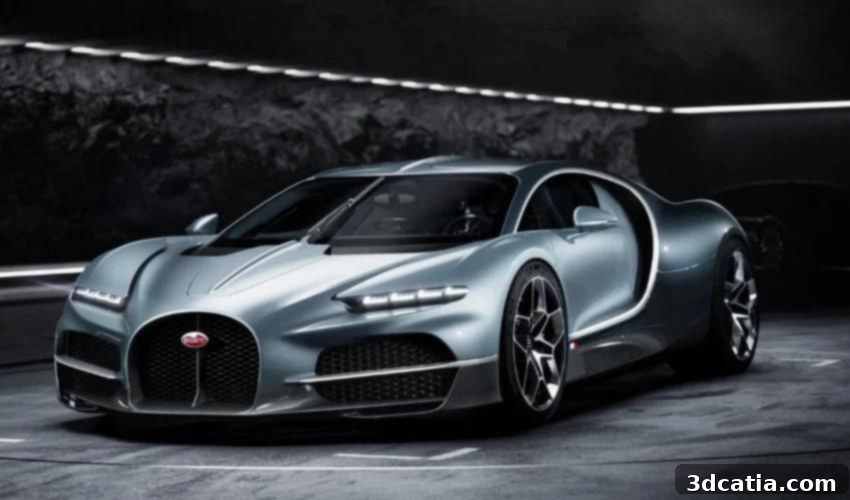
The Bugatti Tourbillon: Redefining Hypercars with Pioneering 3D Printing and Hybrid Technology
Bugatti, the legendary purveyor of automotive excellence, has once again captivated the world with the unveiling of its latest hypercar masterpiece: the Tourbillon. As the highly anticipated successor to the iconic Chiron, the Tourbillon doesn’t merely replace its predecessor; it elevates the benchmark for ultimate performance, luxury, and technological innovation. This new model represents a profound fusion of cutting-edge engineering, immense power, unparalleled luxury, and highly advanced aerodynamics, all meticulously crafted to deliver an extraordinary driving experience.
At the heart of the Tourbillon’s revolutionary design lies an engineering marvel: an impressive 1,800 horsepower hybrid powertrain. Yet, power alone isn’t the sole innovation. Bugatti has embarked on a radical journey to rethink vehicle architecture, particularly with its newly designed chassis and suspension components. These critical elements are not merely manufactured; they are intricately 3D printed using the groundbreaking Divergent Adaptive Production System (DAPS). This sophisticated software and hardware solution, developed by the American company Divergent, enables a complete reimagining of traditional design and manufacturing processes. By leveraging metal additive manufacturing, Bugatti has achieved significant breakthroughs, including a remarkable 45% reduction in suspension weight, propelling the Tourbillon into an unprecedented class of performance.
Unrivaled Power: A Hybrid Masterpiece
The Bugatti Tourbillon’s name, inspired by the intricate and highly precise mechanism found in high-end mechanical watches, hints at the engineering complexity and exquisite craftsmanship beneath its stunning exterior. This hypercar is powered by a truly formidable system: a naturally aspirated V16 engine, a marvel in its own right, complemented by three potent electric motors. Two of these electric motors are strategically placed at the front axle, while a third is integrated into the rear axle. This advanced hybrid setup collectively generates a staggering 1,800 horsepower, pushing the boundaries of what’s possible in automotive performance.
The integration of a hybrid system allows Bugatti to deliver unparalleled power output while also addressing modern demands for efficiency and instant torque. This intricate dance between internal combustion and electric propulsion enables the Tourbillon to reach blistering speeds with astonishing rapidity. Measuring 4.67 meters in length, this hypercar is capable of accelerating from a standstill to 400 km/h (approximately 248 mph) in a mere 25 seconds. Such figures are not just impressive; they place the Tourbillon among the elite few vehicles globally capable of such extreme performance, all while maintaining the iconic Bugatti characteristics of elegance and control.
Design Evolution and Aerodynamic Prowess
While the Bugatti Tourbillon builds upon the instantly recognizable aesthetic of its predecessor, the Chiron, its exterior design is a masterful evolution rather than a mere repetition. The timeless Bugatti lines are preserved, yet every curve, vent, and surface has been meticulously sculpted to optimize both visual impact and aerodynamic efficiency. The design philosophy centers on clean, flowing forms that manage airflow seamlessly, contributing to stability at extreme speeds and enhancing the car’s dynamic capabilities.
A significant aspect of the Tourbillon’s high performance comes from its intelligent use of materials and aerodynamic elements. For instance, a lightweight carbon composite material has been extensively utilized for the car’s primary structure, front air ducts, and rear diffuser. These components are not merely aesthetic; they play a crucial role in directing airflow, generating downforce, and minimizing drag. The expertly designed air ducts ensure optimal cooling for the powerful engine and brakes, while the rear diffuser works in concert with active aerodynamic elements to glue the car to the road, ensuring maximum grip and control even when pushed to its limits. Every design choice on the Tourbillon underscores Bugatti’s unwavering commitment to both breathtaking beauty and uncompromising performance.

The Interior of the Bugatti Tourbillon: A Symphony of Luxury and Precision
An Interior Beyond Imagination: The Art of Swiss Watchmaking
Step inside the Bugatti Tourbillon, and you are immediately transported into a realm of unparalleled luxury and exquisite craftsmanship. While the exterior hints at its performance pedigree, the interior epitomizes an experience reserved for the most discerning connoisseurs. Bugatti has collaborated with a renowned Swiss watchmaker to craft many of the interior accessories, infusing the cabin with the same level of precision, artistry, and mechanical brilliance found in horological masterpieces. This partnership is evident in every detail, from the tactile feedback of the controls to the flawless integration of complex mechanisms.
The dashboard itself is a focal point of this artisanal excellence. Composed of an astonishing 600 individual pieces, it is a testament to meticulous hand assembly and design. This intricate dashboard is further adorned with precious stones, including vibrant rubies and deep sapphires, elevating the cabin to the status of a jewel box. In a nod to both elegance and modern discretion, the central screen, encased in rich leather, remains hidden until the driver’s explicit request, preserving the analog purity of the cabin. The Tourbillon’s interior truly lives up to its name, offering a stunning blend of elegance, mechanical complexity, and performance, where every interaction is a moment of refined luxury.
The Additive Manufacturing Revolution: Partnering with Divergent
The challenge of incorporating three electric motors into an already immensely powerful hypercar meant a significant potential increase in overall vehicle weight. To counteract this, and indeed to push the boundaries of performance further, Bugatti embarked on a close collaboration with Divergent Technologies. This partnership was instrumental in designing an entirely new chassis and a significantly lighter suspension system for the Tourbillon. Divergent’s advanced manufacturing system, which ingeniously combines the power of 3D printing with artificial intelligence, was crucial for optimizing the vehicle’s performance without compromising structural integrity or adding unnecessary mass.
Divergent’s proprietary Adaptive Production System (DAPS) represents a paradigm shift in how complex structures are designed and manufactured. By leveraging generative design algorithms and high-precision metal additive manufacturing, DAPS allowed Bugatti engineers to create components with optimized geometries that are impossible to achieve with traditional methods. This process not only reduces weight but also enhances stiffness and durability in critical areas. The Tourbillon chassis now proudly features a 3D-printed aluminum multi-link suspension, a significant departure from the heavier steel double wishbone system previously used in the Chiron hypercar. This innovative manufacturing approach has been pivotal in achieving the remarkable 45% reduction in suspension weight, directly translating to improved handling, responsiveness, and overall dynamic performance.
Mate Rimac, CEO of Bugatti Rimac, underscored the significance of this partnership: “We are excited to announce this partnership after working closely together for the past 18 months. It is clear that Divergent is the industry leader in digital engineering and additive manufacturing. These optimized chassis components find their perfect home in our most advanced vehicle to date.” His statement highlights the deep collaboration and the transformative impact Divergent’s technology has had on Bugatti’s latest hypercar, setting new standards for automotive construction.
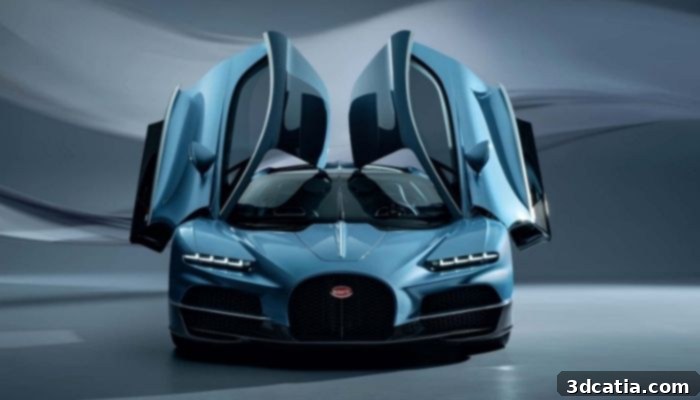
The Bugatti Tourbillon: Lighter, Faster, More Powerful
Beyond Suspension: Structural Reinforcements and Advanced Materials
The application of 3D printing and advanced materials in the Bugatti Tourbillon extends far beyond just the suspension system. The vehicle features numerous 3D-printed structural reinforcements strategically integrated throughout its architecture. These components, often intricate lattice structures, are designed to provide maximum strength and rigidity while minimizing material usage and weight. This allows for unparalleled optimization of the vehicle’s structural integrity, contributing to both safety and dynamic performance. From complex chassis nodes to bespoke brackets and internal reinforcement elements, additive manufacturing has unlocked new possibilities for creating parts that are stronger, lighter, and more precisely tailored to their function.
Complementing the 3D-printed metal components is the extensive use of redesigned materials, particularly lightweight carbon composite. This advanced material was chosen for the car’s primary structural elements, as well as crucial aerodynamic components like the front air ducts and rear diffuser. Carbon composite offers an exceptional strength-to-weight ratio, which is indispensable for a hypercar aiming for peak performance. All these factors—the innovative 3D-printed components, the judicious selection of advanced materials, and the relentless pursuit of aerodynamic perfection—converge to reduce the vehicle’s overall weight while simultaneously offering a symphony of high performance, superior handling, and unparalleled aerodynamic efficiency. The result is a hypercar that is not just fast, but dynamically brilliant and structurally optimized.
Exclusivity and the Future of Hypercars
The Bugatti Tourbillon is positioned not just as a vehicle, but as a statement of automotive artistry and engineering prowess. Its exclusivity is underscored by its formidable price tag of 4.2 million USD, placing it firmly in the realm of ultra-luxury collectibles. This price reflects not only the brand’s heritage and the performance capabilities but also the meticulous craftsmanship, groundbreaking technology, and the rare materials employed in its construction. Limited production numbers ensure that the Tourbillon will remain a coveted possession for a select few, offering an ownership experience as unique as the car itself. It represents a bold step forward, showcasing how traditional automotive excellence can be seamlessly integrated with revolutionary manufacturing techniques like 3D printing to create the hypercars of tomorrow.
The Bugatti Tourbillon is more than just Bugatti’s latest model; it is a clear indicator of the future trajectory for the hypercar segment and the automotive industry as a whole. By embracing hybrid powertrains and pioneering additive manufacturing, Bugatti has not only created a successor to a legend but has also laid down a new challenge for what an ultra-high-performance luxury vehicle can be. Its blend of power, luxury, and advanced technology makes it a true tour de force.
What do you think of Bugatti’s latest hypercar and its embrace of 3D printing? Let us know in a comment below or on our LinkedIn, Facebook, and Twitter pages! Don’t forget to sign up for our free weekly newsletter here for the latest 3D printing news straight to your inbox! You can also find all our videos on our YouTube channel.
*All Photo Credits: Bugatti