
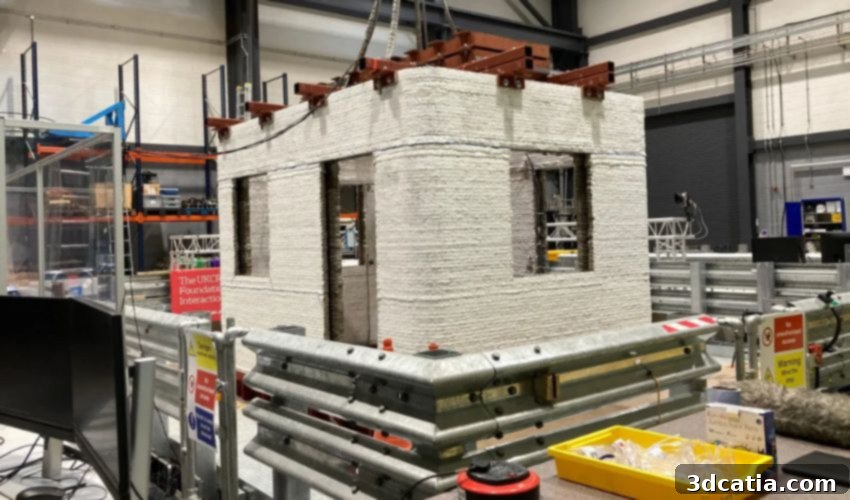
Revolutionizing Construction: Ensuring Seismic Safety with 3D Printed Concrete Buildings
In recent years, the landscape of construction has been profoundly reshaped by the emergence of 3D concrete printing. This innovative technology has rapidly established itself as a legitimate and transformative method within the broader construction industry, offering unprecedented advantages in speed, cost-efficiency, and design flexibility. Experts widely acknowledge its immense potential, seeing 3D concrete printing not just as a novel technique, but as a vital solution to pressing global challenges. From rapidly addressing severe housing shortages in developing regions to constructing robust, sustainable buildings in challenging and remote environments, its applications are vast and impactful. However, as with any groundbreaking technology, thorough research is paramount to ensure its safety and reliability. Consequently, researchers at the prestigious University of Bristol have embarked on a critical investigation: meticulously examining how a 3D printed concrete building would perform and withstand the powerful forces of an earthquake, a crucial step towards widespread adoption and trust in this advanced construction method.
This pivotal research project was initiated by Professor Anastasios Sextos and Dr. Raffaele de Risi, who astutely identified a fundamental gap in the existing knowledge base concerning additive manufacturing within the construction context. Recognizing the imperative to bridge this theoretical-to-practical divide, they spearheaded a collaborative effort with the University of Bristol’s advanced engineering facilities. According to the project leaders, the primary objective of their ambitious experiment is to precisely “fill the knowledge gap surrounding the dynamic response of 3D-printed units, particularly how they perform under recorded and simulated seismic events.” To achieve this ambitious goal, the research team is utilizing one of the United Kingdom’s most impressive engineering assets: the nation’s largest vibrating plate. On this formidable platform, the team is rigorously testing an almost life-size 3D printed house, meticulously constructed from concrete, subjecting it to simulated seismic forces that mimic real-world earthquake scenarios. This hands-on, large-scale experimentation represents a significant leap forward in understanding the structural integrity and dynamic behavior of 3D printed concrete structures under extreme conditions.
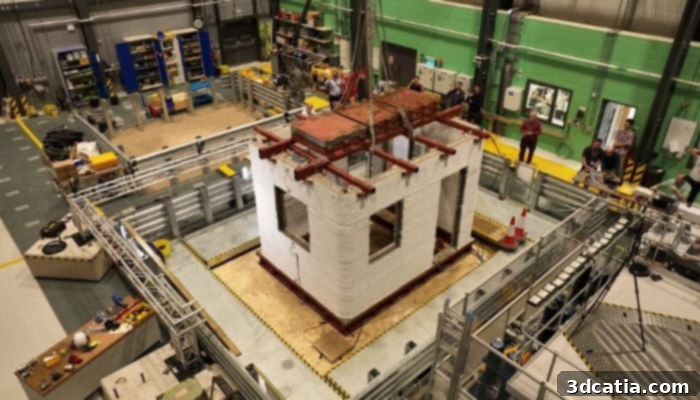
The meticulously constructed model house positioned on the UK’s largest vibratory plate, poised for rigorous seismic analysis.
Why This Groundbreaking Research Is So Important for Future Construction
The integration of additive manufacturing into the construction industry holds immense promise, particularly for its ability to deliver fast, sustainable, and cost-effective buildings that are built to last. This technology offers a paradigm shift from traditional construction paradigms, which are often labor-intensive and generate significant waste. However, the unique manufacturing process of 3D concrete printing—characterized by the layer-by-layer application of material—differs fundamentally from conventional construction methods, which typically involve pouring concrete into molds or assembling pre-fabricated elements. This inherent difference introduces a host of new variables and complexities. How these novel structures react to dynamic seismic forces has not been sufficiently investigated, presenting a critical gap in current structural engineering knowledge, as highlighted by the research team. Additive manufacturing processes produce distinctive material properties and intricate geometries that transcend the scope of previous knowledge regarding earthquake resilience in conventionally built structures. For instance, the interfaces between printed layers, the curing behavior of the concrete under rapid deposition, and the potential for anisotropic material strength can all influence a building’s response to tremors, making accurate predictions based solely on traditional models exceedingly complicated. Therefore, understanding these new variables is not just academically interesting but practically vital for the safe deployment of 3D printed buildings in seismically active regions.
The long-term vision for identifying the potential strengths, weaknesses, and unique failure mechanisms of 3D concrete printing in seismic regions is to establish robust safety standards and comprehensive design guidelines specifically tailored for these innovative buildings. This is not merely about identifying problems but about proactively developing solutions that will empower architects, engineers, and urban planners to design with confidence. Prof. Sextos and Dr. de Risi further emphasize the profound impact of their work, stating that “the team will identify strengths, weaknesses, and failure mechanisms specific to this construction method.” This detailed understanding will be instrumental in informing regulatory bodies, insurance providers, and construction companies, ensuring that 3D printed structures not only meet but potentially exceed existing safety benchmarks. By pinpointing exactly how and why these structures might fail under stress, researchers can develop precise recommendations for material compositions, reinforcement techniques, and structural geometries that optimize seismic performance. This proactive approach ensures that the benefits of 3D printing in construction are realized without compromising public safety, paving the way for a resilient and sustainable future for our built environment.
Understanding the Earthquake Safety Project: Methodology and Setup
At the heart of the University of Bristol’s pioneering research is a sophisticated experimental setup designed to simulate real-world earthquake conditions with unparalleled accuracy. The core of this facility is the UK’s largest vibrating plate, an engineering marvel capable of carrying an enormous payload of up to 50 tons. This formidable capacity allows for the testing of substantial, almost life-size structures, providing data that is far more representative of actual buildings than small-scale models. To construct the test subject, the team leveraged state-of-the-art robot-controlled additive manufacturing techniques, employing advanced concrete printing technology to fabricate an almost lifelike model of a typical 3D-printed house. A crucial aspect of this construction was the meticulous effort to imitate both the material composition and the intricate geometric characteristics of an actual 3D printed residential structure. This attention to detail ensures that the experimental results accurately reflect the behavior of buildings intended for real-world occupation. Once the model house was securely placed on the vibrating plate, the team systematically and gradually increased the simulated seismic forces. These forces, mimicking various earthquake intensities and frequencies, were applied in a controlled and incremental manner, allowing for precise observation. Every minute development, from micro-cracks to significant structural deformations, was recorded in excruciating detail using an array of sophisticated sensors and monitoring equipment, with all data captured and analyzed in real time. This rigorous, step-by-step approach provides an invaluable, comprehensive dataset on the structural response of 3D printed concrete under seismic stress.
The vast amount of precise data obtained through this meticulous experimental process is now being rigorously analyzed to assess the structural resilience and ultimate failure mechanisms of the 3D printed unit. This assessment goes beyond simple observation; it involves complex computational models and material science analysis to fully understand the dynamic interplay between the applied forces and the unique properties of the 3D printed concrete. A significant component of the research agenda involves a direct comparison of the seismic performance of these additive manufactured structures with that of buildings constructed using traditional methods. This comparative analysis is vital for contextualizing the findings and demonstrating where 3D printing either excels or requires further refinement. Furthermore, the research team is dedicated to the validation of various theoretical calculation models designed to predict seismic behavior. By testing these models against real-world experimental data, they can be refined and made more accurate, providing powerful tools for future design and planning. The implications of these findings are far-reaching and transformative. As the research team collectively asserts, “These findings will be essential for engineers, architects, and policymakers exploring the future of earthquake-resistant constructions.” They will inform the development of new building codes, material specifications, and design philosophies, ensuring that the next generation of structures, particularly those leveraging the efficiency of 3D printing, are not only innovative but also inherently safer and more resilient to natural disasters. This work is pivotal in moving 3D concrete printing from a promising concept to a trusted, standard construction practice in seismically active zones.
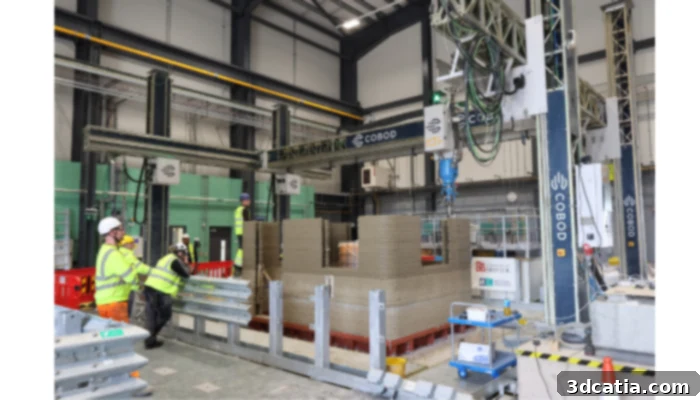
A COBOD 3D printer, renowned for its efficiency and precision, was instrumental in producing the intricate model house for the seismic tests.
In practical terms, the outcomes of this comprehensive research project could fundamentally guide the future construction of various essential structures, including residential houses, critical emergency shelters, and vital infrastructure projects around the globe. The insights gained will specifically inform design principles focused on achieving significantly greater earthquake resistance. This means moving beyond merely meeting minimum safety standards to actively engineering structures that can withstand and recover from severe seismic events with minimal damage and disruption. Dr. de Risi eloquently articulates the broader vision behind this endeavor: “By testing the seismic resilience of 3D-printed concrete for the first time, we’re not just exploring the future of construction—we’re helping shape a safer, smarter, and more adaptive built environment.” This statement underscores the transformative potential of their work, moving the conversation from theoretical possibilities to tangible safety advancements. The findings will contribute to a more resilient world, where communities in earthquake-prone areas can benefit from rapidly constructed, affordable, and, crucially, safe buildings. The University of Bristol’s commitment to this cutting-edge research reinforces its position at the forefront of engineering innovation, actively contributing to global efforts in disaster preparedness and sustainable development. For those eager to delve deeper into the specifics of this groundbreaking study, more comprehensive information can be accessed HERE.
What are your thoughts on this pioneering research into the earthquake resistance of 3D printed concrete? Do you believe this technology holds the key to building safer communities in seismic zones? Share your perspectives and insights in a comment below or join the conversation on our LinkedIn and Facebook pages! Don’t forget to sign up for our free weekly Newsletter here to receive the latest 3D printing news, directly delivered to your inbox. You can also discover all our compelling videos and interviews on our YouTube channel, offering visual insights into the world of additive manufacturing.
*All Photo Credits: University of Bristol