

Revolutionizing Surgery: NIHR Bristol BRC Pioneers 3D Printing for Enhanced Patient Safety
February 1st, 2018, marked a significant milestone for medical innovation in the United Kingdom with the grand opening of the National Institute for Health Research (NIHR) Bristol Biomedical Research Centre (BRC). This pivotal event, underpinned by a substantial £21 million investment, established a cutting-edge facility dedicated to the rigorous trial and development of innovative surgical technologies. At the forefront of these groundbreaking advancements is the integration of 3D printing, poised to revolutionize surgical preparation and practice through the creation of highly detailed, custom surgical models. This initiative is set to redefine patient care, safety, and the future of medical training within the UK’s National Health Service (NHS).
The establishment of the NIHR Bristol BRC underscores a national commitment to pushing the boundaries of medical science, specifically within surgical disciplines. The Centre’s mission extends beyond mere research; it aims to translate scientific discoveries into tangible clinical benefits, directly impacting patient outcomes. By focusing on emerging technologies, the BRC is strategically positioning the UK at the forefront of surgical innovation, ensuring that the healthcare system remains equipped with the most advanced tools and techniques available. This bold investment reflects an understanding that continuous innovation is key to addressing the complexities of modern medicine and safeguarding public health.
A Monumental Leap for UK Healthcare and 3D Printing Technology
The United Kingdom, home to the globally renowned National Health Service (NHS), undertakes an astonishing volume of surgical procedures annually. In 2017 alone, nearly 5 million operations were performed across the nation. This colossal figure highlights the immense pressure on the healthcare system and, critically, the absolute necessity for unwavering precision and safety in every intervention. Surgical procedures, by their very nature, carry inherent risks, and even minor errors can have life-altering or even fatal consequences. It is against this backdrop that the NIHR Bristol BRC emerges as a beacon of hope and progress, dedicated to minimizing these risks and significantly enhancing patient safety.
The £21 million allocated to this state-of-the-art centre is a strategic investment in human lives and the future of healthcare. It is designed to foster an environment where novel surgical approaches can be rigorously tested and refined before they are introduced into clinical practice. By doing so, the BRC aims to drastically reduce the incidence of surgical complications and preventable deaths. This forward-thinking approach is not just about adopting new technologies but about fundamentally reshaping the surgical landscape, making it safer, more efficient, and ultimately more successful for millions of patients across the UK and beyond. The integration of advanced manufacturing techniques, particularly 3D printing, is central to achieving these ambitious goals.
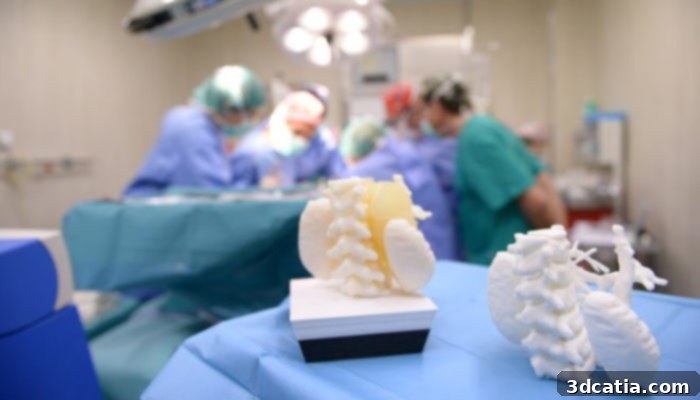
3D printing is seeing more uses in hospitals and treatments. This is due to its speed in creating custom prototypes and recreating replica organs.
Indeed, the new NIHR centre’s core mission extends beyond merely developing innovative surgical practices. It is equally dedicated to rigorously upgrading existing techniques and ensuring that every new methodology introduced is optimized for maximum safety and efficacy. This comprehensive strategy is vital, especially considering that a concerning percentage – over 5% – of all hospital deaths are currently attributed to preventable situations. This statistic underscores the paramount importance of proactive measures and continuous improvement in medical procedures. The BRC’s work directly tackles this critical issue, aiming to close the gap between current surgical outcomes and the highest possible standards of patient care.
By fostering an environment of continuous innovation and stringent safety protocols, the NIHR Bristol BRC is poised to make a profound impact. It serves as a national hub where clinicians, engineers, and researchers can collaborate, sharing insights and developing solutions that address the most pressing challenges in surgery. This collaborative spirit, combined with access to cutting-edge tools like advanced 3D printers, promises to accelerate the pace of medical discovery and ensure that the benefits reach patients as quickly and safely as possible. The focus on preventable deaths is a testament to the ethical foundation of the center’s work, driven by a deep commitment to saving lives and improving quality of life.
Transformative Applications of 3D Printing in Modern Hospitals
The integration of 3D printing technology into the healthcare sector represents a paradigm shift, offering a diverse array of applications that enhance diagnostic accuracy, surgical planning, training, and patient-specific treatments. Far beyond its initial uses, 3D printing is now an indispensable tool in hospitals and treatment rooms worldwide, and the NIHR Bristol BRC is leveraging its full potential. The primary and most immediately impactful application is the creation of incredibly realistic anatomical models.
By utilizing materials like silicone, hydrogels, and specialized polymers, 3D printers can accurately mimic the texture, elasticity, and structure of human tissues, organs, and bones. This capability allows for the production of near-perfect replicas of specific body parts or complex pathologies. For medical students and trainee surgeons, these models are invaluable. They provide a safe, repeatable, and realistic environment to practice intricate surgical procedures before ever operating on a live patient. This drastically shortens the learning curve, refines motor skills, and builds confidence, ultimately leading to more skilled and proficient surgeons, which directly translates into fewer complications and improved patient outcomes.
Beyond Training: Advanced Clinical Uses
The utility of 3D printing extends significantly beyond just surgical training models. One of its most profound impacts is in **pre-surgical planning**. For complex cases, such as those involving intricate tumors or delicate anatomical anomalies, surgeons can use patient-specific 3D printed models derived directly from MRI or CT scans. These models allow for detailed visualization, enabling surgeons to physically hold and examine a precise replica of the patient’s anatomy. This pre-operative rehearsal can identify potential challenges, determine optimal surgical approaches, and even minimize operating room time, thereby reducing risks associated with prolonged anesthesia and surgical stress on the patient.
Furthermore, 3D printing is instrumental in creating **custom surgical guides and instruments**. In fields like orthopedics, maxillofacial surgery, and neurosurgery, patient-specific guides can be printed to assist with highly precise bone cuts, screw placements, or tumor resections. These guides ensure unparalleled accuracy, leading to better functional outcomes and reduced recovery times. Similarly, custom instruments can be designed and printed to navigate unique anatomical challenges, providing surgeons with tools perfectly adapted to the individual patient’s needs.
The field of **prosthetics and orthotics** has been dramatically transformed by 3D printing. Traditional prosthetics can be costly, time-consuming to produce, and often lack a perfect fit, leading to discomfort and reduced functionality. 3D printing allows for the rapid creation of custom-fitted prostheses and orthoses that are tailored precisely to the patient’s limb or body contours. This not only enhances comfort and usability but also makes advanced prosthetics more accessible and affordable, greatly improving the quality of life for individuals with limb loss or orthopedic conditions.
Looking to the future, **bioprinting** represents the cutting edge of 3D printing in medicine. While still largely in the research phase, bioprinting aims to create functional tissues and organs using living cells and biomaterials. This technology holds immense promise for drug testing (reducing reliance on animal models), regenerative medicine (repairing damaged tissues), and ultimately, the creation of organs for transplantation, potentially eliminating organ donor waiting lists. The NIHR Bristol BRC, through its focus on innovative surgical technologies, will undoubtedly contribute to advancements in this revolutionary area.
This video offers additional insights into the crucial work and vision of the NIHR, highlighting its broader impact on national health research and innovation:
Fostering Dialogue and Driving Progress: The Broader Vision
Beyond the state-of-the-art facilities and research, the launch of the NIHR Bristol BRC was complemented by a series of engaging events and illuminating debates throughout the day. These gatherings served as crucial platforms for discussing the profound implications of surgical research on overall public health and well-being. Experts, policymakers, and the public converged to explore how continuous innovation in surgical techniques and technologies can lead to healthier communities, reduced healthcare burdens, and ultimately, a better quality of life for all citizens.
Among the highlights were exhibitions showcasing sophisticated 3D models, including highly intricate representations of heart diseases. These visual aids served not only to demonstrate the technological capabilities of the BRC but also to educate attendees on complex medical conditions in an accessible manner. By leveraging 3D printing to visualize pathologies, the centre is actively aiming to demystify complex medical issues and foster a deeper understanding among both medical professionals and the general public. This hands-on approach illustrates the centre’s commitment to using advanced tools to combat preventable deaths and elevate surgical procedures to unprecedented levels of safety and efficacy.
For those familiar with Matthew Syed’s insightful book, “Black Box Thinking,” the critical importance of learning from errors and continuously improving systems resonates deeply with the mission of the NIHR Bristol BRC. Syed argues for an open, analytical approach to failure, transforming mistakes into valuable learning opportunities. The surgical world, historically, has faced challenges in this regard, with preventable errors contributing to significant morbidity and mortality. The NIHR Bristol BRC directly addresses this by creating a controlled environment where new technologies and procedures can be developed, tested, and refined, thereby systematically reducing the potential for human error and enhancing systemic resilience. The numbers associated with preventable medical errors are indeed alarming, making the proactive stance of this £21 million investment not just beneficial, but absolutely essential for modern healthcare.
The ongoing work at the NIHR Bristol BRC is a testament to the transformative power of investment in medical research and technology. It’s an investment not just in equipment and facilities, but in the future health and safety of the nation. By integrating cutting-edge 3D printing technology with rigorous research and a commitment to patient-centric outcomes, the Centre is set to lead the way in surgical innovation, offering hope for safer, more effective treatments across a multitude of medical disciplines.
What are your thoughts on this significant £21 million investment in advancing 3D printing technology within the realm of surgery? We invite you to share your perspectives in a comment below or join the conversation on our Facebook and Twitter pages! For all the latest news and developments in the exciting world of 3D printing, don’t forget to sign up for our free weekly Newsletter, delivered straight to your inbox!