
Bold Design: Revolutionizing Creativity and Sustainability Through Advanced 3D Printing
In today’s rapidly evolving industrial landscape, the transformative power of 3D printing, also known as additive manufacturing, has become increasingly evident. This innovative technology is no longer confined to niche applications but has successfully integrated into a vast array of sectors and industries globally. Its widespread adoption is largely attributable to inherent advantages such as unparalleled flexibility, boundless design freedom, accelerated manufacturing speeds, and significant cost reductions in prototyping and production. Across Europe, a growing number of small and medium-sized enterprises (SMEs) are embracing 3D printing as a core production methodology, whether through strategic investments in their own machines or by leveraging specialized 3D printing services. A prime example of this pioneering spirit can be found in France, with the emergence of Bold Design. This visionary studio was established with a clear mission: to democratize the accessibility and application of 3D printing across diverse creative disciplines. Their work spans a broad spectrum, from intricate craftsmanship and bespoke interior decoration to advanced product design and artistic installations. To gain deeper insights into their groundbreaking work and philosophical approach, we recently had the opportunity to speak with the esteemed founders of Bold Design.
3DN: Could you introduce yourself and your connection with 3D printing?
Hello, we are William Boujon and Julien Benayoun, the co-founders and principal designers behind Bold Design. Our studio is dedicated to crafting a diverse range of products, including objects, furniture pieces, immersive spaces, and various custom items for a wide array of corporate clients and collaborators. Our profound relationship with 3D printing has developed organically and intensively over many years, becoming an indispensable part of our creative process. At our core, we operate as a dynamic research laboratory, constantly probing the intricate possibilities and inherent limitations of these advanced manufacturing technologies. This continuous exploration allows us to push boundaries and discover innovative applications. Consequently, an increasing number of companies are seeking our expertise to develop unique 3D-printed parts and entire collections. These collaborations often aim to infuse their products with a more distinctive, tactile, and sensitive quality, moving beyond conventional manufacturing aesthetics. Beyond our design projects, we are also committed to knowledge sharing, regularly organizing numerous interactive workshops focused on the convergence of 3D printing and design principles. Furthermore, we frequently deliver lectures to diverse audiences, sharing our insights and experiences on this fascinating subject, fostering a deeper understanding of additive manufacturing’s creative potential.
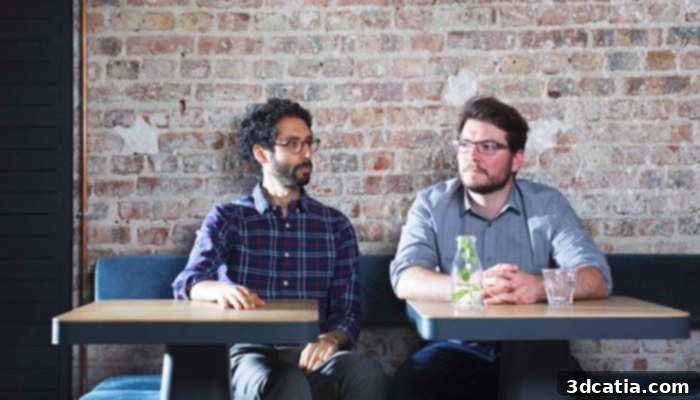
William Boujon and Julien Benayoun of Bold Design (photo credits: Maia Art / Kataba)
3DN: How did the idea to start Bold Design come about?
The genesis of Bold Design’s journey into additive manufacturing can be traced back to 2014. At that time, we engaged with the French company DOOD to produce numerous mock-ups for a design project involving a small wearable object, developed in collaboration with the prestigious MIT Media Lab. This initial interaction sparked our interest and provided a hands-on introduction to the capabilities of 3D printing. The following year, our relationship with DOOD deepened when we were commissioned to design an FDM (Fused Deposition Modeling) 3D printer for them. Our primary objective was to transform their printers from purely functional tools, typically found in the makers’ world, into aesthetically refined products with a distinct identity. We envisioned printers that would seamlessly integrate into educational institutions, architectural firms, and design agencies, appealing to a broader professional audience. Upon setting up the first prototype in our agency, we embarked on an intense period of experimentation. We began questioning the tool’s capabilities, exploring how specific shapes could be printed under various conditions. This hands-on, iterative approach quickly led us to compile what we affectionately termed our “3D idea book.” Each new idea and subsequent experiment invariably sparked dozens more, fostering a rapid accumulation of practical knowledge. It’s worth noting that neither of us had formal training in 3D printing; most of our expertise was forged through countless hours of direct, immersive printing, troubleshooting, and continuous learning by doing.
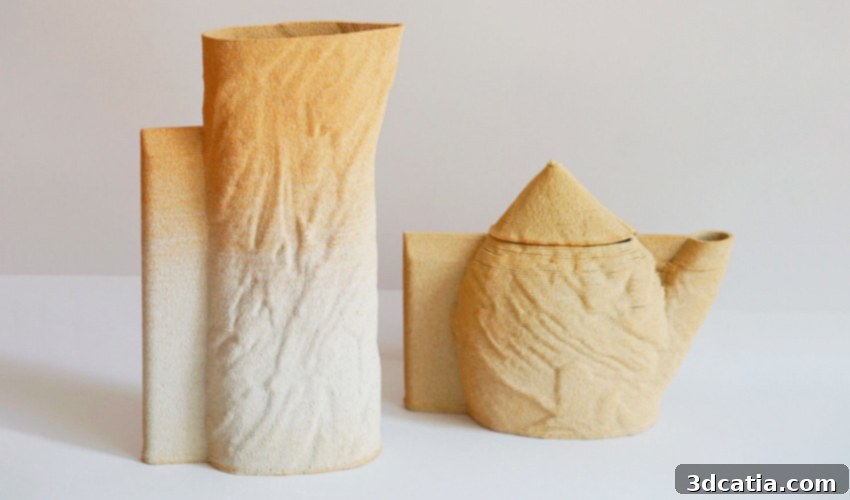
One of our initial and most intriguing questions was whether it would be possible to directly print fibers onto the machine, thereby integrating texture and material properties directly into the design. We dedicated considerable effort to developing innovative modeling strategies and conducting extensive tests to achieve this. We then shared these pioneering experiments on social media platforms, which serendipitously caught the attention of the AYBAR gallery in Miami. Impressed by our work, they commissioned a unique collection of three vases, which we named “POILU” (meaning ‘hairy’ in French), crafted using PLA loaded with natural fibers such as bamboo, coconut, or wood. This project garnered significant publicity, featuring prominently across various online platforms and in numerous print publications. This exposure was instrumental in drawing broader public attention to the intersection of design and advanced 3D printing, showcasing the potential for novel aesthetics and material expressions. Building on this success, we soon initiated fruitful collaborations with the Habitat Design Lab and other renowned designers, further solidifying Bold Design’s reputation as an innovator in the field of additive manufacturing for creative applications.
3DN: What 3D printing technologies and materials do you use at Bold Design?
At Bold Design, our methodology is highly adaptable; we engage with a diverse spectrum of workflows, cutting-edge technologies, and advanced materials, tailoring our approach specifically to the unique requirements of each client and project. For our FDM (Fused Deposition Modeling) 3D printing endeavors, our process begins with meticulous concept development and detailed 2D sketches, which then transition into sophisticated 3D modeling using industry-standard software like Rhinoceros or Fusion 360. Fusion 360, in particular, proves exceptionally valuable due to its robust “history” function, which allows for parametric adjustments and efficient design iteration. We then meticulously design the precise shapes and meticulously configure the printing files within advanced slicer software such as Cura or SuperSlicer. Following this digital preparation, we undertake the initial printing of models ourselves to rigorously test and refine the designs. Once this critical phase is successfully underway, we seamlessly collaborate with one of our trusted partners for both rapid prototyping and efficient series production, ensuring scalability and consistency. For specialized projects, such as the distinctive studio masks commissioned by the prestigious Centre Pompidou, we partner with the esteemed French company Cosmyx 3D. Conversely, for other design initiatives, like the development of several innovative lighting collections for Quincaillerie Moderne, we collaborate closely with Batch.works, a prominent design and manufacturing firm based in London and Amsterdam. Our collaboration with these partners is deeply integrated, working hand-in-hand to iteratively develop products until they achieve an impeccable standard of both aesthetic appeal and technical perfection.
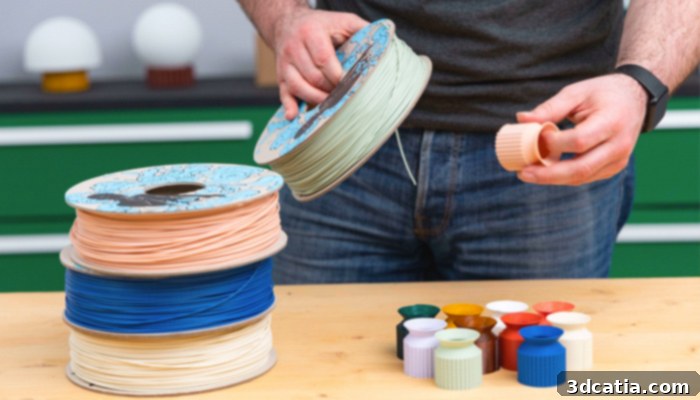
Photo Credits: domestika
Our expertise extends beyond FDM, as we are continuously approached by pioneering companies like Lynxter, eager to present their advancements in 3D printer development and their use of highly innovative materials, including sophisticated silicones and specialized ceramics. In these instances, our process involves an in-depth study of their proprietary technologies, followed by hands-on experimentation with their unique processes within their dedicated workshops. This immersive approach allows us to generate a comprehensive set of design ideas and applications. The resulting design files are typically created using traditional methods in Rhinoceros 3D or by leveraging the powerful Grasshopper plugin to precisely determine and optimize tool paths for these advanced materials. The overarching goal of these collaborations is to vividly illustrate the core essence of our respective know-how and to emphatically highlight the collective experiences gained through these challenging explorations. In a similar vein, we have embarked on an exciting collaboration with Pâtisserie Numérique to conceptualize novel designs for 3D-printed pastries. This unique project utilizes their distinctive process, which involves printing a liquid paste, precisely contained within a syringe, onto a bed of edible powder—a proprietary secret they meticulously guard, allowing for unprecedented culinary creativity.
Recently, we undertook a significant project involving the design of a demonstrator piece utilizing metal 3D printing. This endeavor employed advanced techniques such as laser fusion and powder-bonding, executed in close partnership with the Armines laboratory, the Carnot Institute M.I.N.E.S, and the CNRS. Through extensive dialogue with the laboratory, we gained a profound understanding of the specific advantages and inherent limitations of these sophisticated metal additive manufacturing technologies, mirroring our investigative approach with all new tools we integrate. The primary objective of this project was not to conceive a functional, mass-produced item but rather to create an exceptional work of art. This piece was designed to possess a striking visual impact, replete with numerous intricate details that would eloquently illustrate the myriad possibilities offered by metal as a 3D printing material. We meticulously conceptualized a narrative scenario and then intricately drew the various elements as a cohesive whole. Subsequently, our detailed 3D files were transmitted to the laboratory, where their experts meticulously adapted and optimized the objects to ensure flawless printability. Beyond merely sending files, our team invested substantial effort directly within the laboratory, designing complex shapes with sometimes subtle and challenging details, pushing the boundaries of what could be achieved with these advanced metal printing processes.
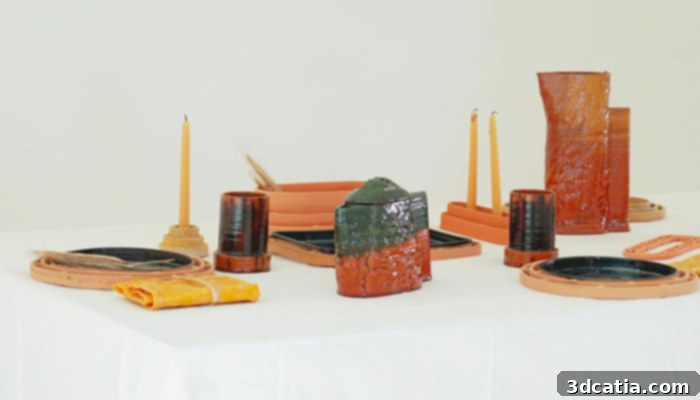
Exhibition of 3D-printed objects by Emmanuelle Roule, Bold Design and 8 Fablab (photo credits: Emmanuelle Roule).
3DN: What are the advantages of 3D printing over traditional methods?
At Bold Design, our guiding principle is always to employ the most appropriate manufacturing method for each individual project, recognizing that traditional and additive techniques each offer distinct strengths. However, the advantages conferred by 3D printing, especially in the context of design innovation, are manifold and often unparalleled. By leveraging the power of parametric and advanced 3D design tools, we gain the unparalleled ability to develop projects across vastly different scales, typologies, and material requirements with remarkable efficiency and precision. We fully capitalize on the extraordinary possibilities that additive manufacturing technologies offer in terms of customization and creative freedom. This freedom consistently enables a new and distinctive aesthetic to emerge from the objects we create, one that is often unattainable through conventional means. Furthermore, 3D printing facilitates the relatively straightforward creation of novel materials, particularly by incorporating recycled or reused production scraps, thereby fostering a more circular and sustainable design process.
When it comes to manufacturing products, particularly those intended for mass production or mass customization, 3D printing offers a strategic advantage by enabling the creation of objects much closer to the end user. This localized production capability significantly streamlines supply chains and reduces environmental impact. Critically, additive manufacturing empowers us to limit the need for extensive stockpiling by producing small series or even on-demand items without necessarily incurring prohibitive cost increases. This stands in stark contrast to traditional methods like injection molding, which demand substantial upfront investments in costly and complex tooling, often necessitating large minimum order quantities. Our profound mastery of design specifically optimized for 3D printing allows us to seamlessly integrate both intricate aesthetic considerations and highly technical functional elements within a single part. This holistic approach significantly limits the need for extensive human intervention during the manufacturing process. The result is the production of remarkably precise, consistently high-quality objects at exceptionally reasonable price points, making advanced manufacturing more accessible and efficient for a diverse range of applications and clients.
3DN: Any last words for our readers?
We at Bold Design hold a firm and unwavering belief in the immense, transformative potential of additive manufacturing technologies. Indeed, these innovations are no longer future concepts but are already ubiquitous, profoundly impacting diverse sectors ranging from cutting-edge nanoscale medical solutions and bioprinting to large-scale construction, concrete structures, and countless other applications in between. The versatility and adaptability of 3D printing ensure its continued expansion into every facet of modern industry and daily life.
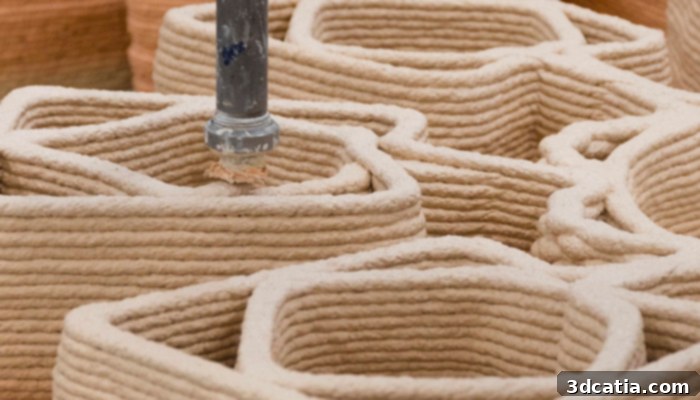
Bold Design is also exploring the possibilities of 3D printing using Leatherstone ©, a material made from leather scraps left over from production (photo credits: Marc Dimitrov).
In the crucial domains of object, furniture, and building manufacturing, certain additive technologies offer unparalleled speed and ease in repurposing what has historically been considered mere waste. This capability is particularly vital given our current historical juncture, where humanity has extensively exploited the planet’s finite resources, pushing some essential materials to the brink of exhaustion. Concurrently, we are overwhelmed by the staggering volume of waste generated by the production of consumer goods, among other industries. It is imperative, therefore, that we actively embrace and utilize these “new” materials—derived from historically old and regrettably “abundant” waste materials—in large-scale projects. This strategic shift is not just about innovation; it is a critical step towards sustainably building the future. For those interested in delving deeper into our projects and philosophy, more comprehensive information can be found on the official Bold Design website HERE.
What are your thoughts on the groundbreaking work of Bold Design? We invite you to share your insights in a comment below or engage with us on ourLinkedIn,Facebook, andTwitter pages! Don’t miss out on the latest advancements in additive manufacturing—be sure to sign up for our free weeklyNewsletter here, delivering the freshest 3D printing news directly to your inbox! Additionally, you can explore all our exclusive video content on our dedicatedYouTube channel.
*Cover Photo Credits: Emmanuelle Roule