
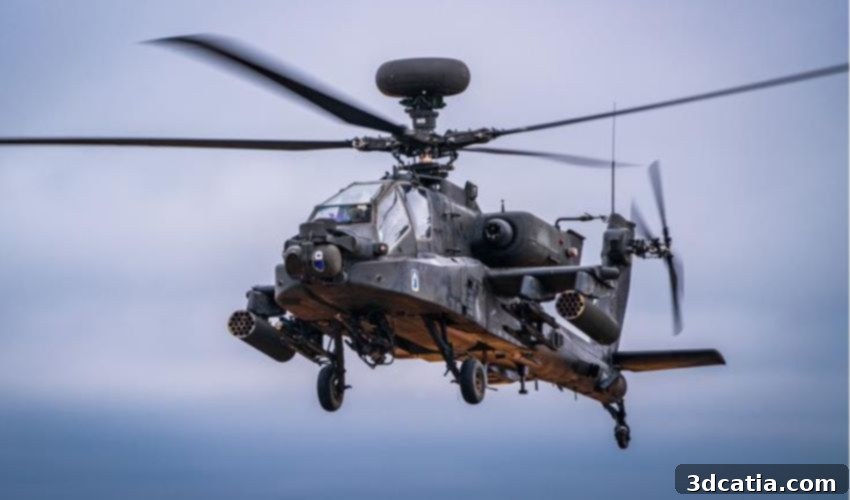
Revolutionizing Defense: Boeing Tests 3D Printed Main Rotor System for AH-64 Apache Helicopters
The landscape of the U.S. defense industry is undergoing a significant transformation, largely propelled by the increasing adoption of additive manufacturing, commonly known as 3D printing. This advanced technology is rapidly gaining momentum, promising to reshape the production and deployment of critical military components. A groundbreaking initiative from aerospace giant Boeing exemplifies this shift: the company has announced ambitious plans to begin testing a fully 3D-printed prototype of the main rotor system for its renowned AH-64 Apache attack helicopter. Slated for April 2024, this move signifies a pivotal moment in integrating state-of-the-art manufacturing processes into the complex world of defense systems.
Boeing’s testing methodology is robust and comprehensive, involving a direct, comparative evaluation of the 3D-printed components against those produced through conventional means. This rigorous assessment aims to validate not only the structural performance but also the long-term durability and reliability of the additively manufactured parts under operational conditions. Furthermore, extensive fatigue tests will be conducted, meticulously comparing the resilience and lifespan of the 3D-printed parts with their traditionally forged counterparts. According to Andy Pfeiffer, Boeing Global Services’ senior design engineer and additive manufacturing expert, this meticulous approach is fundamental to confirming the full viability and potential advantages of 3D printing for mission-critical aerospace applications, ensuring unwavering safety and performance standards.
The Jointless Hull Project: Forging the Future of Military Vehicle Production
The commitment to advancing additive manufacturing within the defense sector extends beyond individual helicopter components. At the recent annual meeting of the Association of the U.S. Army (AUSA), Boeing, in a collaborative effort with the non-profit Applied Science and Technology Research Organization of America (ASTRO), unveiled a major achievement as part of the visionary Jointless Hull Project. This ambitious initiative, which has garnered previous attention for its transformative goals, seeks to push the boundaries of large-format additive manufacturing for advanced military vehicles, creating structures with enhanced integrity and reduced complexity.
During the AUSA gathering, the collaborative team proudly showcased their initial 3D-printed component developed under this pioneering project: the main rotor joint assembly. This vital joint, essential for the functionality of the helicopter’s rotor system, was produced entirely as a single, integrated piece. This remarkable feat was accomplished using the world’s largest metal 3D printer, located at Rock Island Arsenal, Illinois. Printing such a complex assembly in one continuous piece offers immense benefits. It drastically reduces the number of individual parts, thereby minimizing assembly time and potential points of failure, which translates directly into improved structural integrity, increased reliability, and streamlined manufacturing processes for critical defense assets.
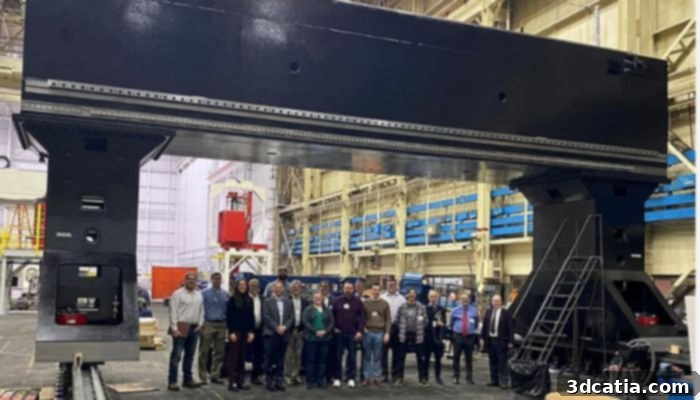
The world’s largest metal 3D printer at Rock Island Arsenal (photo credits: ASTRO America)
The Jointless Hull Project itself represents a bold vision where the U.S. Army aims to cultivate additive manufacturing capabilities substantial enough to print an entire armored hull for a vehicle as a single, seamless unit. This innovative research is actively supported by the Army’s Ground Vehicle Systems Center, which has provided significant financial backing to ASTRO, allocating an impressive $95 million from the U.S. budget. This substantial investment is specifically earmarked to accelerate advancements in large-format additive manufacturing techniques, with a direct focus on producing substantial and complex components like tank hulls and various combat vehicle prototypes, which are indispensable for maintaining modern defense superiority and operational readiness.
Beyond the immediate technical advancements, ASTRO is also deeply engaged in evaluating the comprehensive economics associated with producing diverse 3D-printed components. This includes a thorough analysis of parts for the AH-64 Apache helicopter, as confirmed by ASTRO engineer Emma Gallegos. Understanding the precise cost-effectiveness, scalability, and long-term economic viability of additive manufacturing is absolutely crucial for its widespread adoption across the defense sector, ensuring that technological innovation is not only achievable but also sustainable and advantageous from a financial perspective for future production and deployment cycles.
Additive Manufacturing Versus Conventional Forging: A Strategic Comparison for Apache Helicopters
Boeing’s strategic embrace of 3D printing for the AH-64 Apache helicopter introduces a compelling and insightful comparison with traditional manufacturing methods, particularly the long-established process of forging. One of the most prominent benefits of additive manufacturing is its remarkable speed in production. For instance, the intricate 3D printing process for the 6000 series aluminum main rotor joint assembly took approximately eight hours to complete. An additional 45 minutes were required for the precise application of the aluminum material itself. This efficiency stands in stark contrast to conventional forging techniques, where producing similar complex components can extend lead times dramatically—often necessitating up to an entire year from initiation to completion, as noted by Andy Pfeiffer. This profound reduction in manufacturing lead times offers an unparalleled strategic advantage, enabling significantly quicker prototyping, faster design iterations, and the expedited delivery of critical parts essential for modern defense operations.
This substantial gain in efficiency has led Boeing to supply ASTRO with an extensive list of components identified as candidates for renewal or potential creation using 3D printing technology. The capability to rapidly produce complex, high-performance parts on demand holds the potential to fundamentally transform existing supply chain dynamics, especially for maintaining aging aircraft fleets or in scenarios demanding urgent repairs and replacements under pressing operational timelines. Additive manufacturing not only accelerates the production cycle but also unlocks unprecedented opportunities for design freedom, allowing engineers to craft optimized geometries and consolidate multiple parts into a single, intricate component. This design flexibility can result in parts that are lighter, stronger, and more aerodynamically efficient, directly contributing to improved aircraft performance, enhanced fuel efficiency, and extended operational ranges.
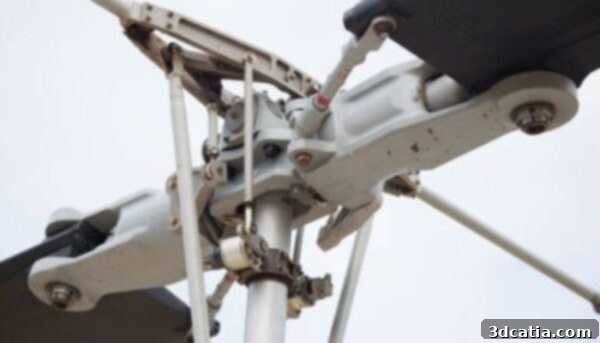
The helicopter’s rotor (photo credits: 123RF)
While additive manufacturing undeniably offers superior speed and unparalleled design advantages, conventional forging often maintains a significant economic edge when it comes to mass production scenarios. For extremely high-volume manufacturing, the established setup costs and material utilization efficiencies of traditional forging processes can translate into considerably lower per-unit costs. However, for the production of smaller quantities, highly specialized components, or parts requiring exceptionally rapid turnaround, 3D printing consistently proves to be more cost-effective and economically advantageous. This inherent flexibility allows defense contractors to judiciously select the most optimal manufacturing method based on specific production demands, the complexity of the part, and the required quantities, thereby optimizing both cost and time.
Beyond purely economic considerations, additive manufacturing also brings forth impressive benefits in material science. Components produced using 3D printing frequently exhibit a superior microstructure, which directly contributes to higher stability, enhanced robustness, and improved overall material strength when compared to structures fabricated by conventional manufacturing processes. This advantage often stems from the precise, layer-by-layer creation method of 3D printing, which can be meticulously controlled to optimize the grain structure of the material and effectively minimize internal defects. For critical aerospace components such as rotor systems, these significant improvements in material integrity directly translate into greater operational reliability, extended service life, and enhanced safety, all of which are paramount for military aircraft operating under the most extreme and demanding conditions.
Optimizing Defense Supply Chains and Future Strategic Implications
Boeing’s strategic adoption of additive manufacturing is driven by a broader, forward-thinking vision to fundamentally optimize the supply chain for parts traditionally produced through forging. By diversifying manufacturing capabilities and integrating advanced processes, defense companies can significantly reduce their reliance on single-source suppliers. This strategy also effectively mitigates risks associated with geopolitical instabilities, natural disasters, or disruptions inherent in traditional, elongated supply chains. Such enhanced resilience is absolutely vital for national security, ensuring that essential parts are consistently available, even in the most challenging or unforeseen circumstances. The ultimate decision-making process when choosing between additive and conventional manufacturing methods often hinges critically on existing supplier relationships and the immediate availability of specialized tooling. For components that have well-established forging suppliers and existing, fully depreciated tooling, an immediate, wholesale transition to 3D printing may not always be the most practical or economically efficient choice in the short term.
Nevertheless, Boeing emphatically underscores the transformative importance of additive manufacturing for urgent aircraft repair work. The capability to produce flexible, on-demand replacement parts drastically minimizes the downtime for critical military assets, thereby ensuring optimal operational readiness at all times. Consider a scenario where a specific part for an AH-64 Apache helicopter is damaged in a remote operational theater; instead of waiting weeks or even months for a traditionally forged replacement to be manufactured and subsequently shipped across vast distances, a high-quality 3D-printed part could potentially be produced locally or very near the point of need within days, or in some cases, even hours. This extraordinary capability represents a monumental leap forward in logistics, maintenance efficiency, and battlefield responsiveness for military operations worldwide, ensuring that forces remain agile and effective.
The far-reaching implications of Boeing’s advancements in leveraging 3D printing for the AH-64 Apache extend well beyond this single helicopter platform. This pioneering initiative not only vividly demonstrates the significant maturation and proven capability of additive manufacturing technology but also sets a compelling precedent for its broader, more comprehensive adoption across the entire defense industrial base. As advancements in material science continue to evolve and printing technologies become even more sophisticated, we can confidently anticipate the fabrication of increasingly complex, high-performance components with unprecedented speed, precision, and efficiency. This transformative shift promises to profoundly enhance military capabilities, streamline complex logistics operations, and foster a new era of innovation in defense manufacturing, ultimately contributing to the development of more agile, resilient, and technologically superior armed forces capable of meeting future challenges.
What are your thoughts on Boeing’s innovative approach to producing AH-64 Apache helicopter parts using cutting-edge 3D printing technology? We warmly invite you to share your valuable insights and perspectives in the comments section below or engage with our community on our various social media platforms, including LinkedIn, Facebook, and Twitter. To ensure you don’t miss out on the very latest advancements and news in additive manufacturing, be sure to sign up for our free weekly Newsletter here, delivering the freshest 3D printing updates directly to your inbox! Additionally, you can explore all our compelling and informative videos on our YouTube channel for more in-depth content and visual insights.
*Cover Photo Credits: US Army