

Optimizing Elite Athlete Performance: The Role of 3D Printing in Bobsled and Luge
In the dynamic and ever-evolving landscape of competitive sports, the relentless pursuit of marginal gains has driven innovation to unprecedented levels. Among the most transformative technologies making an impact is 3D printing, also known as additive manufacturing. This revolutionary approach allows for the creation of customized equipment precisely tailored to individual athletes, even those competing at the pinnacle of their respective disciplines. From highly personalized protective gear to specialized components designed to enhance specific movements, 3D printing is fundamentally changing how athletes prepare and perform, offering a unique blend of precision, speed, and adaptability.
A prime example of this technological integration into elite sports comes from the German Bobsled, Luge and Skeleton Federation (BSD). As a leading national sports organization, the BSD has long understood the critical importance of technological superiority in achieving success on the international stage. Their unwavering commitment to innovation is further amplified by a long-standing partnership with the BMW Group, a relationship that began in 2010. For over a decade, BMW’s unparalleled engineering expertise and advanced manufacturing capabilities, particularly in the realm of 3D printing, have consistently provided German athletes with a distinct competitive advantage. This powerful collaboration is once again at the forefront as the BSD gears up for the demanding challenges of the upcoming winter season, with a specific focus on optimizing performance through ingeniously designed 3D printed components, most notably customized spikes for bobsled shoes.
The upcoming season features two major international events where these cutting-edge innovations will be rigorously tested: the FIL World Championships Luge in January 2024 and the prestigious BMW IBSF World Championships Bobsled and Skeleton scheduled for February–March 2024. In both luge and bobsled, the margins of victory are incredibly fine; milliseconds can determine the difference between securing a gold medal and missing the podium entirely. The fundamental objective is always to optimize the athletes’ speed from start to finish and, consequently, their total run time. Achieving this requires not only peak physical condition, exceptional skill, and mental fortitude but also equipment that is perfectly harmonized with the athlete’s unique biomechanics and the often-unpredictable environmental conditions of the ice track.
A crucial element in this comprehensive optimization strategy is the “BMW Data Coach,” a sophisticated technological platform that has been utilized in luge since 2016 as a direct outcome of the BMW Group’s strategic partnership with the BSD. This advanced system allows for the precise recording and meticulous analysis of intricate run data, capturing every nuance of an athlete’s performance as they navigate the treacherous ice channel. By meticulously replicating and simulating these runs digitally, the “BMW Data Coach” provides invaluable, data-driven insights. These insights enable coaches and engineers to offer highly individualized recommendations, leading to significant refinements in the athletes’ riding behavior and critical adjustments to their luge and skeleton equipment. When the conversation naturally shifts towards such a high degree of personalization, precision engineering, and performance optimization, the pivotal role of additive manufacturing becomes undeniably clear, offering solutions that traditional methods simply cannot match.
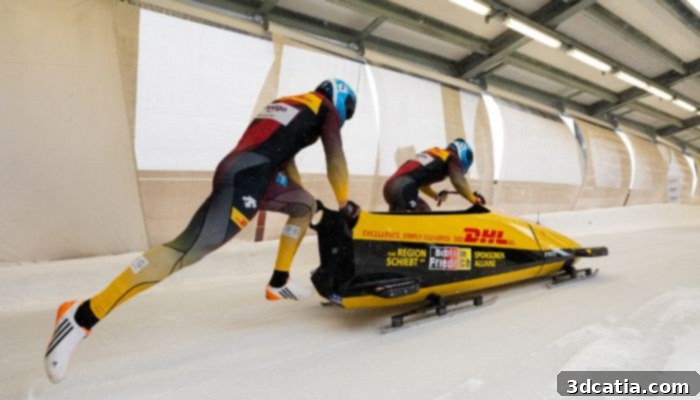
Bobteam Friedrich – (c) BSD/Viesturs Lacis
Precision Engineering for Victory: 3D Printing in Bobsledding and Skeleton
The overarching trend in elite sports is a continuous push towards individualized adaptation – meticulously tailoring conditions, training regimens, and most importantly, equipment to the specific needs of each athlete and the unique demands of their competitive environment. This paradigm shift is powerfully underpinned and significantly accelerated by the latest advancements in 3D printing technology. At the upcoming BMW IBSF Bobsled and Skeleton World Championships, for instance, athletes will benefit directly from these innovations, receiving individually customized spike plates for their bobsled boots. These meticulously engineered components are crafted using state-of-the-art 3D printing techniques, with the clear expectation that they will significantly elevate the athletes’ chances of securing podium finishes and ultimately, achieving victory.
The Critical Role of Spikes in Bobsled Performance
To truly appreciate the profound impact of 3D printed spikes, it’s essential to understand their vital role in bobsledding. The start of a bobsled run is arguably one of the most explosive and technically demanding phases of the entire sport. Athletes propel the heavy sled with immense force, relying entirely on the precision grip and robust leverage provided by the spikes on their specialized shoes. The initial acceleration generated during this powerful push-start directly influences the sled’s velocity throughout the entire track, making every fraction of a second gained here absolutely critical for overall performance and final race time. Traditional manufacturing methods often involve standard spike plates, which, while generally effective, cannot fully account for the minute differences in an athlete’s foot strike, their unique gait, or the subtle nuances of their power transfer mechanics. This is precisely where additive manufacturing steps in, offering a transformative and highly individualized solution.
Unlocking Performance Through Additive Manufacturing
The magic of additive manufacturing lies in its unparalleled ability to transcend the inherent limitations of conventional production techniques. How does it specifically enhance bobsled spike plates to such a degree? Firstly, it enables engineers to precisely determine and implement the optimal placement of each individual spike on the bobsled boot’s sole. This is far from a one-size-fits-all approach; instead, it meticulously considers the athlete’s unique foot structure, their specific pressure points during the push, and their dynamic pushing style. Secondly, 3D printing allows for the innovative design and creation of spike plates with an optimal number of teeth and precisely engineered supporting struts, all meticulously designed to maximize grip on the ice and ensure the most efficient possible transfer of power from the athlete to the sled. This level of geometric complexity, intricate detail, and personalized customization would be either prohibitively expensive or even physically impossible to achieve with traditional molding or machining techniques.
Beyond merely optimizing placement and structural design, 3D printing provides unparalleled flexibility in adapting critical material properties to suit individual needs. The overall weight and the specific stiffness of the entire spike plate can be meticulously customized to each athlete’s preference, body type, and even the prevailing track conditions. For instance, a heavier athlete might benefit significantly from a stiffer plate to ensure maximum energy transfer and minimal flex, while a lighter athlete might find a slightly more flexible design advantageous for absorbing impact or providing a different, more nuanced feel. This granular control over mechanical properties ensures that the equipment becomes a truly seamless and perfectly integrated extension of the athlete’s body. Furthermore, the inherent efficiencies of 3D printing mean that the production of these highly customized spike plates can save significant time and costs compared to the elaborate tooling, mold creation, and protracted manufacturing processes typically required for conventional methods. This cost-effectiveness is particularly advantageous for the rapid prototyping phase, allowing for extensive experimentation.
The ability to iterate rapidly is undoubtedly one of the most powerful and transformative advantages of 3D printing in the development of elite sports equipment. Due to the comparatively low costs associated with printing numerous prototypes, engineers and athletes can engage in an intensive and highly responsive cycle of design, print, test, and refine. Multiple iterations of spike plates can be produced quickly, allowing athletes to test various configurations, experimental materials, and nuanced designs under authentic, real-world competitive conditions. This empirical feedback loop is crucial; it ensures that the final model is truly optimized for the individual athlete, maximizing comfort, unparalleled grip, and ultimate power output. In recent developments, athletes have even had the remarkable opportunity to experiment with 3D-printed spike shoes crafted from a diverse range of materials, each offering different combinations of durability, precise weight, and elasticity, thereby fine-tuning their equipment to an unprecedented and competitive degree.
Data-Driven Design: The Synergy of 3D Scanning and Software
The advanced customization of bobsled spike plates is a compelling testament to the powerful synergy that exists between sophisticated design software and cutting-edge 3D scanning technologies. The entire process begins with highly personalized 3D scans of the athletes’ shoes and, crucially, their feet. These high-resolution digital models meticulously capture the precise contours, unique dimensions, and anatomical specificities of each athlete, serving as the foundational data for the subsequent design software phase. Leveraging these detailed scans, specialized software algorithms then intelligently generate spike plates that are individually adapted to each athlete, taking into account their unique biomechanical profile and pushing dynamics. This includes meticulously optimizing the arrangement, precise number, specific shape, and even the localized stiffness of each individual spike. This data-driven approach dramatically increases design flexibility, allowing for the creation of complex, organic geometries that perfectly match the athlete’s exact requirements, while simultaneously reducing production time enormously compared to traditional, less adaptable, and more time-consuming manufacturing workflows.
The direct impact of these finely tuned bobsled boots on an athlete’s performance cannot be overstated. The precise adjustment and optimal design of the spike plates on the forefoot soles directly influence the strength, efficiency, and explosive power of the push-off at the very start of the run. This initial, critical push dictates the immediate acceleration of the sled, setting the tone for the entire race and determining the speed carried down the track. By thoroughly optimizing this critical phase, 3D printed spikes provide athletes with a tangible and measurable competitive edge, significantly improving their start time and, consequently, their overall total run time. The seamless transfer of force from the athlete’s leg through the boot to the ice is paramount for maximum propulsion, and personalized 3D printed spike plates ensure this transfer is as efficient, powerful, and effective as humanly possible, minimizing energy loss and maximizing forward momentum.
BMW’s Enduring Commitment to 3D Printing and Innovation
The integration of cutting-edge manufacturing and development technology, originating directly from the highly innovative automotive industry, has been a defining hallmark of the strategic partnership between BMW and the BSD. BMW, globally recognized as a leader in automotive engineering, brings decades of invaluable experience in material science, advanced aerodynamics, precision manufacturing, and digital design to the specialized world of elite sports. This invaluable cross-pollination of knowledge and expertise allows for the development of spike plates that are not only perfectly adapted to the athletes but also benefit profoundly from the rigorous testing, stringent quality control, and continuous innovation cycles characteristic of high-performance automotive design and production. It’s therefore no surprise that BMW stands at the forefront of this athletic equipment revolution, given its long and robust history with additive manufacturing.
3D printing has been an integral and foundational part of BMW’s development and production processes since as early as 1991, highlighting a sustained, multi-decade commitment to harnessing this transformative technology for innovative solutions across a wide array of diverse sectors. This deep-rooted experience in additive manufacturing ensures that the solutions provided to the BSD are not merely novel but are also built upon a solid foundation of proven technological prowess and extensive research and development. This long-term commitment allows BMW to transfer highly specialized knowledge, from creating intricate engine components to designing ultra-lightweight vehicle parts, directly into the demanding arena of professional sports, giving athletes an unparalleled advantage.
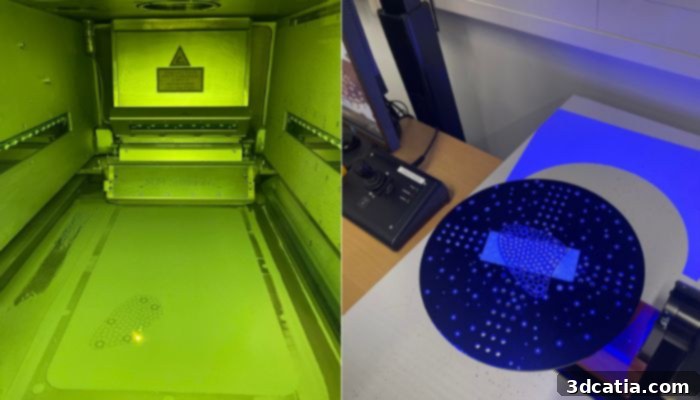
3D printed spikes for bobsled shoes
Looking ahead, the profound collaboration between the BSD and the BMW Group, powered by advanced 3D printing capabilities and sophisticated data analysis, undeniably sets a new benchmark for performance optimization in the challenging and competitive world of winter sports. This powerful synergy not only offers German athletes a critical competitive edge but also represents a comprehensive blueprint for how technology can profoundly transform and elevate athletic achievement across various disciplines. The ability to precisely tailor equipment to an athlete’s unique physical characteristics, biomechanical profile, and specific performance demands unlocks potential that was previously unimaginable. This ensures that German bobsled and luge athletes are equipped with the absolute best, most personalized tools available to fiercely compete for global titles and push the boundaries of human performance.
We’d love to hear your thoughts on these innovative 3D-printed bobsled spike shoes and their potential impact on the upcoming championships! Share your insights in a comment below or join the conversation on our Linkedin, Facebook, and Twitter pages! For the latest advancements in additive manufacturing and breaking 3D printing news delivered straight to your inbox, don’t forget to sign up for our free weekly Newsletter here. You can also explore all our engaging video content on our YouTube channel, offering deeper dives into the fascinating world of 3D technology.
*All Photo Credits: BMW Group