
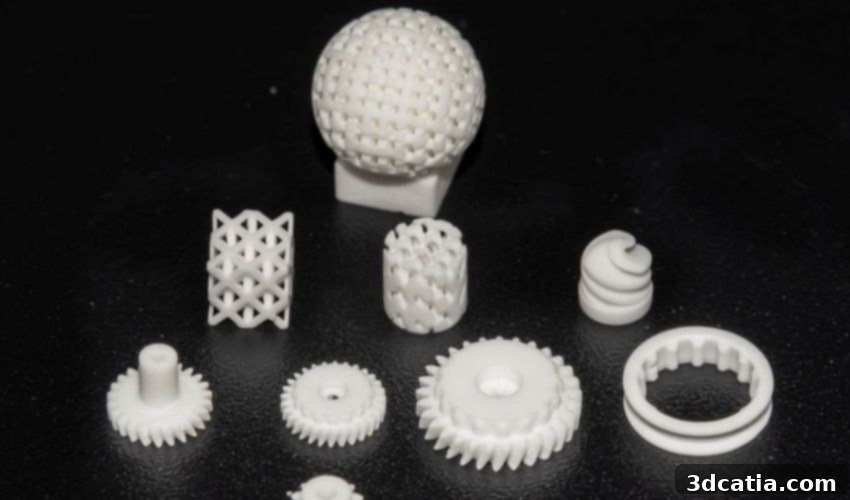
BMF MicroArch S230: Revolutionizing Micro-Precision 3D Printing for Advanced Manufacturing
As the pace of innovation continues to accelerate across various industries, the demand for ever smaller, more complex, and highly functional components is reaching unprecedented levels. This pervasive drive towards miniaturization is fundamentally reshaping manufacturing landscapes, pushing the boundaries of what is possible. In this dynamic environment, Boston Micro Fabrication (BMF), a recognized leader in micro-scale 3D printer manufacturing, has once again underscored its commitment to advancing precision additive manufacturing. With the transition from summer’s calm to the bustling energy of the fall season, BMF has unveiled its latest groundbreaking micro-precision solution: the microArch S230 3D printer, a machine poised to redefine the capabilities of micro-3D printing.
The pursuit of miniaturization is not merely a fleeting trend; it represents the next critical frontier for additive manufacturing. Industries ranging from advanced electronics and medical devices to micro-optics, microfluidics, and biotechnology are increasingly reliant on components that are not only tiny but also intricate and robust. While the concept of using additive manufacturing (AM) for nano and micro parts has long been recognized for its immense benefits – particularly the unparalleled level of customization, geometric freedom, and rapid prototyping it offers – the market for such specialized applications has, until recently, remained relatively niche. However, with the introduction of innovative machines like the microArch S230 from BMF, alongside significant advancements from other prominent micro-scale printing manufacturers such as Nano Dimension, it is undeniably clear that this landscape is rapidly transforming. The advent of these next-generation systems is democratizing access to micro-additive manufacturing, making it a viable and attractive option for an expanding array of high-tech applications, often surpassing the limitations of traditional microfabrication techniques like lithography or micro-molding in terms of design complexity and material versatility.
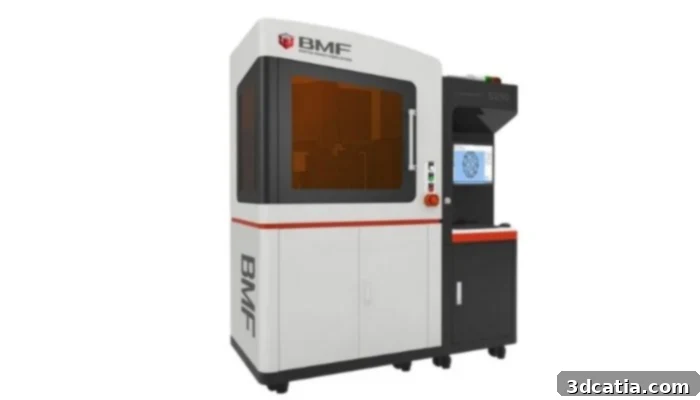
BMF’s latest marvel, the microArch S230 3D printer, represents a leap forward in microfabrication capabilities. (Photo credits: BMF)
With the microArch S230 3D printer, BMF is making a strategic move to broaden the adoption of micro-scale 3D printing, extending its reach to a much wider audience without compromising the hallmark accuracy, precision, and speed for which the brand is globally recognized. John Kawola, CEO of BMF, articulated this vision eloquently, stating, “The miniaturization trend continues to dominate nearly every industry, but as parts get smaller, they become harder to design, more expensive to manufacture, and generally more complicated to put into production. Not to mention, technological barriers had previously made additive manufacturing out-of-reach for most use cases requiring small parts. We changed that notion and brought 3D printing to industries that once deemed it impossible, and this new addition to our portfolio – the most advanced of our highest-resolution printers yet – will open even more doors for new applications on the smallest scale.” This statement underscores BMF’s pivotal role in overcoming the historical limitations that have prevented the widespread application of additive manufacturing for micro-components. The S230 is not just an incremental upgrade; it is a testament to BMF’s commitment to pushing technological boundaries, making sophisticated microfabrication accessible and efficient for novel and existing applications that demand sub-micron level detail and robust material properties.
The Driving Force: Understanding BMF’s PµSL Technology in the microArch S230
At the heart of BMF’s acclaimed micro-precision 3D printing capabilities lies its proprietary Projection Micro-Stereolithography, or PμSL, technology. This innovative 3D printing process is fundamentally rooted in photopolymerization, a method that leverages ultraviolet (UV) light to selectively cure liquid resin layer by layer, meticulously building up incredibly detailed and precise parts. BMF describes its PμSL approach as one that “leverages light, customizable optics, a high-quality movement platform and controlled processing technology to produce the industry’s most accurate and precise high-resolution 3D prints for product development, research and industrial short run production.” Unlike traditional stereolithography (SLA) which often uses a single laser point to draw each layer, PμSL employs a digital micromirror device (DMD) to project an entire layer’s image simultaneously. This ‘flash’ curing technique significantly accelerates the printing process while maintaining, and even enhancing, the microscopic resolution necessary for true microfabrication.
The inherent advantages of PμSL technology for micro-scale applications are multifaceted. Its ability to cure an entire layer at once means that print time is largely independent of part complexity, making it highly efficient for producing batches of intricate micro-components. Furthermore, the optical resolution of the projection system allows for exceptionally fine feature sizes and smooth surface finishes, critical attributes for micro-parts where even minor imperfections can impact functionality. The microArch S230 represents the pinnacle of this PμSL technology to date, embodying the highest resolution system the company has ever introduced. This latest iteration is meticulously engineered for applications demanding ultra-high resolution prints, capable of achieving features down to an astonishing 2 micrometers (µm). To put this into perspective, a human hair typically measures around 70-100 µm in diameter, meaning the S230 can print details approximately 35 to 50 times smaller than the thickness of a human hair. This ability to print at such an incredibly fine scale unlocks unprecedented possibilities for creating micro-components with intricate geometries and superfine details that were previously unattainable through conventional manufacturing or even earlier additive manufacturing methods. This unparalleled resolution, combined with BMF’s unwavering commitment to accuracy, precision, and speed, solidifies the S230’s position as a game-changer in micro-additive manufacturing. It empowers engineers and researchers to prototype and produce complex micro-parts with a fidelity that truly mimics the intended design, opening new avenues for innovation in fields demanding extreme miniaturization and performance across sectors like medical implants, micro-robotics, and advanced sensor technology.
Key Innovations and Performance Enhancements of the microArch S230
The microArch S230 is not merely an incremental improvement over its predecessors; it introduces several significant enhancements that elevate its performance and broaden its application scope for micro-precision 3D printing. One notable advancement is its expanded build volume, now reaching an impressive 50x50x50mm. While this might seem modest in the context of macro-scale 3D printing, for microfabrication, it represents a substantial increase. This larger capacity allows for the simultaneous production of more micro-parts in a single batch, significantly boosting throughput and efficiency for short-run production and rapid prototyping. Alternatively, it enables the creation of larger individual micro-components or complex assemblies that were previously too big for existing micro-printers. This improvement directly addresses the growing demand for higher production volumes and larger micro-devices across various sectors, from industrial manufacturing to advanced scientific research.
Speed is another critical factor in manufacturing, and the microArch S230 delivers a remarkable improvement in this area, boasting print speeds up to five times faster than earlier BMF machines. This dramatic increase in speed translates directly into reduced lead times, enabling faster iterations for product development and quicker market entry for new micro-products. For industries where rapid prototyping and agile manufacturing are paramount, such as in the development of new medical devices or consumer electronics, the S230’s enhanced speed offers a significant competitive advantage, accelerating the entire innovation cycle from concept to final product. This combination of increased build volume and accelerated print speeds positions the microArch S230 as a highly efficient tool for both advanced research and industrial micro-part production.
Beyond speed and size, the microArch S230 incorporates advanced features meticulously designed to ensure consistent quality and ease of use, which are paramount in micro-precision additive manufacturing. These include active layer leveling and automated laser calibration. Active layer leveling intelligently adjusts the print platform in real-time to ensure each cured layer is perfectly uniform and perfectly aligned, a crucial factor when dealing with features measured in micrometers. Any deviation at this scale can lead to critical failures in micro-components, compromising their functionality and reliability. Automated laser calibration, on the other hand, ensures that the PμSL projection system is always perfectly tuned for optimal performance, minimizing manual intervention and significantly reducing the potential for human error. These sophisticated automation capabilities not only enhance the reliability and repeatability of the printing process but also streamline workflows, making the S230 more accessible to a wider range of users, from experienced manufacturing engineers to academic researchers.
Perhaps one of the most impactful advancements in the microArch S230 is its enhanced material handling capabilities. The machine is now equipped to precisely process higher molecular weight materials with viscosities of up to 20,000 centipoise (Cp). This expanded material compatibility is a game-changer for engineering-grade parts. High-viscosity resins often possess superior mechanical, thermal, or chemical properties, making them ideal for demanding applications that require robust performance beyond standard polymers. Historically, working with such materials in micro-3D printing has been challenging due to their flow characteristics, difficulty in dispensing, and the extreme precision required for micro-layer formation. The S230’s ability to expertly handle and precisely cure these advanced resins opens doors to entirely new material science applications in microfabrication, enabling the creation of components with greater strength, durability, temperature resistance, and overall functionality for critical uses in aerospace, medical technology, and industrial sensing.
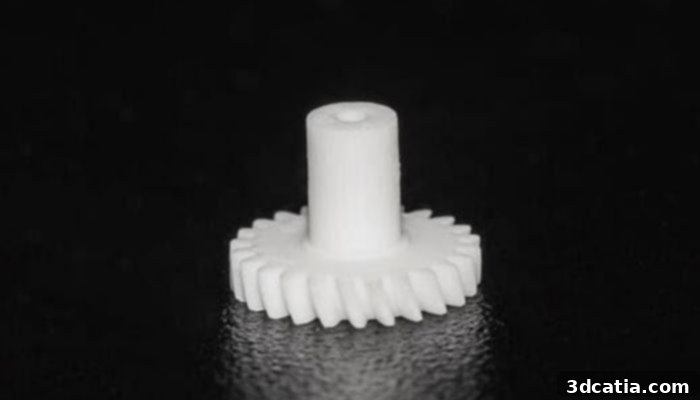
A meticulously crafted micro-part made with Alumina AL Ceramic, showcasing the capabilities of BMF’s newest engineering-grade materials. (Photo credits: BMF)
Expanding Material Horizons: BMF’s New Engineering-Grade Resins
Complementing the groundbreaking hardware innovations of the microArch S230, BMF has simultaneously unveiled three groundbreaking new resins: AL (Alumina) Ceramic, HT 200, and MT (Magnesium Titanate) Ceramic. These additions to BMF’s material portfolio are specifically formulated to leverage the S230’s advanced capabilities, pushing the boundaries of what is achievable in micro-scale additive manufacturing for high-end, engineering-quality parts across a diverse range of demanding applications.
The introduction of **AL (Alumina) Ceramic** resin marks a significant leap for applications requiring extreme hardness, wear resistance, chemical inertness, and high thermal stability. Alumina (Al2O3) is a widely used advanced ceramic known for its excellent dielectric properties, high mechanical strength, and biocompatibility, making it an ideal candidate for micro-electromechanical systems (MEMS), advanced sensors, high-performance micro-optics, and miniature medical implants. The ability to precisely 3D print complex geometries with ceramic resins at a micro-scale opens up new possibilities for durable and high-performance micro-parts that can withstand conditions far beyond what standard polymers can endure, offering solutions for environments with high temperatures, corrosive chemicals, or stringent electrical insulation requirements.
**HT 200** is a new high-temperature resistant resin specifically designed for demanding applications where thermal stability and mechanical integrity at elevated temperatures are paramount. Many critical micro-components, particularly in sectors such as aerospace, automotive, power electronics, and industrial processing, operate in environments with consistently high or fluctuating temperatures. The HT 200 material allows for the fabrication of complex micro-parts that maintain their structural integrity, dimensional stability, and functional performance under sustained heat, significantly expanding the use of BMF’s technology into critical sectors where thermal management is a key design consideration and conventional plastics would fail.
Finally, **MT (Magnesium Titanate) Ceramic** resin offers a distinct set of unique properties, particularly advantageous for advanced RF (Radio Frequency) and microwave applications. Magnesium Titanate is renowned for its excellent dielectric properties, low dielectric loss tangents, and high Q-factor at high frequencies. This makes it an ideal choice for precisely creating micro-antennas, filters, resonators, and other passive components for advanced communication systems, high-frequency electronics, and 5G/6G infrastructure. The ability to accurately and repeatedly 3D print complex geometries from such a specialized ceramic material at a micro-scale provides designers with unprecedented freedom to optimize performance and reduce component size in compact electronic packages, paving the way for smaller, more efficient, and higher-performing electronic devices.
These new materials are crucial for unlocking the full potential of the microArch S230, directly addressing the multifaceted needs of engineers who require not just small parts, but small *high-performance* parts capable of operating in extreme conditions or exhibiting specialized electrical characteristics. By offering a diverse range of engineering-grade resins, BMF empowers designers to select the optimal material properties for their specific application, from extreme temperatures and harsh chemicals to demanding electrical requirements. This comprehensive approach – combining cutting-edge hardware with advanced materials – solidifies BMF’s position at the forefront of the micro-precision additive manufacturing revolution, providing an integrated solution that drives innovation. Further details on these materials and the microArch S230 can be found in the official press release HERE.
The Future of Micro-Additive Manufacturing
The introduction of the BMF microArch S230 represents a pivotal moment in the evolution of micro-additive manufacturing. By seamlessly combining ultra-high resolution PμSL technology with enhanced speed, an expanded build volume, advanced automation features, and a pioneering suite of engineering-grade materials, BMF is effectively dismantling traditional barriers to the production of high-performance micro-components. This printer is more than just a new machine; it’s a powerful catalyst for innovation, enabling engineers and researchers to design and produce previously impossible geometries with unprecedented accuracy, detail, and material versatility. From revolutionary medical devices, complex micro-robotics, and advanced biosensors to next-generation electronic components and sophisticated micro-optics, the applications are boundless and continually expanding.
BMF’s continued leadership in micro-precision 3D printing is not only pushing the boundaries of what is technically feasible but also making these advanced capabilities more accessible to industries worldwide. The microArch S230 is set to accelerate the transition from traditional, often laborious, and geometrically limited microfabrication techniques to a more agile, cost-effective, and highly customizable additive manufacturing workflow. As the global demand for miniaturized, high-performance parts grows exponentially, innovative solutions like the S230 will be instrumental in driving progress and innovation across a vast spectrum of advanced manufacturing sectors, cementing micro-3D printing’s role as a cornerstone technology of the 21st century and beyond.
What are your thoughts on the transformative potential of the microArch S230 3D printer and the future of micro-additive manufacturing? Share your insights and join the conversation in the comments below or connect with us on our Facebook and Twitter pages. Don’t miss out on the latest advancements in 3D printing; make sure to sign up for our free weekly newsletter, delivering all the essential news directly to your inbox!