
Revolutionizing Regenerative Medicine: How 3D Bioprinting Creates Vascularized Skin That Connects to Living Tissue
The field of regenerative medicine is continuously pushing the boundaries of what’s possible, especially in addressing critical challenges like tissue repair and replacement. For decades, skin grafts have been a vital treatment for severe burns, chronic wounds, and various skin conditions. However, conventional grafting techniques often face significant hurdles, including immune rejection and, critically, the inability of the grafted tissue to fully integrate with the host’s native vascular system. This crucial lack of vascularization means that transplanted skin often struggles to receive adequate blood supply and essential nutrients, leading to poor survival rates, limited functionality, and temporary outcomes.
In a monumental leap forward for advanced tissue engineering, researchers at Rensselaer Polytechnic Institute (RPI) in New York and Yale Medical School have achieved a groundbreaking feat: they have successfully bioprinted functional, vascularized human skin tissues. What makes this advancement truly revolutionary is not just the creation of complex skin structures, but their unprecedented ability to connect to and integrate with the existing blood vessels of a living organism. Tested successfully on a mouse model, these bioprinted skin tissues demonstrated a remarkable capacity to establish stable vascular connections, promising a future where skin grafts could overcome the pervasive challenges of rejection and facilitate far more successful, long-lasting clinical outcomes for patients in dire need of durable skin regeneration.
The Persistent Challenge in Skin Bioprinting
The concept of 3D bioprinting for skin is not entirely novel within the medical sector. For several years, scientific communities worldwide have been exploring various sophisticated methods to reproduce skin tissues using additive manufacturing techniques. These pioneering efforts are primarily aimed at developing innovative solutions for a wide range of critical applications, from treating extensive chronic wounds and severe burns to facilitating complex reconstructive surgery for trauma victims, and even envisioning advanced biomedical solutions for unique scenarios such as astronaut health in challenging space environments. The promise of creating “skin on demand” for accelerated wound healing, precise drug testing platforms, or even ethical cosmetic research has driven considerable investment and rapid innovation in this rapidly evolving area.
Despite these significant strides in creating bio-mimetic skin structures, a major, persistent limitation has consistently plagued early attempts at bioprinting complex, thick skin tissues: the absence of an integrated, functional vascular network. Traditional bioprinted skin constructs, while structurally mimicking natural skin layers, often lack the intricate system of blood vessels essential for long-term viability and physiological function. Without this vital vascular network, the inner layers of the bioprinted tissue cannot receive the necessary oxygen and critical nutrients, nor can they effectively remove accumulating metabolic waste products. This critical deficiency has meant that many previous bioprinted skin models, while showing initial promise for superficial healing, ultimately behave more like sophisticated temporary dressings rather than fully integrated, living tissue that can permanently graft. As Pankaj Karande, an associate professor of chemical and biological engineering and a leading figure in this innovative research team, eloquently explains: “At the moment, everything that is available as a clinical product looks more like a sophisticated dressing. It allows accelerated wound healing, but eventually falls off. It never really integrates into the host cells.” This fundamental challenge — the holy grail of tissue engineering for skin — is precisely what the RPI and Yale team meticulously set out to overcome, successfully paving the way for truly functional and durable skin regeneration with their latest breakthrough.
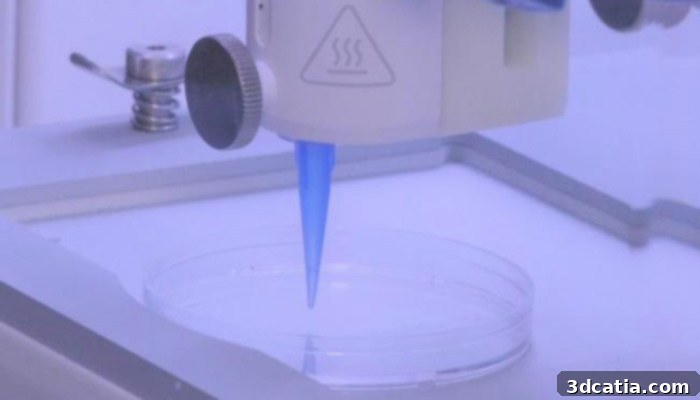
The researchers utilized a high-precision bioprinter to create their groundbreaking vascularized skin tissue, meticulously depositing layer by intricate layer.
The Advanced Process of Creating Bioprinted Vascularized Skin
The sophisticated methodology behind this pioneering research involved a meticulous combination of advanced biological components and cutting-edge additive manufacturing techniques. The researchers developed a highly specialized bioink, a crucial and often proprietary element in 3D bioprinting, by carefully combining specific human cell types with structural biomaterials. This innovative bioink comprised human blood vessel cells, specifically endothelial cells and human pericyte cells. Endothelial cells are inherently vital for forming the crucial inner lining of all blood vessels, acting as the interface between blood and tissue, while pericytes play a critical supporting role in stabilizing, maturing, and regulating blood vessel integrity and function. These highly specialized human cells were then intricately integrated with other essential structural materials, notably collagen of animal origin, which provides a natural, biocompatible scaffold mimicking the extracellular matrix of native skin, along with additional structural cells to accurately reproduce the complex, multi-layered architecture of natural dermal tissue.
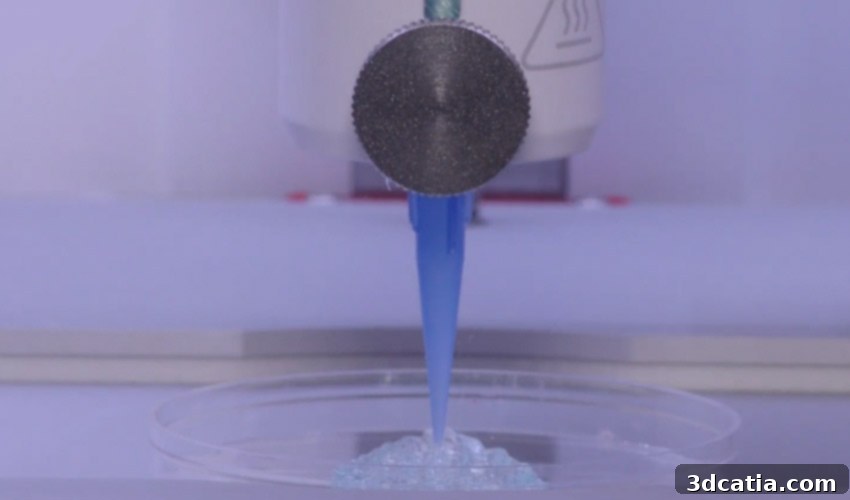
Once formulated with precise ratios and careful handling, this sophisticated bioink was meticulously loaded into a state-of-the-art bioprinter. The team specifically utilized CELLINK’s Bio X bioprinting platform, widely recognized for its exceptional precision, reliability, and versatility in handling sensitive biological materials and complex printing parameters. The bioprinter then meticulously deposited the bioink layer by layer, following a pre-designed digital model of the skin construct. This precise, controlled deposition allowed for the accurate placement and spatial organization of different cell types and biomaterials, effectively mimicking the natural stratification and cellular distribution found in healthy human skin. Critically, within a mere few days after the initial bioprinting process, the encapsulated cells began their remarkable intrinsic process of self-organization, communication, and differentiation. This intrinsic cellular interaction, guided by the bioink’s composition and the scaffold’s structure, led to the spontaneous formation of a nascent, interconnected vascular structure within the bioprinted tissue, demonstrating the inherent biological intelligence and viability of the engineered construct even before transplantation.
Successful Integration: Testing the Bioprinted Skin In Vivo
To rigorously evaluate the functionality, long-term viability, and integration capabilities of their bioprinted vascularized skin, the dedicated research team proceeded with a crucial in vivo transplantation experiment. A meticulously prepared sample of the engineered skin tissue, complete with its nascent vascular network, was surgically grafted onto a mouse model. This crucial step was intricately designed to determine whether the artificial vascular network within the bioprinted tissue could successfully establish a functional and stable connection with the host’s existing circulatory system. The results of this experiment were profoundly encouraging and marked a significant, unequivocal milestone in the burgeoning field of regenerative medicine.
Upon successful transplantation, researchers observed with great anticipation that the nascent blood vessels within the bioprinted skin were not only surviving but were actively communicating and integrating with the intricate microvasculature of the mouse’s circulatory system. This direct, functional connection allowed for the unimpeded and efficient transfer of vital blood and essential nutrients from the host’s circulatory system directly into the grafted tissue. Simultaneously, the newly established and integrated vascular network efficiently facilitated the critical removal of metabolic waste products from the bioprinted skin, a continuous and vital process for maintaining tissue health, preventing cellular damage, and ensuring long-term graft longevity. This successful vascular integration unequivocally demonstrated that the bioprinted graft could be kept alive, nourished, and functional over an extended period, far surpassing the inherent limitations of non-vascularized bioprinted tissues that often undergo necrosis. The ability to maintain sustained blood flow and robust nutrient exchange is the absolute cornerstone of successful tissue transplantation, as it directly prevents graft failure and ensures the long-term survival and functionality of the transplanted tissue. Deepak Vashishth, Director of the Centre for Biotechnology and Interdisciplinary Studies at Rensselaer, succinctly underscored the profound implications of these groundbreaking findings, stating: “This significant development highlights the vast potential of 3D bioprinting in precision medicine, in which solutions can be adapted to specific situations and ultimately to individuals.” This inspiring vision of precision medicine, where tailor-made tissues and organs can address unique individual patient needs, is rapidly transforming from a theoretical concept into a tangible, achievable reality thanks to such pioneering breakthroughs in bioprinting.
Future Horizons: Clinical Applications and Remaining Challenges
The successful bioprinting and robust vascularization of skin tissue open up incredibly exciting new avenues for numerous clinical applications, particularly for patients suffering from chronic conditions where conventional treatments are often insufficient or yield only temporary relief. Ultimately, this advanced bioprinted 3D vascularized skin could offer transformative, life-changing solutions for individuals grappling with specific, debilitating problems such as persistent diabetic foot ulcers or severe venous ulcers. These conditions often lead to prolonged and agonizing healing times, significantly increased risks of severe infection, and profound reductions in overall quality of life due to inadequate blood supply and critically compromised tissue regeneration. A durable, integrated, and vascularized skin graft could provide a long-term, biological solution that significantly accelerates healing, mitigates infection risks, and effectively restores tissue function and integrity where it is most needed.
However, while the immediate potential is immense and transformative, researchers candidly acknowledge that more serious and structurally complex cases, such as extensive third-degree burns, will require considerably more intricate work, sustained research, and technological advancements. Severe burns not only destroy vast areas of skin tissue but also cause extensive and often irreversible damage to underlying nerve structures, hair follicles, sweat glands, and a far more extensive vascular network, presenting a multifaceted and extremely challenging problem for regenerative medicine. Replicating the full complexity and multi-functionality of human skin, including fine sensory nerves, specialized hair follicles, functional sweat and sebaceous glands, alongside a robust and rapidly adaptable vascular network, remains a significant and formidable hurdle. Addressing the simultaneous reconstruction of sensitive nerves and a more extensive, resilient, and adaptable vascular system within larger, full-thickness skin grafts will undoubtedly be the next frontier for this groundbreaking bioprinting technology.
While we are still some distance from seeing these sophisticated bioprinted skin tissues routinely grafted into human patients in clinical settings, this research represents a profoundly encouraging, pivotal, and critical first step in realizing that grand vision. It unequivocally validates the core scientific principles behind creating functional, integrated biological tissues using advanced 3D bioprinting techniques. The journey from laboratory breakthrough to widespread clinical application is typically long and arduous, involving extensive preclinical trials, rigorous regulatory approvals, and meticulous optimization of manufacturing processes to ensure safety, efficacy, and scalability. Nevertheless, the successful demonstration of stable vascular integration in a living organism provides an exceptionally robust and hopeful foundation for future developments and broader applications. This seminal study was meticulously documented and comprehensively published in the esteemed peer-reviewed journal Tissue Engineering Part A, with the full details and scientific findings accessible HERE for those interested in exploring the complete scientific methodology and results.
The Promise of Personalized Medicine Through Bioprinting
This pioneering work by Rensselaer Polytechnic Institute and Yale Medical School is far more than just an advancement in skin regeneration; it is a vivid and compelling illustration of the burgeoning field of personalized, precision medicine. The ability to create biologically complex tissues, specifically designed and engineered to integrate seamlessly with a host’s unique physiology, moves us dramatically closer to a future where medical solutions are not static, one-size-fits-all approaches, but are meticulously tailored to individual patient needs and specific conditions. Imagine a scenario where a patient suffering from a unique chronic wound, a severe burn, or a genetic skin disorder could receive a bioprinted graft perfectly matched to their immunological profile, specific anatomical requirements, and even their cellular makeup, thereby minimizing rejection risks, maximizing therapeutic efficacy, and ensuring long-term success. This innovative research provides a tangible, scientifically validated pathway towards that future, offering immense hope for countless individuals whose conditions are currently deemed untreatable or require less effective, generic interventions. The scalability, reproducibility, and customizable nature of 3D bioprinting technologies are key to realizing this transformative vision on a broader, global scale, enabling the creation of bespoke solutions for a diverse and complex range of medical challenges, from advanced organ repair and replacement to sophisticated drug discovery platforms that accurately mimic human physiology.
What are your thoughts on this truly revolutionary research in 3D bioprinting and its immense potential to transform regenerative medicine and future healthcare? We enthusiastically encourage you to share your insightful perspectives and comments below, or join the dynamic conversation on our Facebook and Twitter pages. Stay comprehensively informed about the very latest breakthroughs and exciting developments in additive manufacturing and biomedical engineering by signing up for our free weekly Newsletter, delivering all the essential news and expert insights straight to your inbox!