
BigRep Revolutionizes Automotive Design with Groundbreaking 3D Printed Wheel Rims
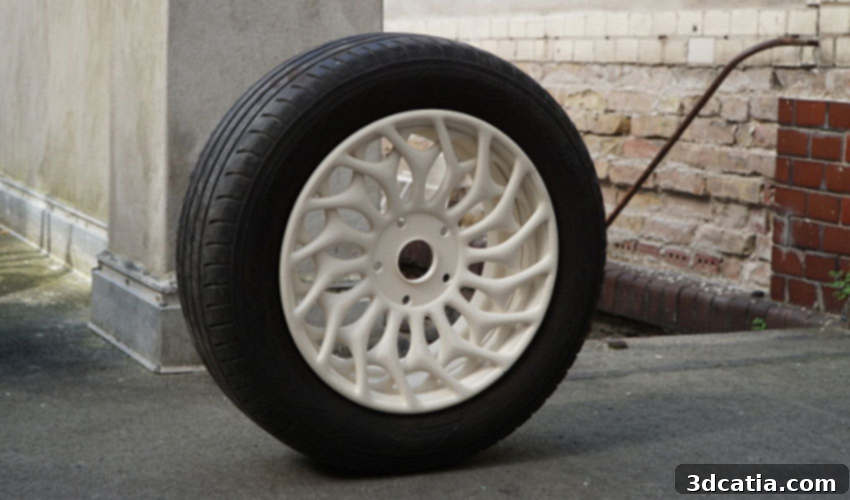
In a significant stride for the automotive industry and additive manufacturing, German 3D printer manufacturer BigRep recently unveiled a stunning prototype of a completely original, large-format 3D printed wheel rim. This innovative project was spearheaded by one of BigRep’s visionary designers, Marco Mattia Cristofori. His primary goal was to powerfully demonstrate how large-format additive manufacturing could not only be profoundly beneficial for the industry but also unlock unprecedented levels of freedom in design. To make this concept tangible and impactful, BigRep chose one of the most visible and highly customized vehicle components favored by car enthusiasts: the wheel rim.
While 3D printing has already firmly established its immense value in the design and prototyping of advanced tires – evidenced by groundbreaking concepts from industry giants like Michelin and Goodyear’s visionary 3D printed Oxygene tire unveiled in recent years – its latest foray into the automotive sector with a fully 3D printed rim represents a new frontier. This critical metal part of the wheel assembly, traditionally manufactured through complex processes, now stands to be revolutionized. The potential for customization is enormous, allowing for structures that can range from elegantly simple to intricately complex, all tailored precisely to the individual needs and aesthetic preferences of drivers. Historically, achieving such bespoke customization typically involves labor-intensive and often prohibitively expensive injection molding techniques, characterized by long lead times and high tooling costs. However, the strategic adoption of additive manufacturing promises to fundamentally alleviate these bottlenecks, offering unparalleled flexibility in terms of form, function, and artistic design, thereby democratizing high-end personalization.
“With 3D printing, you can truly prototype organic forms, much like we achieved with our innovative Terra chair,” affirmed Marco Mattia Cristofori, highlighting the expansive creative possibilities. “It empowers designers to envision and realize far more complex shapes because, fundamentally, you don’t really encounter the same limitations inherent in traditional manufacturing processes.” The exquisitely designed 3D printed rim serves as the ultimate, compelling illustration of this newfound design freedom. Its intricate structure is deeply reminiscent of elegantly interlaced tree branches, gracefully converging and intertwining in the center of the wheel. Beyond its striking aesthetic appeal, this organic design offers all the necessary structural stability required for a functional wheel rim, while simultaneously conveying a powerful and distinct aesthetic – a stark departure from conventionally manufactured hubcaps or rims that are often formed from singular, more restrictive lines or simpler geometries. This ability to integrate natural forms with robust engineering opens up exciting new avenues for vehicle aesthetics and performance.
The inherent complexity of the rim’s structure is precisely what would have made it exceedingly challenging, if not entirely impossible, to achieve with traditional manufacturing methods such as casting, forging, or machining. These conventional techniques are often constrained by tooling costs, material wastage, and the geometrical limitations of subtractive processes. Additive manufacturing, conversely, offers an unparalleled opportunity to rapidly iterate and test a multitude of different designs, meticulously calculate exact dimensions with advanced simulation tools, and produce fully functional prototypes with significantly reduced lead times. This agility is a game-changer for product development. Furthermore, true customization becomes not just feasible but effortless. One could readily envision a future where every single rim produced is uniquely different, featuring branches that are more or less intertwined, varying textures, or an expansive palette of colors to match individual vehicle aesthetics or driver personalities. This level of personalized production heralds a new era for automotive accessories, moving away from mass-produced uniformity towards bespoke artisanal craftsmanship on an industrial scale.
The potential impact extends beyond just aesthetics. Lightweighting is a crucial objective in modern automotive design, directly influencing fuel efficiency and vehicle performance. The ability to create optimized lattice structures and internal geometries that are impossible with traditional methods means these 3D printed rims could also contribute significantly to reducing unsprung mass, thereby improving handling and overall vehicle dynamics. This fusion of intricate design, functional optimization, and personalized aesthetics makes additive manufacturing an indispensable tool for the future of automotive innovation.
The BigRep 3D Studio Printer producing the wheel rim prototype.
The remarkable wheel rim prototype was brought to life using BigRep’s sophisticated FDM Studio 3D printer. This industrial-grade machine boasts a generous build volume of 500 x 1000 x 500 mm, allowing for the creation of large-scale parts with exceptional integrity. Crucially, it achieved an impressively high level of precision and detail, an absolutely essential element according to Cristofori, ensuring that the intricate organic design was accurately translated from digital model to physical object. The prototype of the rim was fabricated using BigRep’s proprietary PRO HT filament, a high-performance material specifically engineered for demanding applications. PRO HT filament is renowned for its excellent thermal resistance, making it suitable for components that might experience varying temperatures, and its interesting mechanical properties, which provide the necessary structural integrity for a functional prototype. While the ultimate manufacturing method for the final production-ready product remains under consideration – which could involve metal additive manufacturing or a combination of techniques – Cristofori emphasized the significance of their achievement: “What we’ve developed here is a true-to-life model that can be powder coated to achieve a robust and visually appealing finish.” Looking ahead to the next steps in their development process, he added, “We are planning to Meta-Coat one of them, to truly see how it looks and performs as a more final product with a highly professional effect, simulating real-world production finishes.” This forward-thinking approach underscores BigRep’s commitment to pushing the boundaries of what is possible with large-format additive manufacturing.
BigRep’s expertise in large-format 3D printing is central to projects like this. Their machines are designed to produce industrial-grade parts, not just small prototypes. This capability allows for the creation of components that are not only aesthetically complex but also functionally relevant, pushing the boundaries of what can be achieved in sectors like automotive, aerospace, and industrial tooling. The FDM (Fused Deposition Modeling) process, utilized by BigRep, offers a cost-effective and versatile method for rapid prototyping and even short-run production, particularly with advanced materials like PRO HT. The transition from filament-based prototyping to potentially metal final products showcases a typical development pathway in additive manufacturing, where design validation and form-fit-function testing are done with polymers before investing in more expensive metal processes. This iterative approach significantly reduces risks and costs associated with product development.
The broader implications of this innovation extend far beyond individual customization. For automotive manufacturers, it means accelerated product development cycles, the ability to test radical new designs quickly and affordably, and the potential to offer highly differentiated products to consumers. For the aftermarket and tuning industry, it opens up a vast new market for bespoke parts that can be produced on demand, reducing inventory needs and expanding creative possibilities. Moreover, the environmental benefits of additive manufacturing, such as reduced material waste compared to subtractive methods, and the potential for lighter parts leading to better fuel economy, contribute to a more sustainable manufacturing future. BigRep continues to be at the forefront of this transformation, proving that large-format 3D printing is not just a niche technology but a powerful force reshaping industrial production.
Find more comprehensive information on BigRep’s revolutionary work and their custom wheel rims project by visiting their official website, where detailed insights into their design philosophy and technological advancements are available.
What are your thoughts on this groundbreaking 3D printed wheel rim and its potential to transform the automotive industry? We invite you to share your insights and opinions in a comment below or join the conversation on our vibrant Facebook and Twitter pages! Don’t miss out on the latest advancements and news in the world of 3D printing – remember to sign up for our free weekly Newsletter, delivering all the essential updates straight to your inbox!