
Weekly 3D Printing Innovations: Unveiling the Future of Additive Manufacturing
Welcome to your essential guide to the most captivating advancements and stories from the world of 3D printing this week. We’re diving deep into a diverse array of applications, from the glitz and glamour of Hollywood special effects to groundbreaking industrial innovations and the surprising capabilities of desktop 3D printers. This compilation brings together expert insights, hands-on reviews, and showcases of cutting-edge technologies that are not only shaping industries but also transforming our daily lives. Prepare to explore how additive manufacturing is pushing boundaries in design, engineering, and creative expression, offering solutions that were once considered impossible. Join us as we uncover the incredible potential of 3D printing and its undeniable impact on tomorrow’s technological landscape. Let’s embark on this exciting journey into the heart of innovation!
1. Hollywood’s Unseen Stars: The Power of 3D Printed Characters
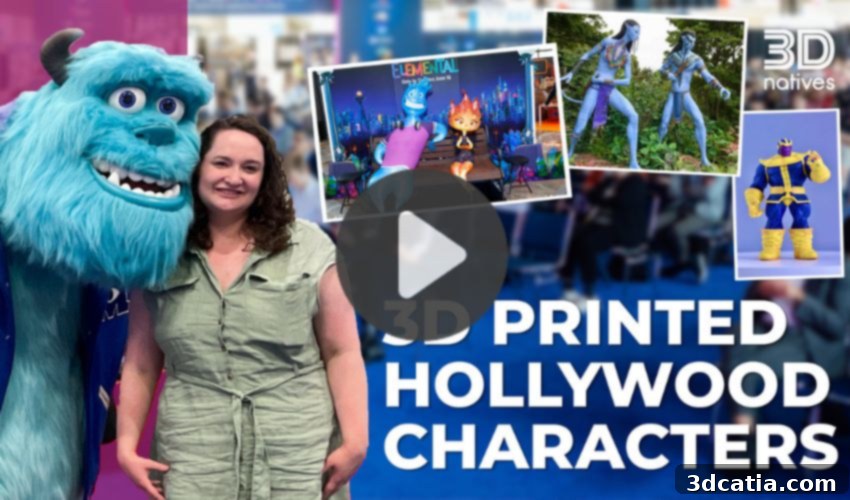
Our first highlight takes us behind the scenes of the entertainment industry, where 3D printing plays a critical, yet often unseen, role in bringing fantastical characters and intricate props to life. Join Jason Lopes, the distinguished CTO at Gentle Giants, as he guides the 3Dnatives team through an exclusive tour of the Hollywood Showcase, a special exhibition featured at the prestigious RAPID + TCT 2024 event. This fascinating segment reveals the profound integration of additive manufacturing within the film industry, showcasing an array of top 3D-printed characters that have graced the silver screen in blockbuster Hollywood movies.
Lopes passionately details how these meticulously crafted figures, which also find their way into theatrical productions and immersive theme park attractions, represent a seamless fusion of advanced 3D printing techniques with time-honored traditional fabrication methods. From the initial conceptualization to the final, polished product, 3D printing empowers artists and designers to rapidly iterate and perfect every minute detail. Whether it’s producing scaled-down prototypes for initial approvals or fabricating full-size maquettes that serve as crucial references for visual effects and animatronics teams, additive manufacturing offers unparalleled precision and speed. Lopes further elaborates on the iterative process, highlighting how 3D printing allows for precise adjustments to character features, texture, and even how light interacts with their surfaces, ensuring that every nuance contributes to the overall cinematic vision. This revolutionary technology not only accelerates production timelines but also opens up new creative avenues, enabling the creation of complex geometries and fantastical elements that would be prohibitively expensive or impossible to achieve through conventional means alone. The ability to customize, reproduce, and refine models with such fidelity has cemented 3D printing’s status as an indispensable tool in Hollywood’s toolkit, truly making it an unseen star of the show.
2. The Era of Plug-and-Play: Is 3D Printer Modification Becoming Obsolete?
Next, we turn our attention to the rapidly evolving landscape of desktop 3D printing, where the focus is increasingly shifting towards out-of-the-box performance and user-friendliness. My Tech Fun delivers an insightful and comprehensive exploration of the Creality K1 Max 3D printer, a device that challenges the long-held notion that extensive modifications are a prerequisite for achieving high-quality, versatile 3D prints. The review places significant emphasis on the K1 Max’s impressive capability to effectively handle a wide spectrum of filament types right from its initial setup, drastically minimizing the need for users to invest additional time and resources into upgrades or tweaks.
The video kicks off with an enthusiastic unboxing and a straightforward assembly demonstration, setting the stage for what promises to be a user-centric experience. Following this, the host meticulously tests the printer’s performance across a diverse range of filaments, including standard PLA, PETG, and more challenging technical materials like ABS, ASA, and even high-temperature-resistant engineering plastics. Throughout these trials, the host expresses profound satisfaction with the K1 Max’s consistent and reliable performance. A standout feature highlighted is the printer’s inherent ability to print technical filaments at temperatures reaching up to 300°C without requiring any additional hotend upgrades or enclosed chamber modifications. This built-in capability democratizes access to advanced materials, previously reserved for more industrial or heavily modified machines, making it accessible to a broader audience of hobbyists and professionals alike.
The overarching conclusion drawn from My Tech Fun’s in-depth analysis is clear: the Creality K1 Max distinguishes itself as an exceptionally capable and versatile 3D printer, perfectly suited for a vast array of applications. Its design and engineering philosophy prioritize performance and reliability, suggesting that, for many users, the need for aftermarket modifications has significantly diminished. This trend signifies a major shift in the desktop 3D printing market, moving towards more refined, ‘plug-and-play’ solutions that offer advanced features and material compatibility without the typical headaches of customization. It’s a strong indicator that the era of mandatory 3D printer modification might indeed be fading, paving the way for a more accessible and efficient 3D printing experience for everyone.
3. Engineering Miniatures: The Promise of 3D Printed Hydraulic Systems
Continuing our exploration of innovative applications, Indeterminate Designs presents a truly captivating demonstration of how 3D printing technology can be harnessed to produce intricate miniature hydraulic systems. This groundbreaking project was sparked by the prohibitively high costs associated with commercial hydraulic options, particularly those used in high-performance environments such as Formula 1 gearboxes. The video serves as a compelling proof-of-concept, showcasing a compact and fully integrated hydraulic system meticulously designed and fabricated using SLA (Stereolithography) resin.
The heart of this miniature system is an ingenious design that seamlessly integrates a gear pump, a pressure relief valve, and control valves, all contained within a single, intricately 3D-printed block. This level of integration is a testament to the design freedom offered by additive manufacturing, allowing for complex internal geometries and fluidic pathways that would be challenging, if not impossible, to achieve with traditional subtractive manufacturing methods. The use of SLA resin, known for its high resolution and ability to capture fine details, was crucial for producing the precise components necessary for a functional hydraulic system, where tight tolerances are paramount.
While the initial stages of the project encountered some expected design challenges, such as minor leaks and lower-than-desired pressure output – attributed to factors like the inherent inefficiencies of miniature 3D-printed gears and the specific material properties of the resin – the overall demonstration powerfully underscores the immense potential for creating compact, yet remarkably powerful, actuators for a myriad of future applications. The iterative nature of 3D printing allows designers to rapidly test, refine, and optimize components, addressing issues like sealing, material compatibility, and pressure generation through successive prototypes. This opens doors for innovations in fields requiring compact force and motion, such as advanced robotics, specialized medical devices, prosthetics, and even micro-fluidic systems for lab-on-a-chip technologies. The ability to rapidly prototype and customize such complex functional systems heralds a new era for engineering, where bespoke hydraulic solutions can be developed and manufactured on-demand, transforming efficiency and performance across various sectors.
4. Shaping Tomorrow: 3D Printing as a Transformative Technology
In our fourth highlight, High Tech Horizons delves into a broader discussion about several cutting-edge technologies that are collectively poised to revolutionize various facets of human existence. Within this compelling overview, additive manufacturing is prominently featured as a cornerstone of future innovation, demonstrating its profound impact across multiple sectors. The video eloquently illustrates how these technologies are not just incrementally improving existing systems but are fundamentally reshaping our capabilities and aspirations.
One of the most inspiring examples cited is SpaceX’s Starship, an ambitious and fully reusable spacecraft designed to significantly reduce the cost of space travel and ultimately facilitate humanity’s expansion to Mars and beyond. Critically, Starship’s development relies heavily on advanced manufacturing processes, with 3D printing playing a vital role in producing complex components for its groundbreaking Raptor engines and various structural elements. The ability to print intricate, high-performance parts with minimal waste and accelerated production timelines is instrumental to SpaceX’s rapid iteration and ambitious goals.
Beyond aerospace, the segment meticulously highlights the dramatic advancements in 3D printing technology itself, showcasing its evolution from primarily working with basic plastic filaments to mastering an impressive array of materials including robust metals, advanced composites, and sophisticated biomaterials. This material revolution has catalyzed an exponential expansion of 3D printing’s applications, fundamentally disrupting and enhancing industries ranging from healthcare to defense. In healthcare, additive manufacturing is revolutionizing the creation of custom prosthetics, patient-specific surgical guides, intricate medical implants, and even complex tissue engineering for regenerative medicine. This personalization leads to better patient outcomes and more efficient treatments. In space exploration, 3D printing enables the creation of lightweight, structurally optimized components that can withstand extreme conditions, facilitating missions that require maximum efficiency and reliability. The capacity to print tools and spare parts on-demand, even in remote locations like the International Space Station, offers unprecedented logistical advantages.
Moreover, 3D printing is making significant strides in construction, allowing for the rapid assembly of affordable housing, and in the automotive sector, where it’s used for prototyping, tooling, and producing lightweight performance parts. Its versatility in material handling and design complexity positions it as a truly life-changing technology, empowering innovation, fostering localized manufacturing, and offering sustainable solutions for the challenges of tomorrow. As these technologies continue to converge and mature, 3D printing stands out as a foundational pillar, enabling a future where complex designs become reality with unprecedented ease and efficiency, truly making it a technology of tomorrow that is transforming today.
5. RAPID + TCT 2024: A Glimpse into the Future of Additive Manufacturing
Finally, we bring you another exclusive report from the 3Dnatives team, wrapping up our highlights with an in-depth look at the cutting-edge innovations unveiled at the RAPID + TCT 2024 event. Our knowledgeable host, Madeleine Prior, guides us through the bustling exhibition floor, introducing groundbreaking advancements in additive manufacturing that are set to redefine industrial capabilities and design possibilities. RAPID + TCT is renowned as one of the premier events in the additive manufacturing industry, serving as a critical platform for showcasing the latest technologies, materials, and applications, attracting experts and enthusiasts from around the globe.
Madeleine begins her tour at the Visitech booth, where she highlights their world-first 4K scrolling system. This revolutionary technology represents a significant leap forward in high-capacity 3D printing, enabling continuous and rapid production of parts with exceptional resolution over large build areas. The “scrolling” mechanism allows for uninterrupted printing, dramatically increasing throughput and making it ideal for mass customization and industrial-scale manufacturing, pushing the boundaries of what’s possible in terms of speed and precision in resin-based 3D printing.
Her journey then takes her to explore the FPM-Trinity by FUJI Corporation. This innovative system stands out for its unique ability to rapidly prototype printed circuit boards (PCBs) using additive processes. The importance of this cannot be overstated in the fast-paced electronics industry, where quick iteration and development cycles are crucial. FPM-Trinity allows engineers to test and refine PCB designs with unprecedented speed and flexibility, reducing development costs and accelerating time-to-market for new electronic devices. This capability is poised to transform product development in consumer electronics, automotive, and aerospace sectors.
The segment concludes with a visit to Additive Industries, where Madeleine showcases their Metal FAB system, notably utilized by the Stake F1 Team Sauber. This powerful metal additive manufacturing solution is instrumental in the highly competitive world of Formula 1, where every gram and every aerodynamic advantage counts. The Metal FAB system allows for the production of lightweight, complex, and high-performance metallic parts, such as intricate aerodynamic components, chassis elements, and engine parts, directly from digital designs. A key differentiator highlighted is its flexible build envelope and a unique monthly licensing model. This flexible approach makes advanced metal additive manufacturing more accessible, allowing teams and companies to scale their production needs efficiently without massive upfront capital investment, offering a service-oriented pathway to leverage cutting-edge technology for critical, high-performance applications. The innovations presented at RAPID + TCT 2024 collectively underscore the industry’s trajectory towards higher speed, greater precision, broader material compatibility, and more integrated, industrial-scale solutions. The event truly offered a compelling vision of the future that additive manufacturing is helping to build.
We hope you found this week’s compilation of 3D printing highlights as inspiring and informative as we did. These innovations, from cinematic magic to industrial breakthroughs and accessible desktop solutions, vividly demonstrate the dynamic and ever-expanding capabilities of additive manufacturing. It’s clear that 3D printing is not just a technology of the future but a powerful tool shaping our present, driving progress across countless sectors. We’re eager to hear your thoughts! Which video resonated with you the most this week? Perhaps you have an insight into how these advancements will impact your industry, or a prediction for the next big thing in 3D printing? Share your perspectives and join the conversation by leaving a comment below, or connect with us on our LinkedIn, Facebook, and Twitter pages. Don’t miss out on the latest developments in the additive manufacturing world – be sure to sign up for our free weekly newsletter here to get all the essential 3D printing news delivered straight to your inbox! For more captivating content, you can also explore our extensive library of videos on our YouTube channel. Stay curious, stay innovative, and keep creating with 3D printing!