
Sustainable Coffee Solutions: Bentax Pioneers 3D Printing for Durable Coffee Machine Spare Parts
For many, the morning ritual of brewing the perfect cup of coffee is a cornerstone of daily life. Yet, finding the ideal coffee machine for home or business can be a significant investment, and the disappointment of a beloved machine breaking down is all too common. The challenge isn’t just in selecting the right model, but in ensuring its longevity, especially when essential components begin to fail. This is a common predicament that Bentax, a forward-thinking Danish company renowned for its comprehensive coffee solutions, is determined to address through innovative means. Recognizing that individual parts, particularly high-wear items like milk pumps, are often the culprits behind machine malfunctions, Bentax has forged a strategic partnership with the Danish Technological Institute. Their mission: to explore and implement 3D printing technologies for the efficient and sustainable repair of these critical components.
The initiative represents a pivotal shift towards more sustainable and economically viable maintenance practices within the coffee industry. By embracing additive manufacturing, Bentax aims to leverage the benefits of producing metal spare parts, promising a more cost-effective production and manufacturing methodology. This approach is not merely about reducing expenses; it’s a profound commitment to environmental responsibility. As part of a MADE materials demonstration project, a pioneering endeavor supported by the Danish Technological Institute, the potential for waste reduction through additive manufacturing is immense. Traditionally, heavily worn and expensive parts, such as milk pumps, would be discarded, contributing to industrial waste. Bentax’s innovative strategy, however, seeks to circumvent this wasteful cycle by breathing “new life” into these old, discarded components.
Anders Myrup, the technical project manager at Bentax, articulated the core philosophy driving this research project: “Initially, the aim is to pump some life into the broken pumps so that we can recycle them. In the long term, we would like to be able to make the spare parts rather than buying new pumps from the supplier, and we would also like to achieve a longer durability and a lower price compared to a new pump.” This statement underscores Bentax’s dual objective: immediate recycling of existing parts and the long-term goal of in-house production of more durable and affordable spare parts, thereby challenging the conventional linear economy model of ‘make, use, dispose.’
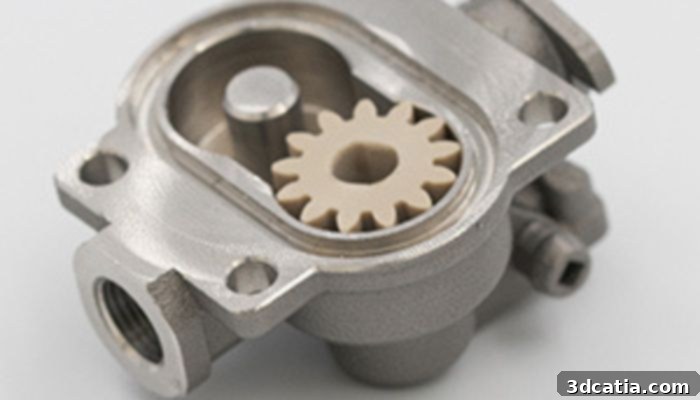
Bentax is researching 3D printing of the gears and housing (photo credits: Danish Institute of Technology).
Revolutionizing Repair: Coffee Machines Get New Life with 3D Printing Technology
The manufacturing of coffee machine components has long been considered a traditional craft, relying on established techniques and materials. However, the fusion of this traditional craftsmanship with cutting-edge 3D printing technologies is now opening up unprecedented possibilities for repair, customization, and sustainability. Bentax’s research project meticulously focused on milk pumps, statistically identified as one of the most susceptible components to wear and tear. The internal mechanism of these pumps features small gears that, over time, can cut into their housing, creating grooves and imperfections. These traces inevitably hinder the pump’s performance, preventing it from delivering the consistent and desired results expected from a high-quality coffee machine.
From Wear and Tear to Digital Blueprint: The Additive Manufacturing Process
This is precisely where the transformative power of additive manufacturing intervenes. The journey to a revitalized milk pump begins with precision. The entire faulty milk pump undergoes a meticulous scanning process at the Danish Technological Institute. This advanced scanning technology captures every intricate detail and dimension of the component, allowing for the creation of a completely identical, high-fidelity digital replica. This digital blueprint serves as the foundation for the additive manufacturing process. Once the digital model is perfected, the component, specifically the housing, is then 3D printed using robust stainless steel. Stainless steel was chosen for its excellent mechanical properties, including corrosion resistance, strength, and durability, making it an ideal material for components exposed to liquids and mechanical stress within a coffee machine.
Precision Manufacturing: Stainless Steel, PEEK, and Chromium Nitride for Enhanced Durability
Following the 3D printing of the housing, a crucial post-processing phase ensures the part meets the exact specifications and aesthetic requirements. The next critical step involves the gears, which are integral to the pump’s function. Instead of 3D printing these specific gears directly in metal in this initial phase, Bentax opted for a hybrid approach to maximize durability and performance. The gears are manufactured using a combination of CNC milling and PEEK (Polyether Ether Ketone). PEEK is a high-performance engineering plastic known for its exceptional mechanical strength, stiffness, wear resistance, and high-temperature performance, making it an excellent choice for dynamic parts like gears that experience continuous friction and stress. This strategic choice for gears, complementing the 3D printed stainless steel housing, ensures optimal functionality. To further elevate the durability and extend the lifespan of these newly manufactured components, Bentax implemented an additional critical step: surface treatment. The individual components of the parts are meticulously surface treated with chromium nitride. Chromium nitride coating is renowned for its outstanding hardness, wear resistance, and low coefficient of friction, significantly enhancing the parts’ resilience against abrasive wear and chemical degradation. This multi-faceted approach, combining advanced 3D printing with precision CNC machining and specialized surface treatments, aims to create spare parts that not only perfectly fit but also surpass the durability of original components, offering a truly long-lasting solution.
The Road Ahead: Testing, Expansion, and a Sustainable Future with Additive Manufacturing
With the initial research and development trials successfully completed, Bentax is now transitioning into an extensive and rigorous test phase, projected to span over 15 months. This crucial period will involve installing the newly manufactured milk pumps, complete with their 3D printed and enhanced components, into actual customer coffee machines. Throughout this phase, the performance of these pumps will be meticulously monitored in real-world operating conditions, gathering vital data on their reliability, efficiency, and overall durability. This long-term testing is essential to validate the success of the additive manufacturing process and to ensure that the repaired components meet and exceed performance expectations.
Anders Myrup expressed immense satisfaction with the progress and outcomes so far, despite the project’s formal conclusion: “We don’t stop here, even though the project is over and we don’t yet have all the answers, because the project has shown that 3D printing makes sense. Here and now it’s a huge success, and we’re quite satisfied with where it is in terms of price, so we’re ready for the next round with 3D printing, and then it’s a fantastic story for us to be able to tell our customers.” This statement highlights Bentax’s commitment to continuous innovation and their confidence in 3D printing as a viable, cost-effective, and sustainable solution for the future of coffee machine maintenance.
Beyond Milk Pumps: Bentax’s Vision for Additive Manufacturing
The success achieved with the milk pumps has ignited a broader vision within Bentax for the application of 3D printing technologies. The company is already actively formulating plans to manufacture a wider array of other coffee machine components using additive manufacturing in the near future. This expansion will not only enhance the reparability of their machines but also potentially allow for greater customization and improved performance across their product lines. Furthermore, Bentax’s forward-thinking approach extends beyond the machines themselves. Anders Myrup concluded with an exciting glimpse into these broader applications: “We see many more possibilities now, also beyond the parts we put into the machines. It could be specially designed tools or adapted holders and hooks for the work tables in the workshop, so that we can optimize our processes – and this is derived from this project.” This signifies a holistic embrace of 3D printing, not just for end-use parts but also for optimizing internal workshop processes, creating custom tools, jigs, and fixtures that can streamline operations, reduce lead times for repairs, and further enhance overall efficiency. This comprehensive approach underscores Bentax’s commitment to leveraging advanced manufacturing for sustainable innovation, setting a new benchmark for product longevity and environmental stewardship within the coffee industry.
For more in-depth information on this pioneering case study from Bentax and their innovative approach to coffee machine maintenance, you can click HERE.
Bentax’s journey into 3D printed spare parts represents a significant stride towards a more sustainable and economically sound future for the coffee industry. By embracing additive manufacturing, they are not only extending the life of valuable coffee machines but also minimizing waste and offering customers more durable and affordable repair solutions. This innovative spirit, coupled with a commitment to environmental responsibility, positions Bentax as a leader in sustainable business practices.
Would you consider purchasing a coffee maker from Bentax, knowing it incorporates advanced 3D printed parts designed for enhanced durability and repairability? We invite you to share your thoughts and opinions in a comment below or engage with us on our Linkedin, Facebook, and Twitter pages! Don’t forget to sign up for our free weekly Newsletter here to receive the latest 3D printing news straight to your inbox! You can also find all our compelling videos and industry insights on our YouTube channel.